Link to the original digital exhibit
- Exhibit by: Agustin Pace, Eleanor Hicks, Kelly Perasso, Margot Milton, Simon Lanzoni, Ursula Roscigno, Joseph Caruso, Emma Chappell
In this exhibit, students transcribed and translated an Italian children’s propaganda textbook from 1936. The book goes through the letters of the Italian alphabet, with each one tied to a theme or concept of the Fascist regime in Italy. These themes are then told in the form of a poem, with illustrations covering the backgrounds of each page.
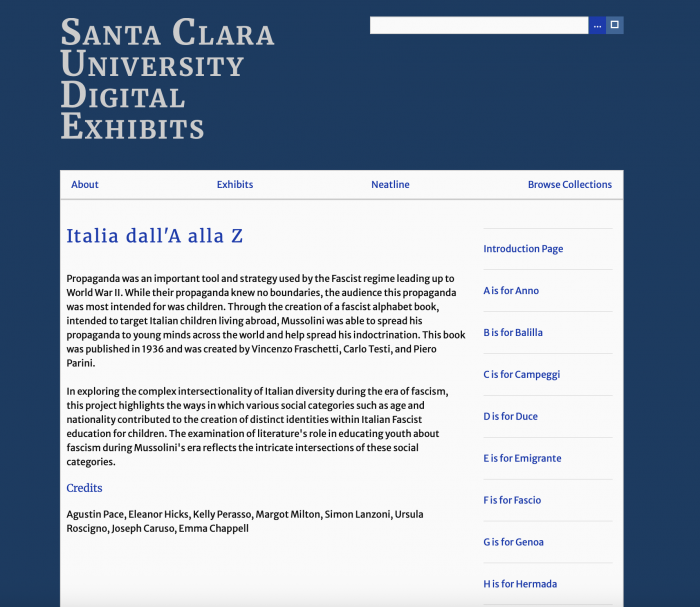
Front page of the exhibit introducing the textbook
Each letter and their poems are divided into separate tabs inside the exhibit that can be accessed through the table of contents on the right. Each tab contains the illustrations of the textbook pages, a written analysis of the content of the letter and the poem in the context of 1930’s fascist propaganda, and a full side-by-side transcription and translation of the poem.
Below are sample pages from the exhibits:
B is for Balilla
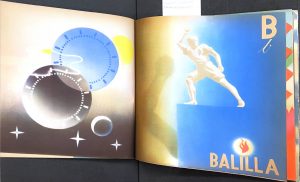
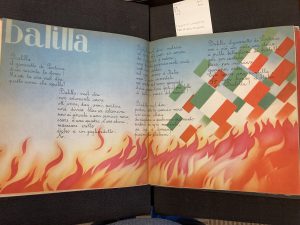
All members of Opera Nazionale Balilla were required to take the following oath: “In the name of God and the Fatherland, I swear to follow the orders of the Duce and to serve with all my energy the cause of the Fascist revolution”. The organization was created in order to raise Italian youth in absolute loyalty to Mussolini, as both soldiers and citizens in general. Opera Balilla was concerned with the “Political and religious, physical and moral, hygienic and athletic, assistenziale and cultural”. It was therefore not just a military organization, but also an educational one (P.W.L. Cox, 267). Mussolini knew that education was crucial to controlling the country, a lesson which Hitler learned from him and implemented in his own regime with Hitler Youth in 1933.
There are a few common themes in the section on “Balilla”. Unsurprisingly, the most prevalent one is nationalism. The poem calls Italy “an immortal fatherland . . . the biggest, the strongest, the most beautiful / of all the countries of the world!” (lines 20-23). The imagery of uniforms, arrays, teams, marching erect, and a thousand battalions of brothers conveys a sense of a strong and unified Italian people. This militaristic diction also probably would have appealed to young boys in particular.
Not only are Italians unified, but they are zealous. The poem makes it clear that Balilla does not just mean to wear the black shirt and to be on a team, but also to have a deep seated love of Italy; “to nourish / in the bottom of the heart a love / that one feeds with passion” (14-16). We can also see this theme visually through the use of raging flames and a dozen Italian flags above them, representing extreme passion for the fatherland.
Transcription: Balilla il giovanetto di Portoria di cui racconta la storia! Ma sai tu cosa vuol dire questo nome che squilla? Balilla: vuol dire non solamente avere ott’anni, dieci anni, portare una divisa bleu coi calzoncini sino ai ginocchi e una camicia nera; essere d’una squadra, d’una schiera, marciare eretto dietro a un gagliardetto No. Balilla vuol dire: nutrire nel fondo del cuore un amore che s’alimenta d’ardore, una fede che profondamente crede: vuol dire: sentire nel nome sereno d’Italia una Patria immortale nel cerchio del nome giocondo il più grande, il più forte, il più bello di tutti i paesi del mondo! Balilla vuol dire: portare sotto la camicia nera un’anima altera da scagliare a qualunque ardimento: sentirsi in ogni momento, sia oggi o domani, fieramente italiani! Balilla: il giovanetto di Portoria non è più un mito, una storia: à mille battaglioni di fratelli: gole per cantare passi per marciare cuori per osare. Egli accese una scintilla, oggi ogni bimbo d’Italia è un Balilla! | Translation: Balilla, the young boy of Portoria of which history tells! But do you know what it means this name that rings? Balilla: it means not only to be eight or ten years old, to wear a blue uniform with trousers down to the knees and a black shirt; to be on a team, in an rank, to march erect, behind a banner No. Balilla means: to nourish in the bottom of the heart a love that one feeds with fervor, a faith that one deeply believes: it means: to hear in the fair name of Italy an immortal Fatherland in the circle of the cheerful name the biggest, the strongest, the most beautiful of all the countries in the world! Balilla means: to wear under the black shirt a proud soul, to unleash with fervor: to feel in every moment, be it today or tomorrow, proudly Italians! Balilla: The young boy of Portoria it is no longer a myth, a story: he has a thousand battalions of brothers: throats for singing steps for marching hearts for daring. He lit a spark, today every child of Italy is a Balilla! |
References
Cox, P. W. L. “Opera Nazionale Balilla — An Aspect of Italian Education.” Junior-Senior
High School Clearing House, vol. 9, no. 5, Jan. 1935, pp. 267–270.
Student Authors
Ursula Roscigno, Joseph Caruso, Emma Chappell
E is for Emigrante
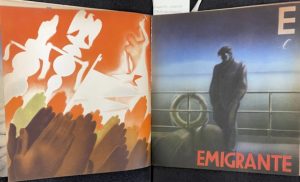
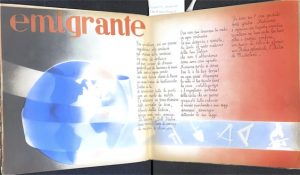
The use of “emigrante” for the letter E is of particular importance as it engages with the main purpose of the book’s publishing. It was written specifically for Italian children living abroad. The visual imagery, paired with the linguistic imagery of the poem were intentionally designed to have a piercing effect on the reader. The opening line, “You were a disillusioned one, you were a poor wanderer who roamed the world spontaneously” sets the tone for the poem. This, paired with the imagery of a somber looking man standing on the bow of the ship, and the use of dark and ghastly colors was clearly designed to instill fear in the children reading the book. It is important to note that the children reading this book were the descendants of people who migrated, or left Italy at a young age. Thus, they likely had no choice or control in regards to leaving Italy. Many of those who left Italy did so in the late nineteenth century, when the country was in economic despair. Hundreds of thousands were leaving Italy every year for the Americas at that time, but as the fascist regime took control the numbers of migrants began to decrease radically, as in the 1930s the number fell to sixty thousand per year. This is noteworthy, as it was imperative, that the fascist regime instill a sense of fear, and desire to return, in order to create a sense of nationalism among expats who never lived in Italy.
The poem’s progression is quite evocative of the fascist perspective as it does not end with the sense of fear created in the first stanza. Rather, as the poem progresses it changes tone from one painting the migrant as sad, to someone who carries on the glory of the Italian nation. Mussolini viewed migration from Italy as inherently part of his foreign policy, and sought to transform immigrants from a weakness of Italy, to a strength of the nation. Instead of describing them as having left Italy the idea is now that they are spreading the pure Italian aryan seed around the world. Once the fascists took control, Italy became “great again” and thus the shame associated with the first part of the poem is no longer. This poem broke the spirit of the Italian migrant child at the beginning, and then rebuilt it with a heightened sense of nationalism and purpose: to serve the “country of sun and glory: a shining Italy, the Italy of Mussolini.”
Transcription: Eri un deluso, eri un povero vagabondo che andava nel mondo alla ventura In cerca di fortuna col suo carico di stracci gonfio il cuor di lacrime e di crucci: solo contro ogni vento in una terza classe di treno in una terza di bastimento. Dietro di te si serravano tutte le porte con un vuoto di morte. Ci ritrovavi in terra straniera solo, accorato la sera, sfinito dalla fatica, senza una voce amica. – Di dove sei? – Dell’Italia. (una smorfia). – Paese di canzoni: di miserie e straccioni. Ora non piu: dovunque tu vada in ogni contrada la più dispersa o remota, tu senti il nodo materno Della tua Patria che non t’abbandona Come una cosa ignota. Nessuna porta si serra Tra te e la tua terra! In ogni paese straniero Tu rechi il tuo spirito fiero, La viva intelligenza E l’orgogliosa potenza Della razza che un giorno Conquistò tutto intorno Il mondo piantando i suoi seggi Dovunque, dovunque Dettando le sue leggi. – Di dove sei? Ora gridalo Forte: grida: Italiano E ognuno con trepida invidia Ricercherà nei tuoi occhi lontano Oltre i propri confini Un paese di sole e di gloria: un’Italia splendente, l’Italia di Mussolini. | Translation: You were a disillusioned one, you were a poor wanderer who roamed the world aimlessly in search of fortune with his laden rags heart swollen with tears and worries: alone against every wind in a train’s third class. in a ship’s steerage. Behind you all doors were closed behind you a void of death. You found yourself in a foreign land alone, aching at night, exhausted from the toil, without a friendly voice. -Where are you from? – Italy. (a grimace). – Land of songs: of miseries and rags. Now no longer: wherever you go in every corner the most dispersed or remote you feel the maternal bond of your Fatherland who does not abandon you like something unknown. No door closes between you and your land! In every foreign country you carry your proud spirit, the living intelligence and the proud power of the race that once conquered all the world planting its cause everywhere, everywhere dictating its laws. -Where are you from? Shout it now loudly: shout it: Italian and everybody with trembling envy will search in your distant eyes beyond their own borders a country of sun and glory: a shining Italy, the Italy of Mussolini. |
References
Cannistraro, Philip V., and Gianfausto Rosoli. “Fascist Emigration Policy in the 1920s: An Interpretive Framework.” The International Migration Review, vol. 13, no. 4, 1979, pp. 673–92. JSTOR, https://doi.org/10.2307/2545181. Accessed 9 Mar. 2024.
Luconi, Stefano. “Fascism and Italian-American Identity Politics.” Italian Americana, vol. 33, no. 1, 2015, pp. 6–24. JSTOR, http://www.jstor.org/stable/43926785. Accessed 13 Mar. 2024.
Oxford University Press. “Benito Mussolini.” Oxford Reference, Oxford University Press, https://tinyurl.com/u7vteuzf. Accessed 27 January 2024.
(Ask about citation above)
Student Author
Simon Lanzoni
F is for Fascio
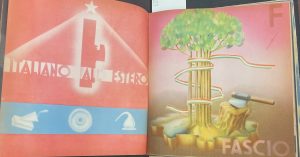
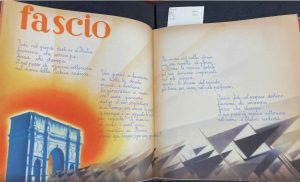
Fascism as an ideology was largely founded in Italy post WWI, with Mussolini having written its Doctrine. “The Doctrine of Fascism,” was an essay in the 14th volume of the Italian Encyclopedia. It is rather fitting that Mussolini’s own ideology would be the word used for the corresponding letter. Many of the themes and ideals written on the doctrine are present in this page of the book, with the pictures adding to the symbolism of the message. For instance, the use of “radiant” to describe Italy as the homeland in the text and the picture showing a light radiating out of the gates.
There are various English translations of “The Doctrine of Fascism,” with many documents provided by educational institutions across the US, but to use the pages from San Jose State University, fascism doctrine defines life as “a struggle in which it behooves a man to win for himself a really worthy place… so for the nation” (1). A primary focus of fascism doctrine is that everything done is for the State. Everything done in life is for the betterment of the State. However, what is defined as betterment is largely something of power, strength, and imperial. The doctrine outlines that “expressions of Fascism such as party organization, system of education, and discipline can only be understood when considered in relation to its general attitude toward life” (1). Mussolini knew that to move forward with these ideals, to make a people want to live for the State, indoctrination through education and propaganda were powerful tools.
These ideals are all found in the text of the children’s book, with the reference of victorious marches by the moving youth, imprinting strength, and faith in one’s destiny. But as the poem mentions, that destiny is of a glorious era for Rome.
In an ideology where the role of the individual is for the benefit and strength of the State, it is clear that no matter what part of Italy one is from, their march is for all of Italy. This extends to the audience. There is not a distinction between the origins of the Italian Americans who would read this. No matter where the family came from, whether North or South, and no matter where they resided now, in the East or West, their efforts abroad would be for the same fascist Italian state
Transcription: Fede nel grande destino d’Italia fiamma che avvampa, forza che stampa il suo passo di marcia vittoriosa nel nome della Patria radiosa Un giorno a fiumane su tutte le strade vicine e lontane, la giovinezza si mosse con cuore guerriero dietro il suo condottiero: se a Roma son chiuse le porte se ovunque è in agguato la morte, che importa? Si marcia, al vento i vent’ anni, si marcia su Roma al vento ogni drappo, ogni cuore, ogni chioma! Fu incisa così nella storia un’era novella di gloria, e Roma la marcia fatale pel suo dominio imperiale nel sole riprese, aperte le strade del mondo per terra, per mare, nel cielo profondo, Fascio: fede nel proprio destino, fiamma che avvampa, forza che stampa il suo passo di marcia vittoriosa nel nome d’Italia radiosa | Translation: Faith in the grand destiny of Italy flame that burns, strength that stamps its victorious march in the name of the radiant Fatherland. One day in torrents on all the roads near and far the youth moved with a warrior’s heart behind their leader if in Rome the gates are shut if death is lurking everywhere what matter? We march, with a youthful wind we march on Rome every crown and every heart to the wind! Thus engraved in history a glorious new era, and Rome returned to its destined march for her imperial dominion in the sun, the world’s roads open by land, by sea, in the deep sky, Fascio: Faith in one’s destiny flame that burns, strength that stamps its victorious march in the name of the radiant Italy |
References
Mussolini, Benito. “The Doctrine of Fascism.” n.d. PDF file. Web. Accessed 13 Mar. 2024. https://sjsu.edu/faculty/wooda/2B-HUM/Readings/The-Doctrine-of-Fascism.pdf
Student Author
Agustin Pace
Students also went beyond translating and analyzing the text written in the book. One wrote a visual analysis of the illustrations of the book while another wrote a page on the role of translation in diversity studies. See a window to their pages below.
Visual Analysis of Illustrations
The study of national regeneration in the context of visual production occupies an essential place in the Italian political and cultural history of Italian nationalism. Palingenetic ultranationalism in Italy led primarily by Benito Mussolini was an extreme effort to redefine Italy’s “striving to achieve new primacy in modern civilization”( 1). Beginning as a reactionary movement to the perceived weaknesses of liberal democracy and the threat of socialism, Italian Fascism emphasized nationalism, authoritarianism, and the primacy of the state. Mussolini’s regime centralized power and suppressed political opposition through violence and censorship creating total obedience and loyalty. To further shape public opinion, cultivate loyalty to the state, and justify the authoritarian policies of the regime, Mussolini utilized the power of media, newspapers, radio broadcasts, films, posters, public speeches, and children’s books. The book Italia dalla A alla Z published as a promotional children’s book gives us insight to the puzzle of fascist Italy and the effects of visual representations on Italian culture at home and abroad. I will use this book to analyze the relationship between power related to race, ethnicity, nationality, age, language, and citizenship In this essay, I will explore how the composition, subject, and visual presentation of Italia dalla A alla Z defines Italy in an unrealistic, manufactured way to promote fascism.
The style in which the children’s book is designed shows the impact of the “aesthetic crusade”(2), that Futurism lent Fascism in the mid-1930s. Filippo Tommaso Marinetti, Launched Futurism in 1909 with the publication of the “Futurist Manifesto”. The movement was characterized by its combination of neo-impressionism and cubism to create compositions that expressed the idea of the dynamism, the energy and the movement, of modern life. Futurism was one of the most politicized art movements of the twentieth century because of its alignment with the Mussolini regime. It merged artistic and political agendas in order to propel change and depict Italy as a strong, organized heroic country. (3) Due to its direct alignment with the fascist political regime the Futurist art movement is synonymous with fascist art.
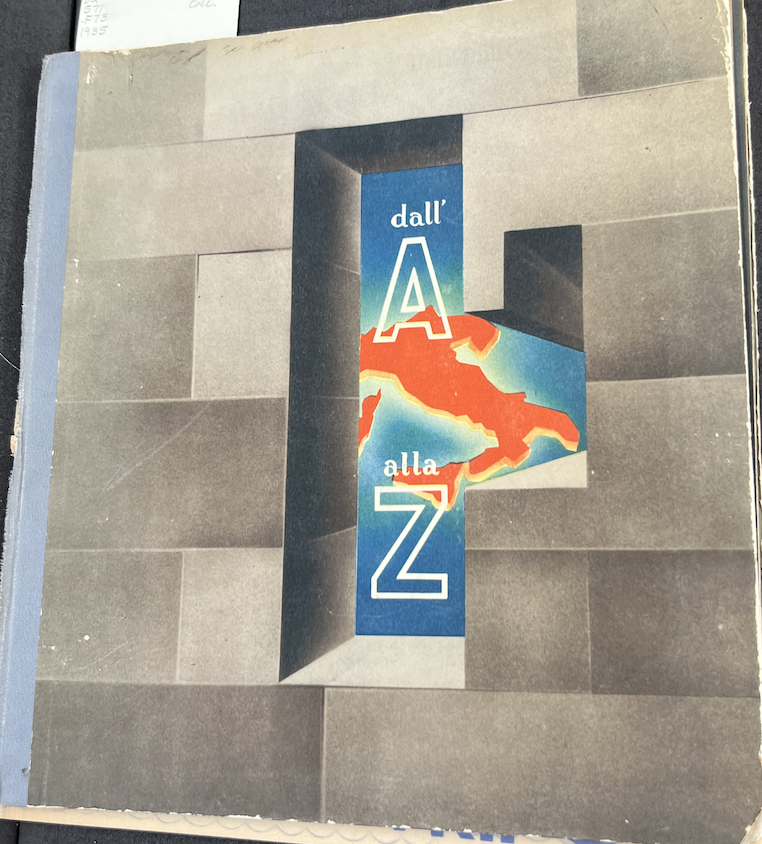
Fascist art tended to favor simple, easily understandable imagery that could convey powerful messages at a glance. Bold colors, strong lines, and clear symbolism were common features of fascist art, allowing it to be easily disseminated and understood by a wide audience. The style of Italia dalla A alla Z shows the effect of this style with its harsh lines and use of bold colors. Even though this book is meant to be for a child it is clear that it is an effort to spread the qualities of facism through visual representation. The cover of the book(fig 1) depicts gray cut stones giving way to the Italian peninsula. It is as if the reader is looking through an otherwise impenetrable wall to see Italy depicted in bold red and outlined in a glowing gold color. The wall is brutalist in composition and exaggerates the glowing Italy inside. The use of red symbolizes power and provides a strong statement and tone for the rest of the book.
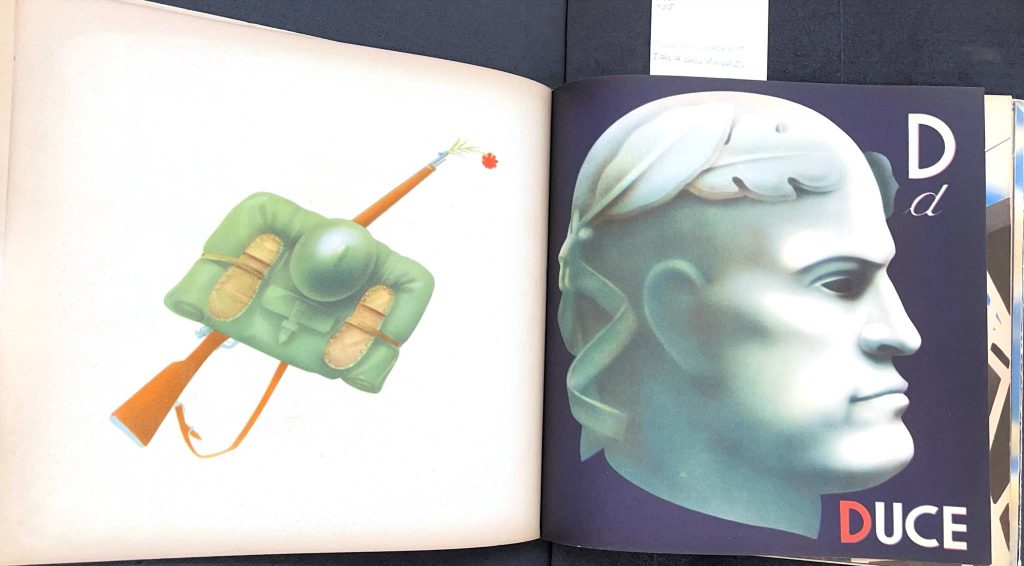
One of the most notable qualities of fascist art is the use of inspiration from classical art and architecture as a reference to Italy’s grandeur of ancient civilizations such as Rome. The figure as seen in the page “D is for Duce”(fig 2) represents Mussolini as a Roman god. He is shown with a large head and a crown of loral leaves on his head symbolizing wealth and power.(5) This representation aims to relate Mussolini and his rule to that of the Great Roman Empire as well as a symbol of heroic realism. Fascist art frequently depicted idealized, heroic figures, often muscular and strong, embodying the virtues of the fascist state. Depicting Mussolini in this manner rather than a typical man of flesh like the other characters of the book makes him superhuman and above the common people in Italy feeding into the cultlike worshiping of their leader essential to a successful dictatorship.
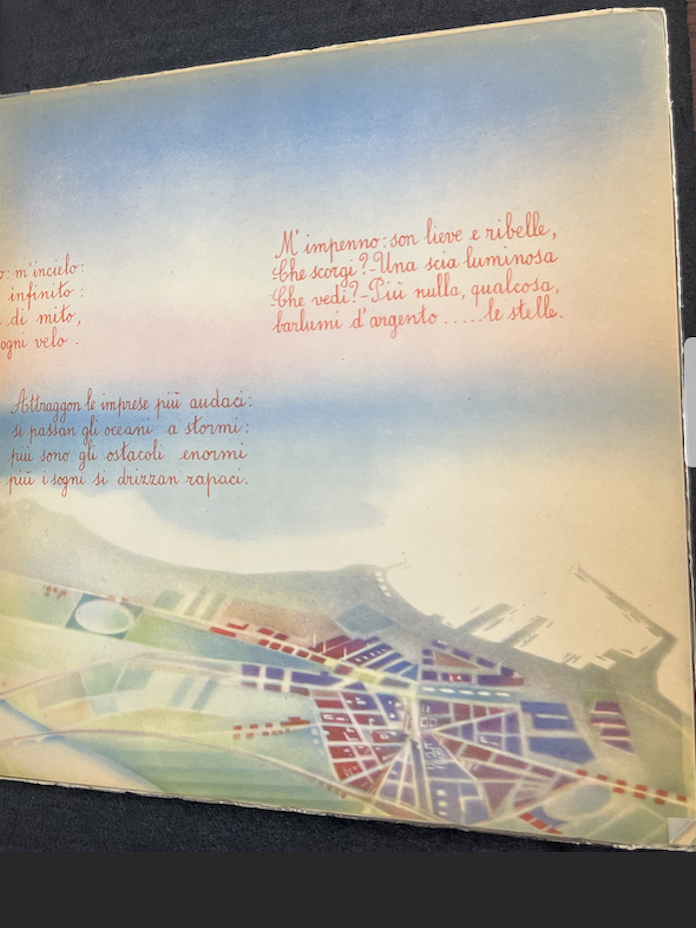
While Classism and Heroic Realism were reoccurring styles of fascist art, the practice of aeropainting also known as aeropittura in Italian was practiced by the futurist painters to promote the power and technological advancement made by the “New Italian” state. (6) The style stems from a growing fascination with aerial perspectives and technological advancements in aviation. Scenes are depicted from above, portraying cities, landscapes, and objects as seen from an airplane or dirigible. This perspective offered a new way of seeing the world, emphasizing speed, dynamism, and the interplay of light and shadow. On page V if for Velivolo(fig.3) the style of aeropainting is mimicked depicting a military airstrip from above. The inclusion of the word Velivolo which means aircraft in Italian promotes the fascist obsession with aviation and the style of the page emulates the aerial perspectives afforded by flight, this iteration of Futurism continued to emphasize the technological advances fostered by Mussolini’s regime.
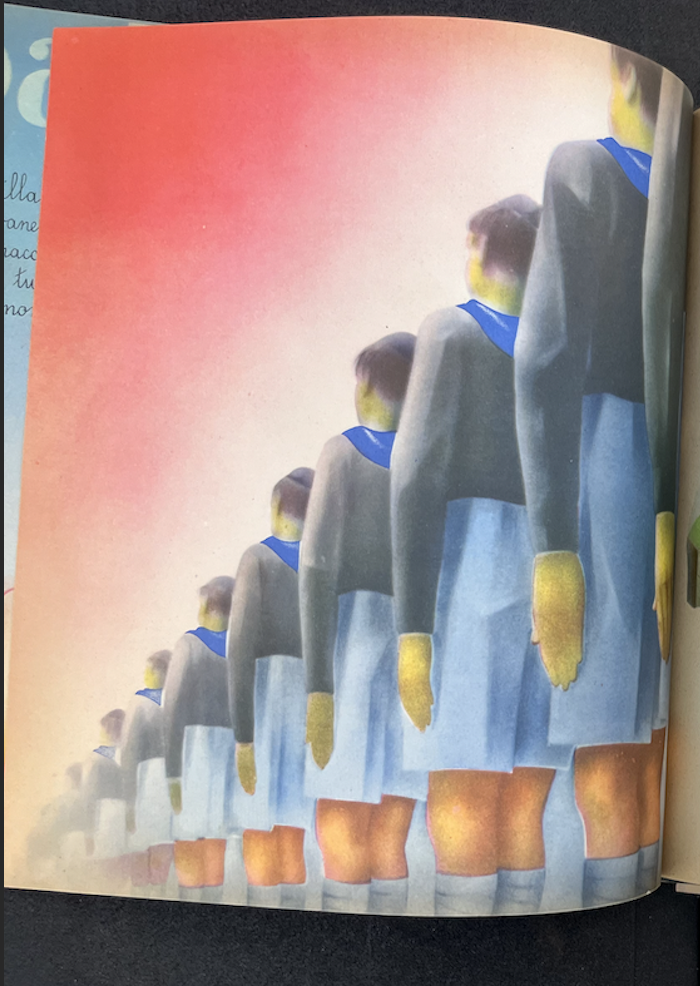
Fascist art generally rejected modernist trends and individual expression in favor of conformity and collective identity. Artists were often required to adhere to strict guidelines and produce works that aligned with the regime’s ideological agenda. As seen in the image of a group of young boys standing at attention on the page “C is for Campeggi”(fig 4) they are all wearing the same uniform, and their faces are hidden, obscuring their identity and therefore their individualism. The boys are exemplary of what was expected of the Italian youth and their conformity and unity is celebrated with their posture and strength in numbers.(7)
In understanding the recurring themes in the visual representation of Mussolini’s Fascist regime, insights are offered into the larger matter of authoritarianism and its relationship to culture. The complexity of Fascist art must be translated to art under fascism because of the tight restrictions and repressions of mass media. Confusing avant-garde movements with carefully crafted propaganda can be a threat to understanding art in a historical context. The art produced under fascism as shown in Italia dalla A alla Z shows the themes of power, technology, and propagandized image that align with Mussonini’s production of Italy but do not emulate the reality of Italian life under Mussolini in any way.
References
Antliff, Mark, and Matthew Affron. Fascist Visions: Art and Ideology in France and Italy. Princeton University Press, 1997.
Casden, Emily. “Italian Futurism: An Introduction – Smarthistory.” Smarthistory, 2015, https://smarthistory.org/italian-futurism-an-introduction/.
Haycock. “Futurist Skies: Italian Aeropainting.” TLS-The Times Literary Supplement, 28 Jan. 2005, p. 18.
McLean, Eden K. Mussolini’s Children: Race and Elementary Education in Fascist Italy. Yale University Press, 2018.
Merjian, Ara H. “Learning from Fascism.” ARTnews, 1 Apr. 2019, https://www.artnews.com/art-in-america/features/fascist-art-learning-from-fascism-63619/.
“Mussolini’s Camps: Civilian Internment in Fascist Italy (1940-1943).” PrintedMatter, 5 Jan. 2020, primolevicenter.org/printed-matter/mussolinis-camps-civilian-internment-in-fascist-italy-1940-1943/.
Tate. “Futurism – Art Term.” Tate, https://www.tate.org.uk/art/art-terms/f/futurism. Accessed 28 May 2024.
Student Author
Eleanor Hicks
A Note on Translation and its Role in Diversity
All translations of these poems were conducted through my knowledge as a student of Italian language. Some creative liberty was used when a direct translation would not match what I think the creative description was from the original Italian author. However, this can lead to discrepancies in how other translations would otherwise be interpreted. In “Translation and Migration,” Dr. Loredana Polezzi speaks of the role of translators as political actors, and if translation is an isolated and controlled process by those who are elite, it may lead to a loss or erasure of what one is trying to say. Dr. Polezzi speaks of this in the context of migrant writing, but it is important to acknowledge here as well. What I translated is my perceived interpretation of the text given my background, and what I analyze from that translation is me playing the role of a political actor, as my audience will most likely take my translation as given and use that to make their own interpretations. The original audience of this text, Italian Americans in the 1930s, would have self-translated the text given their own background of the Italian language, whether it was passed down through their family, or learned in schools. Their interpretations of the text would have certainly been diverse from mine, and given that the schools of Italian language in that era were sponsored by Mussolini, it would be little surprise that the language used in the book catered to the curriculum of these Italian language schools.
Reference
Polezzi, Loredana. “Translation and Migration.” Translation Studies 5.3 (2012): 345–356. https://doi-org.libproxy.scu.edu/10.1080/14781700.2012.701943.
Student Author
Agustin Pace
The full exhibit page can be found publicly on Santa Clara University Digital Exhibits by clicking the link below.
Pingback: The Italian American Experience – Online Exhibits of Italian American History in the Bay Area – Italian Studies