
There is a tendency in American pop-culture to view the poor of developing countries with a lens of pity. We see commercials featuring images of malnourished children with sad music playing in the background. The narrator speaks in a somber tone, urging the viewer to take action in the form of a monetary donation to “save” the subjects of these advertisements. This savior complex is incredibly damaging and insulting. It establishes a hierarchy amongst global individuals on the basis of their possessions. Worst of all, this view implies that those in poorer countries are helpless or lack dignity. As critical as I am of this view, I noticed quickly in Nepal that I still had to unlearn a few characteristics of it in my own worldview.
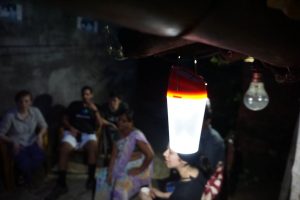
The EG excursion team at Runa’s house, using one of Runa’s solar lights to be able to see.
Prior to my departure, I had studied social entrepreneurship and the mission of Empower Generation for a full academic quarter. Social entrepreneurship derides the notion that the world’s poor are helpless, and aims to rectify the root issues of social inequalities and injustices by shifting unjust equilibriums. Due to my newly acquired knowledge, I (wrongly) felt as though I had a strong idea of the type of impact my research would document; that due to Empower Generation and business ownership, women entrepreneurs become confident and driven. However, this sentiment is as damaging as the advertising I decried earlier. A much better, and exceedingly more accurate phrase is that “Empower Generation allows women to develop their business acumen, leading to more confidence in public speaking and conviction in voicing their opinions in local politics.”
Not only is the second phrase much more specific, but it conveys the dignity and skillsets that these women entrepreneurs possess. The first sentiment wrongly assumes and implies that prior to business ownership, entrepreneurs were not driven or lacked confidence. I’m ashamed and frustrated at myself for my inability to notice the ignorance inherent in that first statement. But I am happy to have realized the damage that this subtle difference in language can have.
I was inspired by the strength and tenacity that these women entrepreneurs displayed. Many were and continue to be social leaders prior to starting their solar light enterprise. Some of these women served as presidents of women’s cooperatives. Others held positions as local representatives for national political parties. One woman, Kala, transitioned her enterprise into an emergency relief distribution operation, distributing solar lights to nearby communities that were without light or electricity following the April, 2015 earthquake. In all cases, many of these women were incredibly confident and driven before becoming entrepreneurs. Empower Generation did not instill these traits into them, but gave these women the opportunity to demonstrate and develop these skills through business ownership—an opportunity that a patriarchal society largely denied them. This distinction is imperative.
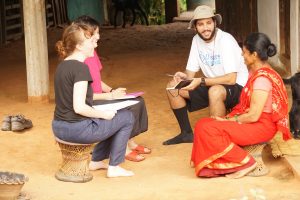
Interviewing Kala at her home in Dhading, Nepal.
It’s been two months since my arrival back into the United States, and I’m still digesting my experience abroad. This experience was truly transformative in the sense that it led me to explore many social issues through a different outlook. It also led to introspection and my own role in perpetuating and ending social inequalities. I learned an immense amount about my privileged status as an American male on a global scale. The recognition of my privilege, previously, was diminished by the unjust treatment I’ve received as a Muslim-Palestinian in the United States. These are sobering lessons and I’m still unpacking many of these feelings on my journey of self-discovery.
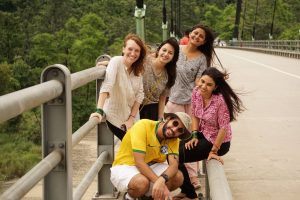
The EG exursion team (minus Clarissa).
I had previously felt that my studies of political science and the Middle East had confined me to a career of macro foreign policy, although I desired to engage the issues facing the region on a grassroots, communal level. I applied for the Global Social Benefit Fellowship after a period of uncertainty following my study abroad term in Morocco. I wanted to spend more time immersed in the developing world and to see the intersection between social science and business as tools for positive social change. My time conducting action research with Empower Generation showed me that and more.
My experience in Nepal demonstrated that working to disrupt unjust social equilibriums with the individuals facing them is my calling. I could not have anticipated just how challenging, yet rewarding action research can be. The joy, satisfaction, and fulfillment that I receive from data collection in the field is incomparable to other work I’ve done. Yet, I still don’t know which direction the “next step” is. As I peruse graduate study programs, I am torn between International Affairs and International Development. It is a daunting decision to make. Regardless, I know that I have a clear focus on inducing positive social change in the communities and areas that need it the most.
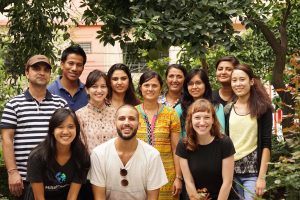
The entire EG team at the central office in Kathmandu.