In the summer of 2011, following my sophomore year of high school, I returned to the West Bank for only the second time since immigrating to the United States, and for the first time in nearly nine years. During this time period, my oldest brother had pioneered Inspire Dreams, a non-profit organization that provided academic, athletic, and arts-based education programs to Palestinian refugee youth. One of the main components of Inspire Dreams was Camp “I Have a Dream”, a weeklong program for refugee youth between the ages of 12-16. The program focused on teaching non-violence, leadership skills, and career development through mediums such as basketball, poetry, and computer based applications. I volunteered for one of these camps in the Dheisheh refugee camp, and it was the first major paradigm-shifting experience in my young life. The youth participating in this camp were all around my age at the time, and it was electrifying to see the faces of my peers illuminate with joy and excitement with each day of these workshops. Furthermore, I was struck by the strength and generosity of these individuals and their families, despite the sociopolitical context in which they lived. I was overwhelmed by the generosity displayed to me. Regardless of how much a family had, I was extended numerous invites into people’s homes for a meal or coffee. This experience played a significant role in shaping my worldview and aspirations.
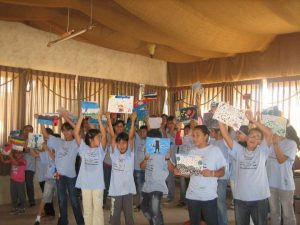
Excited youth showing off their artwork during Camp “I Have a Dream”
Prior to my experience in the Dheisheh refugee camp, I had never really realized or reflected upon the privileged experience and upbringing I was blessed with in the US. I noticed socioeconomic inequalities when my middle school basketball team would play at schools in different cities, noticing differences in the maintenance of their school campus in comparison to the schools in my more affluent East Bay community. Despite awareness of these differences, poverty was still a hard concept for me to grasp due to its distance from my comfortable upbringing. I knew of the existence of millions of people who lack access to the most basic life necessities, but I was still engrossed in my own world and the adolescent problems I was facing. Working with Palestinian youth in Dheisheh was a “wake-up” in the sense that it instilled a sense of responsibility and accountability. I was no longer distant from poverty or oppression. I couldn’t choose to remain ignorant. I couldn’t convince myself that I was unable contribute in the alleviation of these problems any longer.
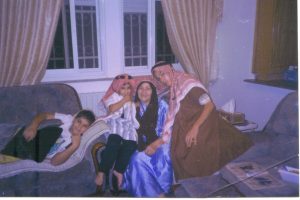
My brother Jawad, myself, my grandmother, and my other brother Hammad.
I was born in the West Bank and lived there until the age of five. A bombing near my brothers’ school uprooted my family, and we found ourselves on a one-way flight to the United States. Growing up as a Palestinian-American in post 9/11 America has been a tremendous challenge, as I often found myself the recipient of ignorant and hateful remarks directed at both my nationality and religion. In addition to my ABC’s and times tables, I navigated feelings of “otherness” and the creation of an American identity that was often presented as incompatible with my Muslim, Palestinian heritage, leading to a long internal struggle with my own identity.
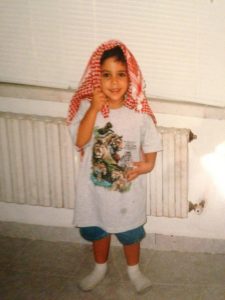
Me at a young age
I am fiercely proud of being a Muslim Palestinian, and I have embraced the notion that my identity is almost wholly Palestinian and Muslim, despite a lack of fluency in Arabic, non-observance, and American upbringing. Life under Israeli-Occupation and the assertion that I am from a non-existent homeland and a member of an imaginary people has had a profound impact on my worldview, serving as motivation and crafting a proverbial chip on my shoulder. Marginalization has only bolstered my convictions, and witnessing injustice and violence in the West Bank has led me to have an interest in social justice—not just in the arena of the Palestinian-Israeli Conflict, but wherever systematic injustices and inequalities exist.
My religious and ethnic background has a large influence on my worldview, but my Palestinian heritage is blended with my American upbringing and the socio-political movements I have witnessed in the US. This diverse mix of a Muslim and American heritage is often forgotten given the Islamophobia that has so often characterized American mass media and the role of Islam as the “other” in contemporary American society. I am a human manifestation of two distinct identities blended together into something continuously transforming, challenging foreign notions of American-ness and demonstrating firsthand the coexistence of an Arabic, Muslim, and American identity. The articulation of my heritage and its relation to my identity is paramount to my character and future aspirations.
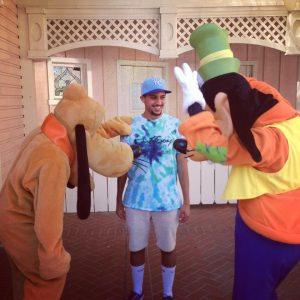
Sharing a laugh with Goofy and Pluto
I currently study Political Science and Arab, Islamic, and Middle Eastern Studies at Santa Clara University. I have always been fascinated by the politics, culture, and history of the Middle East, and I have become immersed with the state of international affairs beyond the role of the nation-state and intrigued with the history of interactions, and the political and apolitical factors that have influenced relations between nation-states. I became more invested in the region through each related class, leading to enrollment in a semester long program with SIT in Rabat, Morocco. The semester long program culminated with a three-week period in which I was able to conduct qualitative research with young Moroccans on their definitions of individual freedoms. While a short period, I found the experience tremendously valuable and academically exhilarating. The nature of my studies has always drawn me towards action research on socio-political and economic issues. Early level undergraduate work, however, often involves a small amount of primary research and it was a very challenging and fulfilling experience to conduct primary research for the first time while abroad.
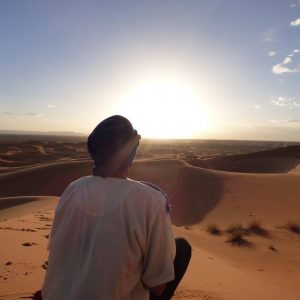
Awestruck by the Sahara in Morocco
Santa Clara’s Jesuit education has been the most transformative component of my educational endeavor. During my time at Santa Clara, I have met professors, faculty, and students who share a common vision of social progress and human advancement that inspires them to pursue knowledge outside of an academic setting, while challenging preconceived notions and problematic paradigms. Santa Clara has allowed me to parlay my academic interests of politics, international affairs, conflict resolution, and the Middle East into applicable opportunities to promote positive social change.
My time in Morocco had ignited a fire inside of me that could not be extinguished and I felt lost as to how to proceed in a positive direction. The return was so abrupt; there was no debriefing, no time to reflect before readjusting to American life and a daily routine. When I discovered the Global Social Benefit Fellowship, I felt as if fate had driven me to a solution to the dilemma of how to continue my professional and personal development through the application of my passions. I loved the social research component of my program and operating in the context of a foreign setting. I’m tremendously excited and honored to apply my passion for research and social justice with Empower Generation in Nepal.
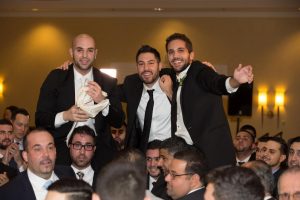
My brothers Jawad (27), Hammad (30), and I celebrating Jawad’s marriage with our entire family