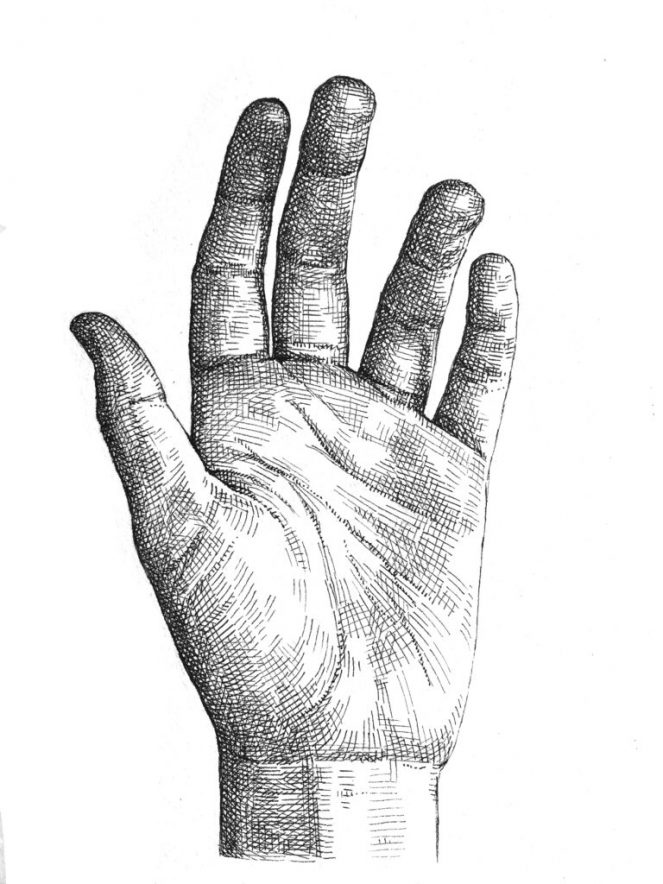
The Woman of Colour is an epistolary novel at heart and thus explores letter writing within the novel’s main character, Olivia. Without even thinking about it, Olivia is using her hands as a channel to write and regress into her life back in Jamaica. In addition, the novel also holds slavery and racism at its core. Thus, these hands also embody the labor and cruelties that Black individuals have faced within their forced servitude and the injustices Olivia faces in the name of her father. Within the word “hand” I want to focus on these two facets of The Woman of Colour, which I feel tie back to this word in a way that makes it exceedingly important to close-read and interpret.
In one instance, “hand” is representative of the physical labor that enslaved individuals endured during this time. In this way, “hand” is illustrative of the struggle, labor, and suppression that enslaved individuals were dealt at the hands of their enslavers. Although she is not enslaved, she is trapped in a situation that she has no control over. This is seen in the quote, “And yet, if Augustus Merton refuses her offered hand, such must be the situation of your poor Olivia!” (75-76). Here we see how Olivia’s future is at the mercy of a decision to be made by a man she has just barely met. Just as the enslaved individuals are at the mercy of their enslavers who are white, Olivia is also at the mercy of Augustus who is white. “The labor that occupies the attention of historical archeologists is the labor that is colonized, often rigidly structured, and simultaneously global and local. Such labor forms the crux of colonialism, mercantilism, capitalism, and class. This type of labor stands as a hallmark of the expansion of the European world economy from the 15th through the 21st century” (Hall). The unfair and unjust treatment reminded me of The History of Mary Prince. In this narrative, we see the labor that enslaved individuals were forced to endure, “Prince knew quite well that as soon as she returned to Antigua she would revert to her former slave status, and she was fearful that as a punishment for her recalcitrance she would be put to work as a ‘—- —-’ and forced to work on the plantations rather than in the household, as formerly” (Prince, xix). Not only do we have accounts of the terrible atrocities that enslaved people endured, we also have this quote from the introduction of Mary Prince that emphasizes just how dangerous it was for her, even though she was technically free in England. This life of constantly looking over your shoulder and wondering if you are really free is frightening and distressing and ties back to the freedom that Olivia felt when confiding in Mrs. Milbanke with her handwritten letters.
In another instance, “hand” represents having agency in terms of liberation, defiance, and resistance. Pertaining to The Woman of Colour, Olivia writes letters using her hands as a form of liberation. Writing is her form of escape, an outlet she can use in order to be free from her reality. “I have sometimes feared that you would never again see the hand-writing of your Olivia—I have feared that the attempt to portray my tale of sorrow would unnerve my brain” (TWOC 136). Although Olivia mentions that she almost does not write to Mrs. Milbanke, she ends up doing so anyway because writing is the way in which she is set free from her past miseries. These miseries are evident in the way in which Olivia is treated and with how she is out of place in this new world. This idea is discussed in the article titled “Interracial Sex and Narrative Crisis in The Woman of Colour” by Joyce Macdonald, “The material presence of Olivia’s Black female body marks her as out of place in her new world, despite the ways in which she is otherwise very much suited to it: well-educated, well-dressed, quietly witty, and beautifully mannered, she reads the Tatler and even quotes a little Shakespeare” (MacDonald 66). Here, we see the emphasis on Olivia not fitting in not only because of the color of her skin, but also because she is a woman. This is also emphasized in Daniel Yu’s article, “August Disgust: Distinction, Disinterest, and Race in The Woman of Colour” where the author explains Augustus’ racism upon first meeting Olivia, ““Augustus relates to this close confidant that, in the instant of his first encounter with Olivia, he was in fact repulsed by her person: “I will confess to you, that the moment when my eyes were first cast on the person of my cousin, I started back with a momentary feeling nearly allied to disgust; for I beheld a skin approaching to the hue of a negro’s, in the woman whom my father introduced to me as my intended wife!” (Yu 105). Here, we see Augustus’ first reaction to Olivia which further places her apart from him, as even she can tell he is bothered by the color of her skin. This pushes forward her need to take control of what is happening to her and she does this through her letters to Mrs. Milbanke.
When thinking of epistolary novels, many minds will immediately go to The Color Purple by Alice Walker or Flowers for Algernon by Daniel Keyes. What ties these two epistolary novels together is the fact that they are relatively contemporary (written in the last 100 years) and that they explore topics that express emotions, beliefs, and inner thoughts (whether that be of the author or the main characters of the story). In The Woman of Colour, we are given a glimpse into Olvia Fairfield’s innermost musings, feelings, and wonderings. We get to see a side of her that readers might not have been able to see if the novel was not expressed through letters. “Personal letters, particularly those written with no apparent thought to publication, have often been read as windows into the soul of the author” (Dodge). These letters may have been produced with no other reason than to lament and express to a friend. Thus, we can look at these letters as a glimpse into Olivia’s true feelings and examine how she attempted to connect back to Jamaica.
The Woman of Colour is captivating in the way it manages to capture the epistolary genre while also allowing letter writing to act as a central theme throughout the main character, Olivia. In this way, Olivia’s hands shift into a channel for her to regress into her life in Jamaica, effectively emphasizing the importance of written words. Additionally, the novel manages to intertwine the major theme of letter writing with slavery and racism, through the use of “hand”. In closely examining this word, readers can discover the multifaceted metaphor that embodies the suppression and labor endured by Black individuals, while also serving as an outlet for resistance and freedom.
Works Cited
Anonymous. The Woman of Colour, A Tale. [1808]. Ed. Lyndon J. Dominique. Broadview, 2008. Print.
Dodge, Rachel. “Regency Women: Pin Money and Private Expenses.” Jane Austen’s World, 6 Jan. 2022, janeaustensworld.com/2021/10/11/regency-women-pin-money-and-private-expenses/.
Hall, Martin. Historical Archaeology. Blackwell.
MacDonald, Joyce Green. “Interracial Sex and Narrative Crisis in The Woman of Colour.” Eighteenth-Century Fiction, vol. 35 no. 1, 2023, p. 65-80. Project MUSE.
Prince, Mary. The History of Mary Prince, A West Indian Slave. [1831]. Ed. Sara Salih. London: Penguin, 2004. Print.
Yu, Daniel. “August Disgust: Distinction, Disinterest, and Race in The Woman of Colour.” Eighteenth-Century Fiction, vol. 35 no. 1, 2023, p. 103-111. Project MUSEmuse.jhu.edu/article/880272.