Throughout The Woman of Colour, the use of the word “colour” is employed for multiple different meanings—both drawing on the racial connotations as well as blushing, makeup, and art. Colour is a homonym, and is also used frequently in a metaphorical sense. I want to note that within the context of this novel and society, I do not wish to identify anyone as c****red, as it is inherently a racial slur. However, the fact that it is a racial slur adds an interesting layer to when the phrase is used in entirely different meanings, such as when “Augustus coloured, and looked indignantly towards Mrs. Merton” (77). In this example, Augustus is blushing at Mrs. Merton’s previous racist comment about Olivia subsisting on rice. Not only does this demonstrate Augustus’ embarrassment at his family member’s ignorant and racist perspective, but it also connects to how the very nature of what is embarrassing him is related to the treatment of a Black woman. Furthermore, because Augustus is potentially set to marry Olivia at this point in the novel and take her last name, saying “Augustus coloured” is also quite literally alluding to the fact that he is transforming his reputation and identity if he were to marry her. Within the perspective of the time period, he could be seen as tainting his position in society.
Immediately before this, Olivia is helping to make tea, which prompts Mrs. Merton to comment that, “Oh yes, the lady is of an active turn I find,’ … still meditating on the coloured print which she held in her hand” (77). The “coloured print” she is reading is “Bell’s Belle Assembly, or Gallery of Fashion” which the footnote details was a “luxurious fashion magazine published between 1794 and 1803” by Nikolaus Hiedeloff (Dominique). Olivia describes this magazine as “a modern periodical publication, where the ladies have coloured specimens of the costume and habits in which they are to array themselves every month” (76). On a surface level, “the coloured print” “in her hand” could be seen as a metaphor for how Mrs. Merton views her relationship with Olivia. As the white, powerful woman who seeks to adopt Olivia’s fortune, she may think she is holding Olivia in the palm of her hand. Additionally, because Olivia is a mixed woman in white company and Mrs. Merton is a lazy, entitled racist, Mrs. Merton thinks she can passive-aggressively dominate Olivia, such as when she tries to serve rice because she “understood that people of your—I thought that you almost lived upon rice … and so I ordered some to be got,—for my own part, I never tasted it in my life, I believe!” (77). On another level, the “coloured specimens of costume” sounds like Olivia is looking down upon Mrs. Merton, while using a phrase commonly used to look down upon Olivia. By referring to fashion as “costumes” Olivia is minimizing and trivializing the things that are important to Mrs. Merton, but also criticizing the frivolous nature of British white women.
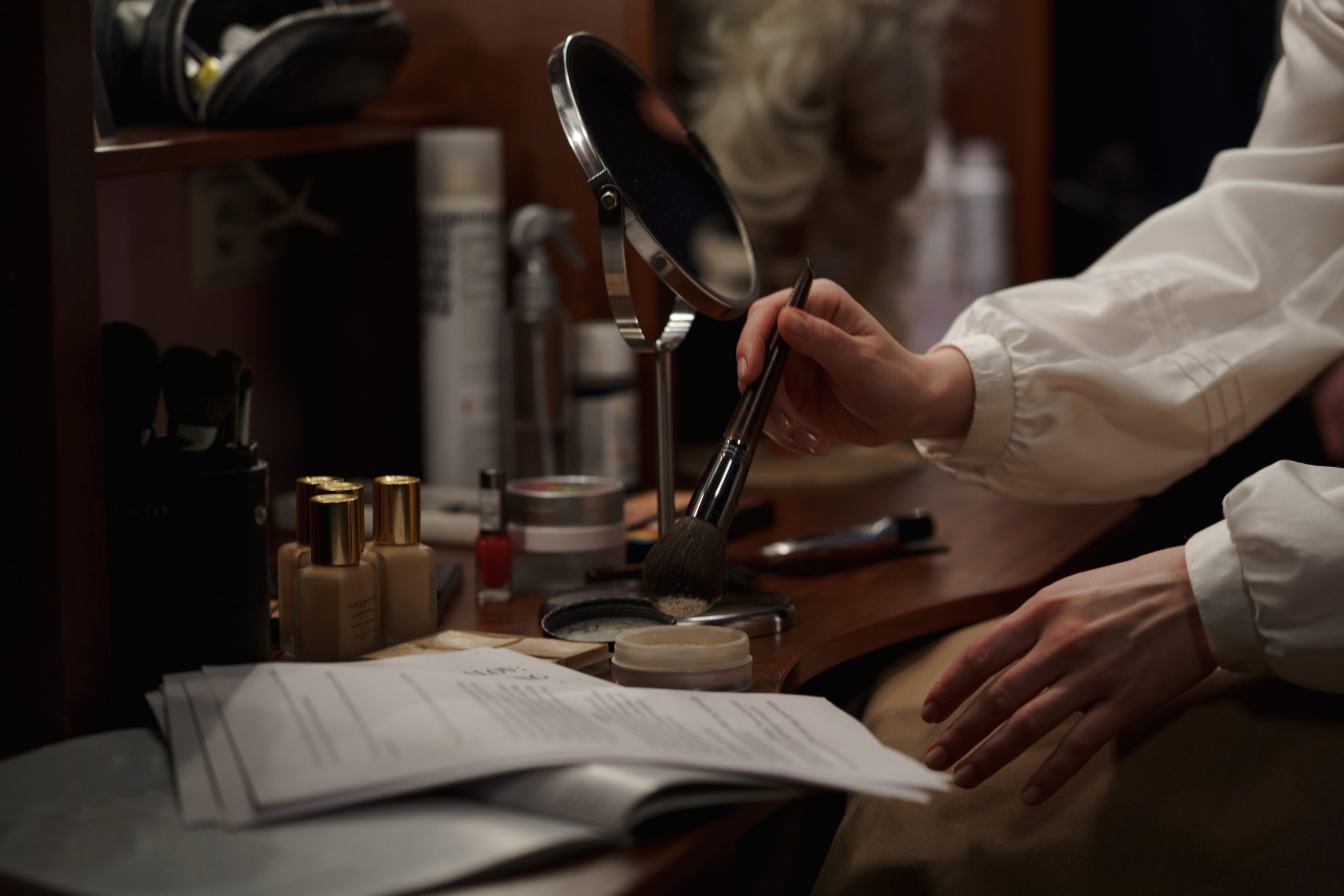
Circling back to the idea of “colouring” as blushing or as makeup, when Olivia first describes Mrs. Merton to Ms. Milbanke, she writes, “Mrs. Merton would be thought pretty by any person who looks for features only. She is very fair, and very fat; her eyes are the lightest blue, her cheeks exhibit a most beautiful (though I am apt to believe not natural) carmine” (73). Mrs. Merton’s beauty is plastered upon herself, and her blush is a form of makeup that might mask her natural expressions. In contrast, Olivia frequently describes herself as blushing or colouring, which connotes a more natural, easy, less self-involved existence. In her article, “‘Mind Is Revealed in the Countenance’: Subversive Laughter and Caricature in The Woman of Colour,” Leigh-Michil George corroborates this point, describing how “the contrivance of Mrs. Merton’s blush implies a defect underneath the façade. She physically exhibits fair features, but there is an affectation to her femininity. The naturalness of Olivia’s complexion—her “cheeks glow,” her “burning blushes,” her “crimson” face—is highlighted in opposition to Mrs. Merton’s artifice” (George 50). While Olivia’s emotions are visible through her blushing, Mrs. Merton’s are hidden, albeit not well. Ultimately this all acts as a commentary against white British women, further differentiating how Olivia does not fit in with them.
Furthermore, in Joyce Green MacDonald’s “Interracial Sex and Narrative Crisis in The Woman of Colour, ” she provides a similar perspective, highlighting how the white characters of the novel see Olivia as purely “an exotic stranger, a racial inferior, or a proto-tragic mulatta, but she cannot see her for who she is: the rich, cultivated, witty, observant young biracial woman” (MacDonald 74). To characters like Mrs. Merton, Olivia is an outsider who will always be most defined by her race.
In addition to the use of “colour” within TWOC, it appears notably within other seminal texts of Black Romanticism. In The Wonderful Adventures of Mrs. Seacole in Many Lands, Mary Seacole describes how she experiences being a mixed woman traveling all over, as both a nurse and an entrepreneur. In the following excerpt, she highlights how differently Americans interact with her versus the others she encounters in her travels:
“failed to teach me that Americans (even from the Northern States) are always uncomfortable in the company of c******d people, and very often show this feeling in stronger ways than by sour looks and rude words. I think, if I have a little prejudice against our cousins across the Atlantic – and I do confess to a little – it is not unreasonable. I have a few shades of deeper brown upon my skin which shows me related – and I am proud of the relationship – to those poor mortals whom you once held enslaved, and whose bodies America still owns. And having this bond, and knowing what slavery is; having seen with my eyes and heard with my ears proof positive enough of its horrors – let others affect to doubt them if they will – is it surprising that I should be somewhat impatient of the airs of superiority which many Americans have endeavoured to assume over me? Mind, I am not speaking of all. I have met with some delightful exceptions” (Seacole 8).
Seacole’s observations are astute, and although the Mertons and other people that Olivia interact with are not American, I would argue that these sentiments apply to them as well. Unlike Mary Seacole, Olivia is too polite to openly call these people out on their racism. There are also great comparisons between Seacole’s description of being related to enslaved people and Olivia’s description. They both take pride in their Blackness, while still tangentially benefiting from the slave trade.
To return to the importance of using the word “colour,” instead of phrasing things differently can be connected back once again to the racial implications. Olivia uses the term frequently, almost as a way to highlight the subtle racism of those around her without directly pointing fingers. It’s almost like a hidden puzzle within her letters for Mrs. Milbanke to draw out, or perhaps simply the repetition of the term will further ingrain the racist experience into her letters. If Olivia chose instead to say “Augustus blushed” instead of “Augustus coloured” we would lose all of the rich double meanings. Ultimately, the racist layers to the word are in part what makes it such a complex and metaphorical one.
Related page numbers in TWOC: 55, 57, 58, 63, 72, 77, 78, 81, 85. 94, 100, 101, 103, 113, 123, 124, 130, 138, 149, 150, 151, 159, 172, 190
Anonymous. The Woman of Colour, A Tale. [1808]. Ed. Lyndon J. Dominique. Broadview, 2008. Print.
MacDonald, Joyce Green. “Interracial Sex and Narrative Crisis in The Woman of Colour.” Eighteenth-Century Fiction, vol. 35 no. 1, 2023, p. 65-80. Project MUSE muse.jhu.edu/article/880270.
George, Leigh-Michil. “‘Mind Is Revealed in the Countenance’: Subversive Laughter and Caricature in The Woman of Colour.” Eighteenth-Century Fiction, vol. 35, no. 1, 2023, pp. 43–64. Project MUSE https://doi.org/10.3138/ecf.35.1.43.
Seacole, Mary. Wonderful Adventures of Mrs Seacole in Many Lands. Penguin Books Ltd. Kindle Edition.