

I’m a very different person than I was a year ago. Well, that’s a grotesque understatement. Every time I reflect on this fellowship and how it has changed me, the first coherent thought that comes to mind is that I have changed so much in the span of nine months.
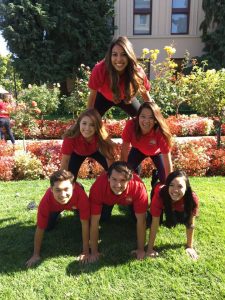
My current Residence Life staff at our inauguration.
When I first heard about the fellowship it was through an email from Dr. Schindewolf, one of the professors from the Spanish department who would later become my faculty research mentor. Upon reading the description and researching ILUMÉXICO, I was immediately inspired to apply. I had been searching for some sort of opportunity to address social justice in a meaningful way but until then had been having difficulty finding something. At the time, I had only been volunteering for non-profit organizations, creating educational programs through my job as a Community Facilitator, and being an activist for change on campus. Even though I was, in my own way, trying to fight against the injustices of the world, I felt like I wasn’t doing anything substantial, like the work I was doing wasn’t having a lasting impact. In a way, I felt like something was lacking. I was obviously doing things, but were they actually impactful, were they actually helping to improve the world? To a degree I felt lost and like I was moving aimlessly, simply trying to help wherever I could. I had a boundless youthful energy and passion for social justice, but I had an equal amount of uncertainty about how to go about my ridiculously wild ambitions. So when I saw Dr. Schindewolf’s email, I figured, I’ll just go for it and see what happens.
Looking back now on the person I was a year ago, I hardly recognize myself. I’ve become a very different person. My passion for social justice and ambitions to be a life-long agent for change remain, but now they blaze brighter than ever. My boundless energy has matured and become more focused. After having encountered obstacles and limits I could never have imagined, I’m even stronger now and have a new concept of what it means to have grit. Because of this fellowship and the entrepreneurial skills I have gained, I think about systems more critically. What seemed like a daunting and intimidating challenge before now is an exciting puzzle for me to tease apart.
Last year, I had absolutely no idea how to go about creating lasting change. I thought that if I kept working and simply helping people, something would happen and the world would somehow be a better place. It was an unsettling feeling riddled with a certain anxiety that my actions would not be enough. However, now I have a few, slightly more concrete ideas about how to alleviate poverty and tackle the complex issues surrounding it and feel more reassured as a result. After all, I have the skill set and mindset to do so—to analyze the deeply complex issues I will encounter, to imagine innovative (and perhaps even wild) solutions, and to shift my plans at any given notice. I still do not know specifically what I will do or the role I will play in alleviating poverty, but I feel comfortable with not knowing everything right now because I understand that my passions and my strengths will guide me and I don’t have to occupy one role for the rest of my life.
I don’t want to be a part of social entrepreneurship just yet, but I will apply entrepreneurial thinking to my work. I used to believe that if whatever solutions I came up with failed, then I had failed. However, failure is another learning opportunity—it is the chance for me to understand the outcomes of my attempts and to try again. This mindset is especially pertinent to tackling global health issues as such issues are comprised of multiple intertwining factors.
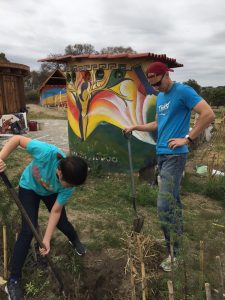
Planting a tree on a farm in Puebla, Mexico.
During my immersion trip to Puebla last March, I met an inspiring woman who fought for indigenous rights by conducting research about the environmental impacts on indigenous populations. She empirically studies how popular environmental policies and practices in Mexico harm the health and economies of marginalized communities. She told me that throughout her life she has used her education and research to fuel the fight against injustices and giving a voice to indigenous people. From her and from this fellowship, I want to be able to use my education to conduct action research to help marginalized communities throughout the Americas. I want to dialogue and interact in a meaningful way with marginalized communities so that I can learn from them and and understand the different factors— socioeconomic, psychological, and spiritual—that influence their health and wellbeing. In this way, we can all work together to build a better world. However, this requires higher educational degrees on my part and will likely come at a later point in my life. For now, I am trying to find work that engages Spanish speaking communities from a health perspective. I want to be able to learn more about health from a social services perspective. In that way, I can develop a more intimate relationship with the community and therefore better understand how I can create impactful programs for marginalized groups.
I’ll admit: I’m still afraid the work I do in my lifetime won’t have a meaningful impact in the fight against poverty, but I’m a little more confident now, a little more assured that it can be done.