
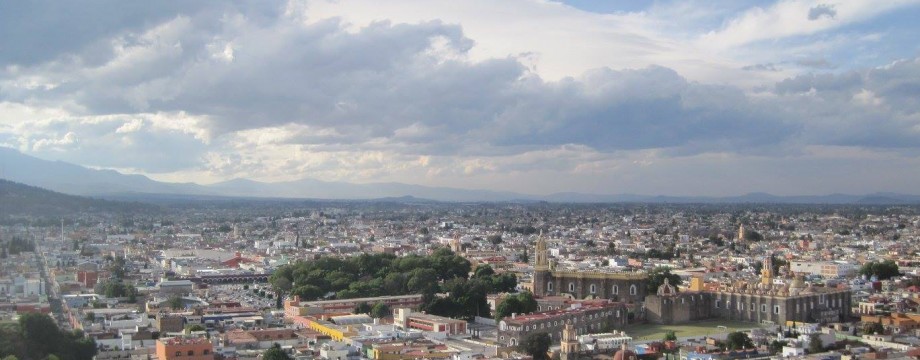
From the very beginning of this fellowship, I knew I would be challenged to new heights. I knew that I would gain new insights into the world. I knew I would come out of this experience a different person. But to what degree? That I didn’t know.
I’ve always been aware of poverty as it is an integral part of my family’s history. However, awareness is vastly different from seeing such poverty first hand. Growing up my family would describe poverty as terrible and as something they refused to ever return to—rightfully so, of course—but because of how my family spoke of poverty and the language they used to describe it, I developed this idea that to be in poverty was to perpetually live in despair and desperation. I thought that poverty consumed every thought, every waking moment of a person’s life. With poverty present, how could you have the time or energy to think of or do anything happy or uplifting? My time in the field showed me otherwise.
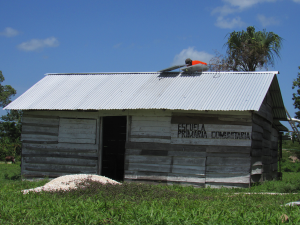
One of the community engineers, Jorge installing panels in Esperancita
I have no specific instance, no exact point in time in which my perspective on poverty changed, but I can recall quite a few small moments in which my preconceptions slowly began to evolve. Like the time we were in Chilam Balan when the family we were staying with was so eager to talk to us and get to know us. They kept asking me questions about where I’m from, what my life is like in the States, and how on earth I got my mother’s permission to travel so far away from home. Or when one man we interviewed was so relieved that we hadn’t taken any pictures of him that day because he had a small, bloody cut on his face that made him feel self-conscious and then proceeded to offer us the two mangos he had just collected that day. Or when one woman we interviewed in Esperancita offered us juice and chatted with us long after the interview itself was over about what has brought all of us to Esperancita. Or when I was in Tabasco,while I was waiting for more people to arrive for interviews, a couple of people I had previously interviewed sat and simply talked with me about how that day was especially hot and how lucky they were to have cold Coca Cola from Señora Blanca’s refrigerator. All of these simple and fleeting moments cued me into the lives these people have beyond the pressing issue of poverty.
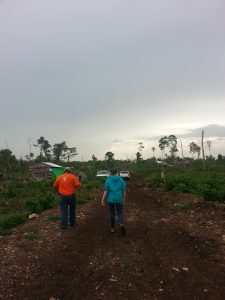
In Chilam Balan getting more supplies for more installations
Whenever I hear or talk about poverty, the conversation highlights the matter as a dark mark in our world, as something completely terrible, bleak, and miserable. It’s true: poverty shouldn’t exist, especially given how far technology has developed. However, in every community we went to, I found myself most taken aback by the sincere kindness and openness I witnessed. All of the people I interacted with had their own story to tell and were so incredibly willing to share a piece of their life with me. I wasn’t expecting them to want to know more about me. I wasn’t expecting them to offer me juice and mangos. I wasn’t expecting them to smile and joke with me. The moments I described earlier appear to be so small and brief yet they have had a profound impact on me because I did not anticipate these sorts of interactions.
In many ways, I feel that we have focused so much on the horrors and bleakness of poverty that we have forgotten the humanity of those living in these situations day to day. We’ve forgotten that they too are people who want to make connections, who are inherently curious about novelties, who talk about the weather, who are self-conscious, who have their own stories that they want to share. To a certain extent, I feel that we unintentionally perpetuate the otherization of people who live in poverty as we allow a dismal situation to become their whole identity. I’m not trying to say poverty is pleasant or something to be admired in any way; we should work to eradicate poverty, but we should remember that just because someone lives in poverty and is deeply affected by it doesn’t mean that poverty defines the entirety of their existence.
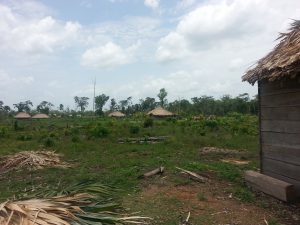
One of the very first views I had of Chilam Balan
I may have left Mexico early for my own personal reasons, but I often find myself missing Mexico and wanting to go back, to return to these communities so that I can converse with them just a little bit more. I want to hear more of their stories, to continue to get to know them, to laugh with them, to simply enjoy their company. This fellowship, with all of its ups and downs, has shifted my perspective and has most certainly cemented my desire to work with people in poverty. I thought this fellowship would show me exactly what job I want. While it didn’t do that, GSBF has certainly clarified more of my career—I want to listen to more stories and to help those stories be heard because they are important, too. How will I do that exactly? That’s a good question; I’m still not sure and that’s ok. If there’s any other important lesson I’ll take away from this experience, it’s that no matter what happens, no matter how many surprises I encounter, I’ll keep pivoting and embrace the unexpected.