
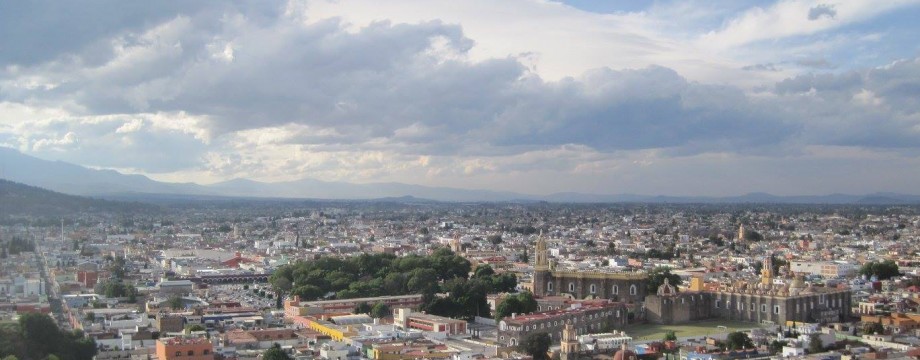
The past month in a country foreign to me has been filled with many, many different surprises that I would’ve never imagined. As I was leaving California, I was absolutely eager to travel to a different country for the first time in my adult life and to start conducting research with Isabel. Our first surprise came within a week: protests in Oaxaca. The night before we were supposed to hop on a bus and leave for Oaxaca to start our research projects, protests escalated in the state, halting public transportation. We scrambled a little at first, but then quickly adjusted to the current events and went off to Campeche.
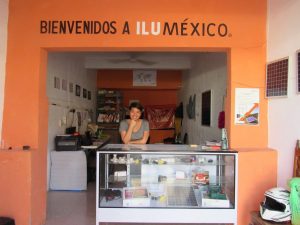
At the ILUCentro ready to work!
In spite of the setback, we arrived in Campeche, still ready to work. We began collecting data with Isabel doing all the talking and I doing all the note taking until–Surprise! I was experiencing a language barrier. The people we were interviewing spoke in a way that I was not accustomed to and were using words I had not heard before. I was only hearing a small fraction of what was being said, making it difficult to record what was going on around me because I simply could not understand. It is one of the few (and very frustrating) moments in my life where I had to be reliant on someone else. Even with the language barrier, Isabel and I worked out an extensive solution so that we could communicate better and collect quality data. Our little plan worked! We were more in sync with each other during the interviews and were able to capture meaningful information.
But then Isabel contracted some sort of stomach infection and had to stay in bed for 2 days. Surprise. The person I had been relying on for fully understanding what was happening around me was decommissioned and I had no other choice than to go conduct research by myself. Nervously, I went out to the field and encountered yet another surprise: everyone knew I wasn’t fully fluent and helped me out.
As likely the only Asian in the area, I stick out like a sore thumb, especially in these communities we visited. As I conducted my interviews, people spoke more slowly for me so that I could understand every word they were saying. If I had trouble communicating something, people had an incredible amount of patience with me and would often work with me to help me get my point across. I remember in one particular group interview, one of the questions I asked was not understood by the people I was talking with. I was running out of synonyms to describe what I was trying to say and quite clearly becoming flustered. Noting this, a woman said, “Oh, is this what you mean?” One of the men in response said, “No, I think she means this.” I sighed in relief and said “Yes, that’s what I mean.” The two days I spent on my own in the field went surprisingly smoothly.
Isabel eventually recovered and we kept on with our research. Since the Oaxaca situation was not improving and did not seem likely to improve anytime soon, we created a new plan of action for the remainder of our trip. Surprise: we had to throw out that plan because of security issues. At this point, Isabel and I have no idea what the rest of our time in Mexico will look like. We’ve dealt with many, many surprises, but I think the most surprising moment we’ve had thus far is when we were helping install systems in a community called Chilam-balan.
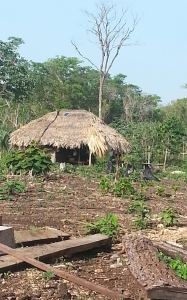
One of the many houses that had solar systems installed in Chilam-balan.
When we first arrived in Chilam-balan with the community engineers, I was shocked by the poverty I saw. I knew this existed. I had been learning about this and had seen pictures of nearly identical scenery from different parts of the globe for the last 6 months through my classes. I had been told stories about these kinds of places since I was a little girl by my mother and my grandmother. Yet even as I observed and walked through this community and installed several solar systems in several households, I still couldn’t believe what I was seeing. None of what I was doing felt “real” until we installed the last house of the day as the last rays of sunlight began to fade away.
At this point, the community engineers, Isabel, and I were exhausted from a hot, humid day full of installations. We still had more houses to install, but the sun was working against us. We hurriedly installed one final house for the day. When we started, the sun had nearly set and with every passing minute, it was getting harder and harder to see. Eventually, I could barely make out the details of the house–only dark figures of objects, people, and animals. But then, someone flipped the switch and the mood immediately shifted. One of the young children of the house screamed, pointing at the light, “Mamí! Mira, mira!” In that moment, not only did a physical bulb turn on, but also a metaphorical one in my mind. Everything we had done that day was finally hitting me and all of the stories my mother and grandmother told me about their lives in Vietnam became more vivid than ever. As soon as we returned to our hotel, I called my mother and told her about Chilam-balan. When I finished telling her my story, I asked her, “Is this how you really lived? Is this how Grandma and her parents lived?” She said yes. We continued to have a lengthy conversation about poverty and human dignity. I knew that I would see poverty firsthand this summer; it was part of the description after all. I just didn’t expect to get a glimpse of my family’s life.
My time in Mexico has been nothing short of surprises and twists and turns. I’m honestly tired of having to pivot, of plans being so up in the air, yet I’m somehow still excited. I’m not as eager or as bright-eyed as I was when we left, and I have absolutely no idea what we will be doing or where we will be for the next three weeks, but I think I still have enough energy for a few more adventures. So here’s to more surprises.