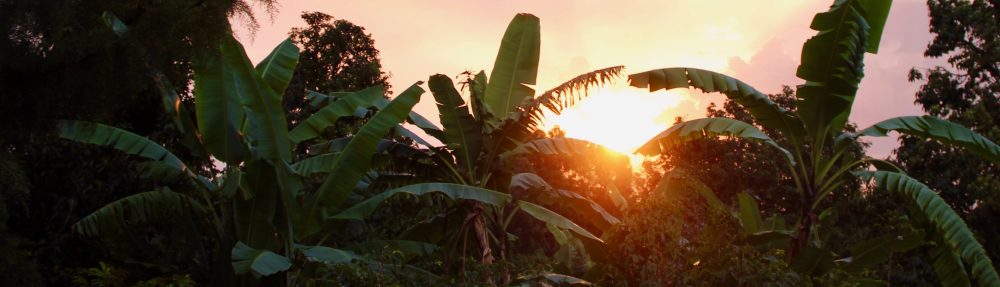
A Journey Just Begun


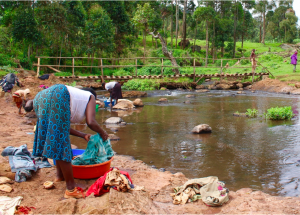
A typical Sunday in Sipi Falls


I remember the day clearly. It was a Monday and Indy and I were driving through Northern Uganda, from Gulu to Lira, on our way to our next school visit. It was the fourth day of our cross-country road trip, and as we drove, I had plenty of time to gaze out the window and try to process my experience in Uganda up until that point. As I was admiring the Ugandan landscape from inside of our van, I found myself fixated on all the boreholes that dotted the communities we passed and the people surrounding each one of them.

These scenes called to mind an interview we conducted with Maya Bretzius, the COO of a water filter enterprise, during our first week in-country. In this interview, Maya was explaining how sales agents educate customers about the enterprise’s products and attempt to, at the very least, convince community members to clean the water they collect from their local borehole.

Maya then explained that when a well or borehole is first tapped, the water is tested and is often found to be safe to drink. Over time, though, animals graze over the land near the borehole and the animal waste (and, in many cases, human waste) seeps into the ground and contaminates the water. Most community members are not aware that the water quality has changed, and continue to drink the water and contract various waterborne illnesses.

Although I was concerned by this potential for contamination when Maya mentioned it during the interview, I did not fully process the implications of the contamination until we were driving through Northern Uganda and I saw how many people rely on water collected from boreholes. I began to wonder how many of the boreholes we passed are contaminated and how many, if any, of the community members are aware that their borehole could be contaminated. I then turned to Indy and asked, “Do you think anyone ever tests the water that is coming out of the boreholes?”

To which Indy replied, “That sounds like a Fulbright idea.”

(Side note: I promised Indy that if I ever finished a Fulbright, I would give him some small note of credit for saying those words to me and sparking the idea for a research project. At the moment I am not planning on applying for a grant so this blog post will have to suffice)
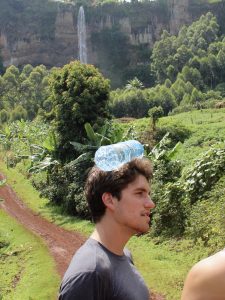
Indy contemplating water quality (probably)


I came to the Global Social Benefit Fellowship out of frustration. In my first blog, I explain how I decided to study civil engineering with a focus in water resources after an immersion trip to Belize during my senior year of high school. It was during that trip that I first came to understand some of the challenges developing countries face in making clean water accessible to all and I felt drawn towards using my own skills and abilities to alleviate those challenges.

However, after almost three years of studying civil engineering and two internships, I could not see how anything I was doing was working towards my ultimate goals. Everything that I had done up until that point had put me on a path towards a very typical entry-level civil engineering job after graduation. If I had learned anything from my internships though, it was that I could not see myself pursuing that type of career in engineering, the type of career that would put me behind a desk and one in which I could not directly work with the end users and beneficiaries of my work. As I began to look for internships for Summer 2017, I felt a wave of frustration driven by my perceived lack of options and a desire to use my talents for something more.
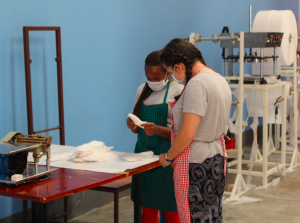
Working directly with social entrepreneurs and TAMTF beneficiaries was my favorite part of our research

Flash forward a few months, and I found myself in Uganda having the time of my life. The and tedium and complacency I had felt at my previous internships seemed to have been washed away and replaced with excitement, enthusiasm, and passion for the research we were conducting for TAMTF. I quickly realized that I loved being able to work on a team in an environment where things were constantly changing and I loved having the ability to take charge of our project. I also found so much satisfaction and joy in meeting all the TAMTF teachers, principals, and students and using their experiences and stories to shape our deliverable.

It was with this excitement and enthusiasm that I found myself seriously considering applying for a Fulbright so I could come back to Uganda and conduct research again. Without going into too much detail, I proposed a research plan to test the quality of water in boreholes across the country, then prepare a comprehensive report that could be presented to governments, NGO’s, aid organizations, etc. in order to outline and draw attention to this water contamination crisis. The proposed plan would allow me to draw upon both my research skills and my engineering skills to work towards improving access to clean water in a developing country as I had always dreamed of doing.

I brought this idea with me to GSBI when I returned to Santa Clara and was fortunate enough to discuss the idea with one of the mentors. This discussion helped me see that reporting the water quality of boreholes in Uganda was not enough to create real change. I needed to go further, the mentor suggested, and consider the how the test results could be used to influence public policy in a concrete way. He then pointed me towards organizations like World Vision and encouraged me to look at World Vision’s Water, Sanitation & Hygiene (WASH) East Africa Programs for inspiration and resources. These types of programs combine water resources engineering and public policy in a way that creates large-scale, countrywide impact with proven success. Suddenly, my dreams, passions, skills, interests, and talents seemed to come together as a new path towards international development work emerged.

I ultimately decided not to pursue a Fulbright grant (at least not right now). However, I chose to discuss my process of considering the grant because it was arguably my most important exercise of vocational discernment. It was through this process that I made two very crucial realizations—first that I ultimately want to work in water resources development, and second, that I need to start my career in development working in civil engineering.
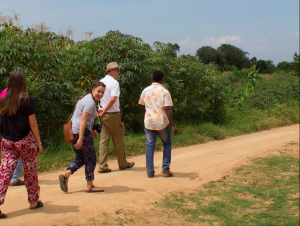

Taking a moment to turn back and smile on my way to Lake Victoria

 “Your career is a journey.

I first heard these words from one of the executives at the Executive Roundtable and I have been repeating them to myself often as I’ve been going through vocational discernment these past several weeks. My career is a journey and my first destination will be working as a water resources engineer. Considering a research plan that required a more technical background helped me realize that my civil engineering degree could be a great asset as I work towards a career in development. The process also helped me realize that even after four years, I still do not possess all the technical skills necessary to conduct such research and/or hold a high-level water resources position. I do not plan to stay in civil for more than a few years, but I can now understand that my engineering education, combined with my GSBF experience, has provided me with exactly the right preparation I need to pursue my dream career.

I can’t help but acknowledge the irony of my decision to go into civil engineering next year. I came into GSBF looking for anything but civil, only to find myself applying for such engineering jobs nine months later.  However, I now see that I wasn’t looking so much for another job title as I was looking for something I could do that would allow me to utilize my skills and passions. GSBF gave me exactly that. In some ways, it feels as if I have simply come full circle since last spring, yet I return to this starting point an entirely different person.

Before GSBF, I never saw myself as the kind of person who could actually achieve the kind of impact I now hope to have and feel as passionate about her career ambitions as I do now. Over the last nine months, I have gained so much more than the skills necessary to complete our action research project and our final deliverable. I have come to understand my own ability to create a positive social impact and developed the confidence to work towards this impact in every step of my career. I may not have found every answer I was looking for, or even fully processed what this fellowship has meant to me, but I leave this fellowship with so much hope for my own future, and utterly filled with gratitude for the experience and everyone at the Miller Center, TAMTF, and Santa Clara who made it possible.


A Voice, A Vocation

Pt. I: Assumptions

“Wow, I really know nothing about Uganda.”

Since I have come back and tried to explain my experience in Uganda, I have heard this over and over from my friends and family. The truth is, though, that neither did I. Despite all the hours I spent researching and learning as much as I possibly could about Uganda’s people, culture, and economy, I still arrived with only a shallow understanding of the country. I could go on about all of the times that I was shocked, confused, delighted, and mesmerized throughout my time in the field, but it was my experience confronting my assumptions about our own research that taught me the most.

Indy and I hard at work during our first day in Kampala

Put very simply, the goal of our research was to identify 2-3 social value products that the TAMTF partner schools could sell as part of their school enterprise programs. There are hundreds of products that could qualify as “social value” products, but the TAMTF employees suggested we focus on researching sanitary pads, alternative cooking fuels, solar lanterns and water filters and understanding schools’ propensity to sell each type of product.

Luckily for us, we had access to a variety of resources throughout Spring Quarter that helped us learn more about the products and the market for them in Uganda. We did our best to keep our minds open about each of the products, but the more we learned the more skeptical we grew about schools’ ability to sell sanitary pads and solar lanterns, in particular. After interviewing the fellows who had worked with Bana last summer, we feared that secondary school students would not be able to successfully sensitize whole communities and end the stigma that surrounds menstruation in many parts of rural Uganda; a stigma that Bana has very effectively trained its saleswomen, or “Champions,” to address when they sell women pads. After interviewing one of the fellows who had previously worked with Solar Sister, we worried that the market for low-cost solar lanterns was totally saturated. Worse yet, many customers have developed an aversion to any products manufactured in China as most, if not all, of the low-cost solar lanterns we came across are.


Pt. II: A Fuller Picture

I have spent a great deal of time thinking about this pre-departure research and the conclusions we drew from it because Indy and I are now preparing a report in which we will recommend that TAMTF partner schools sell exactly the two products that just four months ago we thought would never work. When Indy and I first called Keith from the field and told him that our research had taken this unexpected turn, his first question was, “Well, what happened?”

What happened was that we sat down and had long interviews-turned-conversations with teachers, principals, and social entrepreneurs all over the country who provided us with invaluable information and expertise about the products we were researching. These interviewees, who are truly some of the most awe-inspiring people I have ever met, shared with us personal narratives, experiences, and insights that completely challenged the assumptions we had come in with.

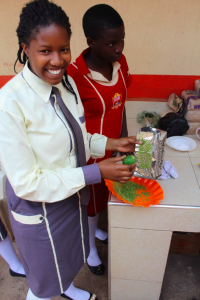
Evelyn, one of Cathy’s students, showing us how she makes donuts for the school’s business

Of all of the interviews we conducted, our interview with Cathy Nakabugo, the lead teacher of the TAMTF program at St. Andrew’s Gombe High School (just outside of Kampala), has resonated with me the most. Cathy is so much more than just a teacher, though. Cathy is currently pursuing a masters degree at a local university, sits on the Uganda Board for Women’s Health and Hygiene (that might not be the exact name, but it’s something close to it), travels to the refugee camps in Northern Uganda to teach refugee women about how and why to use sanitary pads, and works tirelessly to advise arguably the most impressive TAMTF school enterprise program that we observed while in Uganda. It was in this interview that Cathy provided us with a much broader, fuller picture of the sanitary pad market in Uganda. It was through our conversation with her that I began to understand that it is neither stigmas, nor taboos that primarily keep women from purchasing sanitary pads, but a lack of access and affordability.

This is not to suggest that any of the background research that we had done prior to departure was wrong, but instead that studying enterprises like Bana and Ruby Cup provided us a very limited understanding of a very complex issue. We then came to a similar realization in our research of solar lanterns. Although we found that there are, in fact, an abundance of enterprises selling solar lanterns across East Africa, we also found schools in the northernmost regions of the country that were very interested in solar technology, but did not have the ability to communicate this interest to the solar companies located just a few kilometers away in the nearest town.

The more schools and enterprises we visited and the more interviews we conducted, the more it bothered me how misguided we had been about schools’ propensity to sell the two types of products. I was not bothered by the fact that we were wrong, but rather that the Ugandan people are being misrepresented in research papers, case studies, media reports, etc. Again, this is not to suggest that anyone is publishing false information, but that this information does not reflect the needs of all 39 million Ugandans spread across 111 districts in 4 regions, speaking a total of 32 languages.


Pt. III: A Realization 

“Did you ever have an experience of realizing—in a deeper way—that the people in the communities served by these entrepreneurs…are able to speak and act for themselves?”

As I was reading through these guiding questions before sitting down to write this blog, this question struck me. I don’t believe I ever doubted that the people I met, the teachers, principals and students, especially, are able to speak and act for themselves. However, the more that I came to realize how wrong my assumptions about the products were, the more I came to wonder whether it is not the ability to speak and act that the people lack, but the communication channels necessary to amplify their voices and make their needs heard by those trying to help them.

Visiting the school in Arua

For me, this notion that many of the people we met lack not a voice, but a megaphone, was confirmed by one of the principals we met during an interview in Arua, a district of Uganda located just miles south of the border of the DRC. We ran through our typical list of questions about the school’s current operations with her and the lead teacher, then proceeded to explain our research question and ask about the various products. Like several of the interviews we had conducted before, we spent a disproportionate amount of time discussing sanitary pads. For so many of the schools, the need for sanitary pads is so great and so immediate that the teachers wanted to make it very clear to us that they would love for the students to start a sanitary pad business. Still, this principal was the first person to ask us at the end of the interview when they could launch this business. If she could have had it her way, she would have started the pad business that afternoon.

In this moment, I first felt imbued with a new sense of purpose, a new duty to put together the best possible report for TAMTF so that they can get this program off the ground as soon as possible for this principal and so many others who are so desperately in need of affordable pads for their students. I then felt utterly astounded by this woman’s desperate need for sanitary pads in a country where I know affordable sanitary pads exist. During our initial research, we had found multiple enterprises selling both disposable and reusable sanitary pads at a relatively low cost. However, many of the people we met in the North expressed their frustration with their inability to communicate their needs to these enterprises.


Pt. IV: The Return 

After I returned to Santa Clara in August, many people asked me if I was experiencing reverse culture shock. Yes, I said, traffic is too organized, Costco is too massive, and air conditioning suddenly seems like an entirely unnecessary luxury. These were the main things that hit me when I first got back, but the real reverse culture shock didn’t come until I returned to Colorado a few weeks later and finally had the time to process my experience more fully. It was only then that I realized that my understanding of privilege has changed entirely.

I came to realize that privilege goes so far beyond the color of my skin, the wealth I was born into, the education I have received. I am privileged because of what all of these things have given me. I am privileged because unlike so many of the people I met in Uganda, I was born with a voice.

It is from this sense privilege that I am beginning to think about my own vocation. I realize that because was born with a voice, I need to use it on behalf of the voiceless. I was also born with a certain talent to empathize with others and to consider the thoughts, feelings, and needs of others before all else. I wish I could say more about my own vocational discernment, but this is where I am right now. I am still unsure of my next steps, but I carry with me the sense of purpose I gained when I met the principal in Arua and a new determination to create a sustainable, positive social impact going forward.

A candid photo that accurately sums up how I feel about Uganda

Up High and Down Below

When I first walked into the Kampala Yunus Social Business office for a meeting with the Uganda director and partnerships coordinator—a meeting that we were almost late to because the numbering system on the buildings was so complicated that even Google Maps couldn’t save us—I was first taken aback by the view of the city. Nestled on the fourth floor of a large office building, the Yunus employees look out their balcony onto the hills of Northern Kampala. From this point of view, there appears to be a certain order, an organized pattern to the slanted red roofs, the roundabouts in the streets, and the landscaping throughout. As I looked out for a moment, I couldn’t help but think that the view is both breathtaking and deceptive. The Kampala that I have come to know and love in the last five weeks seems to lack any order and pattern.

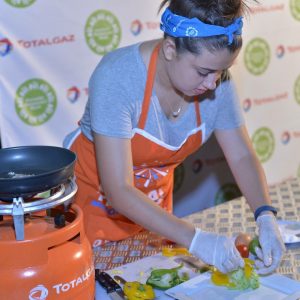
Kampala Restaurant Week cooking competition 

Although I certainly cannot say that I fully understand this city in just five weeks, I have developed a certain appreciation for this organized chaos. There seems to always be something going on in the city, whether it be a spontaneous cooking competition during Kampala Restaurant Week, or a networking event for social entrepreneurs held at a local bar. There have been times in which this all feels completely overwhelming, but for the most part, I have thoroughly enjoyed living in a city with such a diverse scenery and population.


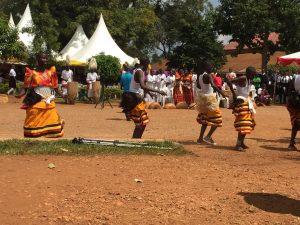
While Indy and I live and work in Kampala near the Teach a Man to Fish (TAMTF) headquarters, our work has taken us all over the country. In our ongoing quest to identify social value products that TAMTF partner schools could sell in their enterprise programs, we have spent our time here interviewing current partner schools and various social enterprises currently selling such products in the Ugandan market. Without a doubt, the school visits have been my favorite part of our project. For our very first school visit at McKay Memorial College, Indy and I found ourselves in the middle of the school’s Bicentennial Celebration with hundreds (if not thousands?) of students, teachers, and community members, in a three-hour long mass, followed by a performance from the student dance troupe.

Dance troupe at McKay College

Looking back on it, it is truly incredible to me how warmly we were welcomed by each and every person we met with that day. When we first walked in, I worried that we may be intruding on a community event and interrupting busy teachers and administrators to ask them questions related to our project while they were trying to supervise and coordinate the big event. To some extent, this was probably true, but not one person made us feel this way. Several teachers and students were eager to talk to us and show off all of the enterprises their TAMTF program has launched in the last few years. They took us to their chicken coop, their farming land, and even toured us around the piggery. It is difficult to put into words, but this day, arguably my favorite this summer thus far, truly captured the spirit of the Ugandan culture and people in the most perfect way.

While these school visits, though most were not quite as eventful as that first one, have been my favorite experiences, the meetings with the social enterprises have been a close second. As we are sitting in these meetings, often across a desk from the enterprise’s founders or COO’s, I find myself thinking that it is one thing to read about these players in the social enterprise movement—the ones who have successfully launched a new enterprise and have achieved a measurable, positive social impact—and an entirely different thing to sit down with them and have them discuss their business with you. I have left each of these meetings inspired by the entrepreneurs’ passion, dedication, and excitement for the work they do and the people whose lives they improve. This is not something that I ever realized was missing from my previous internships working for government water utility agencies, but have since realized interviewing and working with people so devoted to helping others through innovation and entrepreneurship.

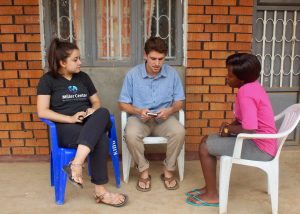
Interviewing one of the Bana Champions during our visit to Mpigi


Although I would like to say that my experience in Uganda thus far has been all piggeries and boda rides, I am beginning to feel as if I am leaving the country soon with more questions and less understanding than I came in with. Specifically, I came in thinking I had a basic understanding of the primary and secondary school system in Uganda and the need for relevant vocational training in these schools that TAMTF hopes to address. With each school visit though, especially the visits to the schools in the Northern region of the country, this understanding is challenged.

I realize now that I came into Uganda with the basic assumption that Ugandans seek primary and secondary education for children for the same reasons that Americans do. While American and Ugandan parents do share many similar priorities in regards to their children’s education, there appears to be a much greater emphasis on teaching practical life skills to young students. For example, the principal of a primary school in peri-urban Mpigi explained to us that he chose to have the students make and sell soap as part of the TAMTF-sponsored enterprise largely because he wanted students to learn how to make soap for their own families and improve their hygiene. Nearly every teacher we met and interviewed in the North expressed similar sentiments regarding their school’s agriculture enterprises, explaining that the earlier students learned to plant and manage crops, the better.

While this realization that parents and teachers place a greater emphasis on the development of practical skills at an earlier age is not particularly surprising when considering that students are not expected to continue onto tertiary education in the same way that American students might be, it changes my perspective on our project. While we aim to identify social value products that will positively impact the community and help design partnerships between existing enterprises who sell these products and TAMTF, I have begun to fear that we could lose focus on the students and their development of practical skills like farming that could ultimately benefit them the most.

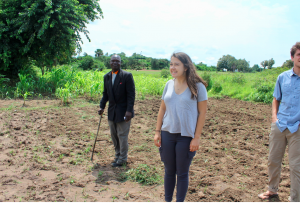
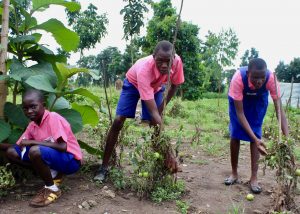
Students tend to tomato plants at a school outside of Dokolo

This was not originally a concern of mine because my experience in primary and secondary school was wholly different than the Ugandan students we have met and visited. When I sold Girl Scout cookies in fourth grade, for example, I did so to raise money for our troop and the organization, not to learn sales and marketing skills as the TAMTF students do in their enterprise programs. I also did not see a major shift in the TAMTF model—from schools choosing their own enterprises to operating the suggested social value product enterprises—as problematic because I was thinking first and foremost about the value lanterns, pads, filters, or briquettes could add to the schools’ communities.

This being said, I still believe in our project—it’s just slightly more complicated now. If schools are to start and operate enterprises selling social value products in a way that allows students to develop necessary practical skills, we must suggest partnerships that provide students with intensive, continuous business training. In many of the schools we have met with, students are taught to manage the enterprise’s finances and are responsible for handling all the money that comes through. This is a practice that must be continued, even if the schools are working with a social enterprise. Furthermore, I developed a new appreciation for the agricultural enterprises during our trip to the North. Although I see why TAMTF has struggled to assist these enterprises, which are often faced with setbacks due to droughts and pests, I believe these programs are extremely beneficial to students in helping their family’s manage their crops. Therefore, I hope we can design partnerships that will allow schools to continue to operate their agriculture businesses as they launch their social value product business.

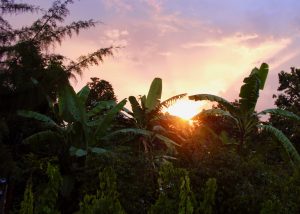
Sunset in Sipi

I still find myself thinking of that view over Kampala from the Yunus office frequently as we travel around Uganda and continue to learn more and more about the country and the people. I believe it acts as a metaphor for what it was like to study and research Uganda before I came. Just like the view of Kampala from four stories up, our project, the educational system, and the country as a whole, made so much more sense before we arrived. That isn’t to say that I don’t love the view from the ground and the challenge that comes with navigating the various streets and systems in place here, only that it is more than I expected. Understanding the complexities of the existing infrastructure and social equilibriums, however, is as perplexing as it is exciting. I may come back to GSBI with more questions than answers, but I also return with the desire to return to Uganda one day and find answers to these questions. I am beginning to feel as if GSBF is just the first step in a much longer journey and I am anxious to see what is ahead.


A little bit about me

“I’ll never forget where I am from–it is essential to remaining humble and evolving” -Frieda Pinto

Growing up in the desert has its advantages and disadvantages. The greatest disadvantage being, of course, the hot, arid climate and a summer that seems to last for half the year. However, spending the first 14 years of my life in Phoenix, Arizona, nested in the heart Sonoran Desert, was one of my greatest blessings. First, being surrounded on all sides by a desert landscape taught me to find beauty in the most unlikely of places—where others see a dusty, dry expanse, I see swaths of land dotted with saguaros, prickly pears, and other cacti that bloom with the most beautiful flowers every spring. I see the most brilliant orange, red and purple sunsets every evening, and listen for the rhythmic chirp of the cicadas throughout each summer night. Growing up in Phoenix taught me to seek out this beauty, and I have carried this skill with me always. More importantly, though, growing up in Phoenix allowed me to grow up just miles away from my grandparents.

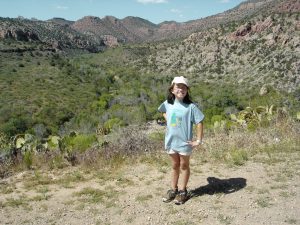
Exploring near my home in Phoenix, circa 2002

I would not be the person I am today without the influence of my grandparents throughout my formative years. Not only have my grandparents generously supported many of my endeavors, but they have also been two of my greatest role models. My earliest experiences volunteering were alongside my mother and grandmother, feeding the homeless at a local shelter. During these hours I spent volunteering, I witnessed my grandmother graciously serve others, with the kindest of eyes, simply because it was the right thing to do. She seemed to see no difference between serving strangers dinner at the shelter and serving my brother and I breakfast on Christmas morning. From these experiences, I learned the importance of both taking the time to serve others, and of treating anyone, especially those I serve, with dignity and respect.

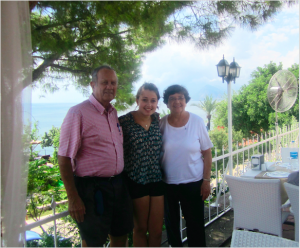
My grandparents and I in Turkey in 2014

In addition to this dedication and passion for service, my grandparents both also imparted in me a spirit for adventure. As two of the most well-traveled people I know, my grandparents filled my young mind with stories of their adventures around the world. Through tales and pictures of them travelling to highest steps of Machu Picchu to the greatest cathedrals in Europe, my grandparents have constantly impressed upon me the importance of travelling. They have shown me that there are no lessons, either in books or in the classroom, greater than those one learns by travelling to a new place, meeting new people, and seeing things entirely different from those they could find in their own home.

If it was my grandparents who imparted in me the desire travel, I owe my curiosity and my independence to my parents. When we weren’t at home or in school, my parents were taking my brother and I on extended camping trips to learn about and experience nature first hand. These trips were not only opportunities for us to spend time together as a family but also to gain a certain sense of confidence, humility and independence that I believe can only be gained by spending extended periods of time outside. If there is one thing I could thank my parents for above all else, it would be for teaching me to love nature and all it has to offer. Never have I felt so humbled as I did sitting in the dry lake bed of Boulder Lake in Colorado at sunset after a long day of backpacking, and never have I felt more accomplished than I did while climbing to the peak of Black Butte in Oregon for the first time when I was just 7 or 8 years old. I believe I have valued these experiences in nature so much because as I have grown up, experienced failures and successes, made decisions large and small, and moved farther and farther away from home, I know that I need only to find myself in nature to find myself in a place I know I belong.

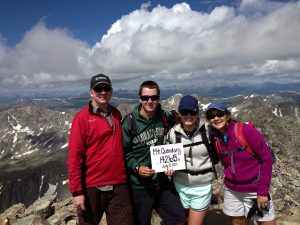
My parents, brother and I hiking in Colorado

I chose to discuss these personal qualities and skills I’ve developed throughout my life because these are the qualities and skills that ultimately led me to decide to travel to the southern tip of Belize my senior year of high school. Although I did not realize it at the time, this trip was a major turning point in my life and has influenced countless decisions I have made since.

My high school in Colorado (where I moved shortly after I finished middle school) has an established relationship with the Punta Gorda community, a town located in the most impoverished area of Belize. It was here that several of my classmates and I were fortunate  enough to spend a couple of weeks working with the elementary school and meeting locals. Going into the experience, I am still not sure what exactly I was expecting. In the end though, Punta Gorda was entirely different than I could have ever imagined and the Belizean people I met and interacted with permanently shifted my worldview.

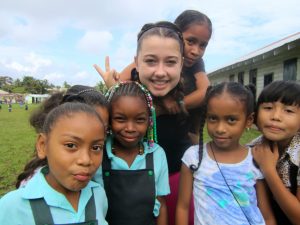
Spending time with the school kids one afternoon in Punta Gorda

Although most of my trip to Belize is something of a blur, I can most vividly remember my bus ride out of the small town on our last day of the trip. It was on this six-hour bus ride that I complete reexamined my place in the world. The poverty I witnessed in Belize was nothing like the poverty I had witnessed in the homeless shelters in downtown Phoenix. This kind of poverty was long-term, systemic, and more complicated than I anticipated. I think that going into Belize, I hoped that my time there would reveal some possible explanation of poverty that I could actively have a role in solving, but what I found was the opposite. I remember sitting in one of the back rows of the old school bus and asking myself over and over, why? Why weren’t things getting better even with outside intervention? What things were lacking in the system that prevented the system from improving? Why was I sent there to witness it?

Ultimately, I found that I kept going back to the fact that in one of the towns we had visited outside of Punta Gorda, the residents had very limited access to clean water. I just couldn’t possibly understand how people were ever to make progress and lift themselves out of poverty if they did not have access to such a basic resource. At this point in senior year, I was already leaning towards studying engineering of some sort in college because I had always excelled in math and science, but it was in this moment that I decided that I needed to study whatever engineering could teach me to design clean water systems. It was in this moment that I decided to study Civil Engineering, with a concentration in Water Resources Engineering, a degree that I am currently on track to finish next year. I made this decision because I realized that although poverty is so, so much greater than any one person, I have a duty to do my part to help eradicate it.

I sit here now more than three years after my return from Belize, still contemplating the lessons I learned during my time there and the impact on the world I hope to one day have. My major is challenging, and often frustrating, but I am still dedicated to completing my degree and I still hope to use what I have learned to design structures and systems for those who need them the most. Earlier this year though, I began to feel as if I was losing focus of my original goal of working to end poverty through engineering. I began to feel as if my education up until this point has been so focused on high-level math and complicated structural calculations that I have not had time to think about how I will use all this knowledge for a greater good.

It was this thought that inspired me to apply to the Global Social Benefit Fellowship. Although I realize that my work will not directly relate to engineering, I am looking forward to taking an in-depth look at social enterprises and how the work of social entrepreneurs has helped developing communities all over the world. And, although I may not be performing any engineering work for this fellowship, I am more than confident that the skills I will develop over the next nine months will prepare me for what lies ahead, whatever that may be. Really, I am again unsure what the next nine months will bring, but I am coming into this experience as I approach all of the opportunities I have had—hoping only have some sort of positive impact and learn as much as possible along the way.

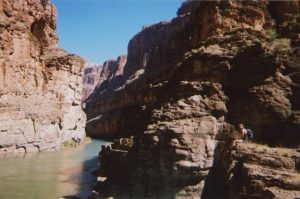
Hiking near the Grand Canyon last spring