Pt. I: Assumptions
“Wow, I really know nothing about Uganda.”
Since I have come back and tried to explain my experience in Uganda, I have heard this over and over from my friends and family. The truth is, though, that neither did I. Despite all the hours I spent researching and learning as much as I possibly could about Uganda’s people, culture, and economy, I still arrived with only a shallow understanding of the country. I could go on about all of the times that I was shocked, confused, delighted, and mesmerized throughout my time in the field, but it was my experience confronting my assumptions about our own research that taught me the most.
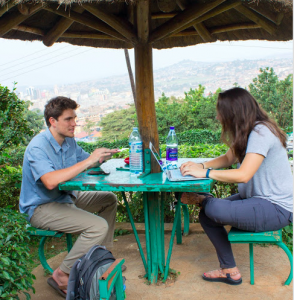
Indy and I hard at work during our first day in Kampala
Put very simply, the goal of our research was to identify 2-3 social value products that the TAMTF partner schools could sell as part of their school enterprise programs. There are hundreds of products that could qualify as “social value” products, but the TAMTF employees suggested we focus on researching sanitary pads, alternative cooking fuels, solar lanterns and water filters and understanding schools’ propensity to sell each type of product.
Luckily for us, we had access to a variety of resources throughout Spring Quarter that helped us learn more about the products and the market for them in Uganda. We did our best to keep our minds open about each of the products, but the more we learned the more skeptical we grew about schools’ ability to sell sanitary pads and solar lanterns, in particular. After interviewing the fellows who had worked with Bana last summer, we feared that secondary school students would not be able to successfully sensitize whole communities and end the stigma that surrounds menstruation in many parts of rural Uganda; a stigma that Bana has very effectively trained its saleswomen, or “Champions,” to address when they sell women pads. After interviewing one of the fellows who had previously worked with Solar Sister, we worried that the market for low-cost solar lanterns was totally saturated. Worse yet, many customers have developed an aversion to any products manufactured in China as most, if not all, of the low-cost solar lanterns we came across are.
Pt. II: A Fuller Picture
I have spent a great deal of time thinking about this pre-departure research and the conclusions we drew from it because Indy and I are now preparing a report in which we will recommend that TAMTF partner schools sell exactly the two products that just four months ago we thought would never work. When Indy and I first called Keith from the field and told him that our research had taken this unexpected turn, his first question was, “Well, what happened?”
What happened was that we sat down and had long interviews-turned-conversations with teachers, principals, and social entrepreneurs all over the country who provided us with invaluable information and expertise about the products we were researching. These interviewees, who are truly some of the most awe-inspiring people I have ever met, shared with us personal narratives, experiences, and insights that completely challenged the assumptions we had come in with.
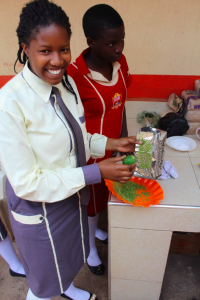
Evelyn, one of Cathy’s students, showing us how she makes donuts for the school’s business
Of all of the interviews we conducted, our interview with Cathy Nakabugo, the lead teacher of the TAMTF program at St. Andrew’s Gombe High School (just outside of Kampala), has resonated with me the most. Cathy is so much more than just a teacher, though. Cathy is currently pursuing a masters degree at a local university, sits on the Uganda Board for Women’s Health and Hygiene (that might not be the exact name, but it’s something close to it), travels to the refugee camps in Northern Uganda to teach refugee women about how and why to use sanitary pads, and works tirelessly to advise arguably the most impressive TAMTF school enterprise program that we observed while in Uganda. It was in this interview that Cathy provided us with a much broader, fuller picture of the sanitary pad market in Uganda. It was through our conversation with her that I began to understand that it is neither stigmas, nor taboos that primarily keep women from purchasing sanitary pads, but a lack of access and affordability.
This is not to suggest that any of the background research that we had done prior to departure was wrong, but instead that studying enterprises like Bana and Ruby Cup provided us a very limited understanding of a very complex issue. We then came to a similar realization in our research of solar lanterns. Although we found that there are, in fact, an abundance of enterprises selling solar lanterns across East Africa, we also found schools in the northernmost regions of the country that were very interested in solar technology, but did not have the ability to communicate this interest to the solar companies located just a few kilometers away in the nearest town.
The more schools and enterprises we visited and the more interviews we conducted, the more it bothered me how misguided we had been about schools’ propensity to sell the two types of products. I was not bothered by the fact that we were wrong, but rather that the Ugandan people are being misrepresented in research papers, case studies, media reports, etc. Again, this is not to suggest that anyone is publishing false information, but that this information does not reflect the needs of all 39 million Ugandans spread across 111 districts in 4 regions, speaking a total of 32 languages.
Pt. III: A Realization
“Did you ever have an experience of realizing—in a deeper way—that the people in the communities served by these entrepreneurs…are able to speak and act for themselves?”
As I was reading through these guiding questions before sitting down to write this blog, this question struck me. I don’t believe I ever doubted that the people I met, the teachers, principals and students, especially, are able to speak and act for themselves. However, the more that I came to realize how wrong my assumptions about the products were, the more I came to wonder whether it is not the ability to speak and act that the people lack, but the communication channels necessary to amplify their voices and make their needs heard by those trying to help them.
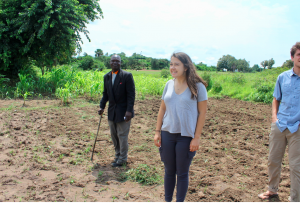
Visiting the school in Arua
For me, this notion that many of the people we met lack not a voice, but a megaphone, was confirmed by one of the principals we met during an interview in Arua, a district of Uganda located just miles south of the border of the DRC. We ran through our typical list of questions about the school’s current operations with her and the lead teacher, then proceeded to explain our research question and ask about the various products. Like several of the interviews we had conducted before, we spent a disproportionate amount of time discussing sanitary pads. For so many of the schools, the need for sanitary pads is so great and so immediate that the teachers wanted to make it very clear to us that they would love for the students to start a sanitary pad business. Still, this principal was the first person to ask us at the end of the interview when they could launch this business. If she could have had it her way, she would have started the pad business that afternoon.
In this moment, I first felt imbued with a new sense of purpose, a new duty to put together the best possible report for TAMTF so that they can get this program off the ground as soon as possible for this principal and so many others who are so desperately in need of affordable pads for their students. I then felt utterly astounded by this woman’s desperate need for sanitary pads in a country where I know affordable sanitary pads exist. During our initial research, we had found multiple enterprises selling both disposable and reusable sanitary pads at a relatively low cost. However, many of the people we met in the North expressed their frustration with their inability to communicate their needs to these enterprises.
Pt. IV: The Return
After I returned to Santa Clara in August, many people asked me if I was experiencing reverse culture shock. Yes, I said, traffic is too organized, Costco is too massive, and air conditioning suddenly seems like an entirely unnecessary luxury. These were the main things that hit me when I first got back, but the real reverse culture shock didn’t come until I returned to Colorado a few weeks later and finally had the time to process my experience more fully. It was only then that I realized that my understanding of privilege has changed entirely.
I came to realize that privilege goes so far beyond the color of my skin, the wealth I was born into, the education I have received. I am privileged because of what all of these things have given me. I am privileged because unlike so many of the people I met in Uganda, I was born with a voice.
It is from this sense privilege that I am beginning to think about my own vocation. I realize that because was born with a voice, I need to use it on behalf of the voiceless. I was also born with a certain talent to empathize with others and to consider the thoughts, feelings, and needs of others before all else. I wish I could say more about my own vocational discernment, but this is where I am right now. I am still unsure of my next steps, but I carry with me the sense of purpose I gained when I met the principal in Arua and a new determination to create a sustainable, positive social impact going forward.

A candid photo that accurately sums up how I feel about Uganda