
Technology, women, and empowerment – the trifecta I once explored through the Physettes at Liberty High School rang true over eight thousand miles away in Kampala, Uganda. It’s there that Mary, Zaina, and Evelyn, along with nearly 200 other women, united as Solar Sisters, manage an organization bringing “light, hope, and opportunity” to women of rural Uganda through the “last-mile” distribution of solar products. The Physettes studied solar power as a way of reducing electricity bills and decreasing the carbon footprint of our high school – this summer I met Solar Sisters who use the savings from switching from kerosene to solar power to pay educational fees required to send their daughters to school in addition to their sons.
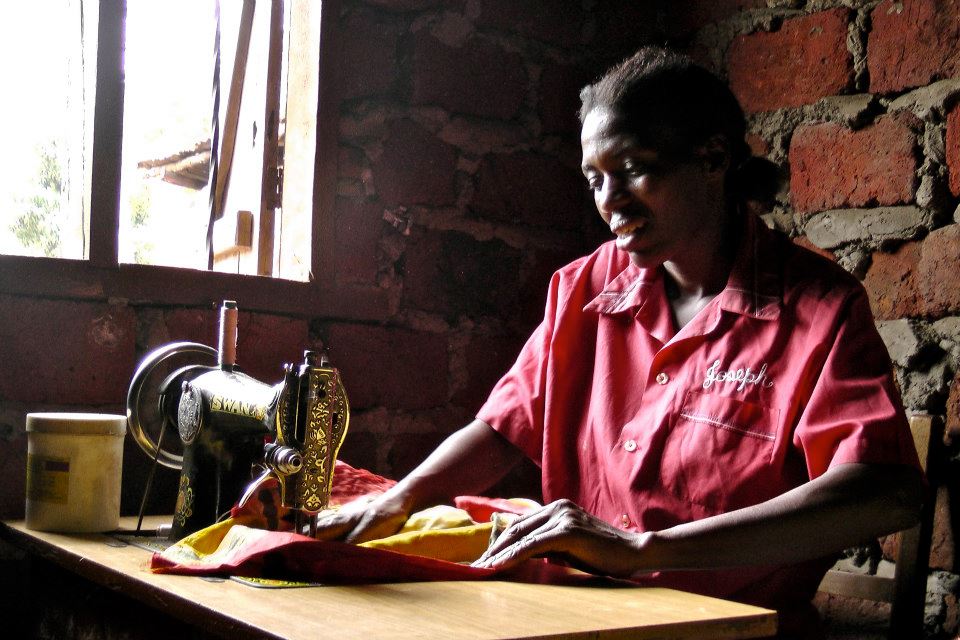
Teddy working on her alterations
I want to share a story about Teddy, a single mother of five girls who makes a living with her alterations business. Every night after the sun sets (we learned very quickly that dark is DARK in rural Uganda) she would walk a long distance into town to rent a hotel room with intermittent electricity in order to finish her sewing, which is costly in terms of time and money, not to mention dangerous. Now she has a Barefoot Power solar lighting system purchased from the Solar Sisters. She does not have to make those long walks at night to the rented room ever again since she can do her sewing at home. As a result she saves money, which goes to her daughters’ school fees.
As I near the completion of a Bachelor’s degree in electrical engineering, I realize education is not something to take for granted. In classes I learn the physics of semiconductors, study the spectrum of the sun, and characterize solar cells; a fairly deep understanding of solar technologies in some models of engineering, but the technical is not the whole picture. The philosopher Will Durant once remarked “we live in a specialized world where it is good to know more and more about less and less.” Fortunately this is not the case at at Santa Clara University where cross-communication of disciplines is the norm and students are encouraged to reach beyond the boundaries of areas of expertise. This is precisely what the Global Social Benefit Fellowship has done for me – helped me to connect my technical background with applications in the developing world.
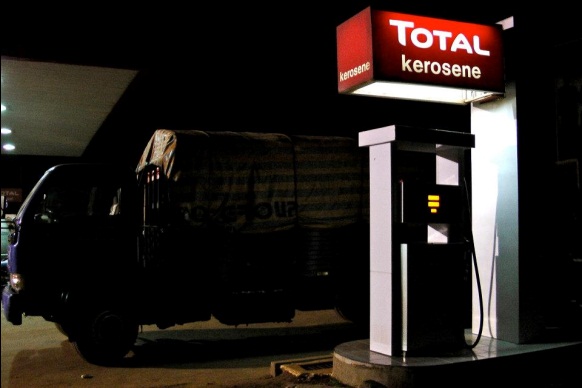
The kerosene pump where Gottery works in Gulu
In Gulu we met Gottery, an attendant at a kerosene pump who due to her asthma uses battery powered lights instead of kerosene. These lights have low-quality batteries which are replaced every three days to corrode in the environment. She expressed interest adopting solar into her household. In this situation, “thinking like an engineer” takes on a new component of breadth, one where the technical interacts with the social. Understanding the technical challenge of designing a product, and the specific needs of the customer – knowing the health advantages of solar, the payment methods for affordability, the long-term cost efficiency without the regular expenditure of batteries. This is where Solar Sister comes in – the technologies have been developed, by other social enterprises specializing in manufacturing, and Solar Sister entrepreneurs are trained to assess the end user’s energy needs and price point to suggest the ideal product.
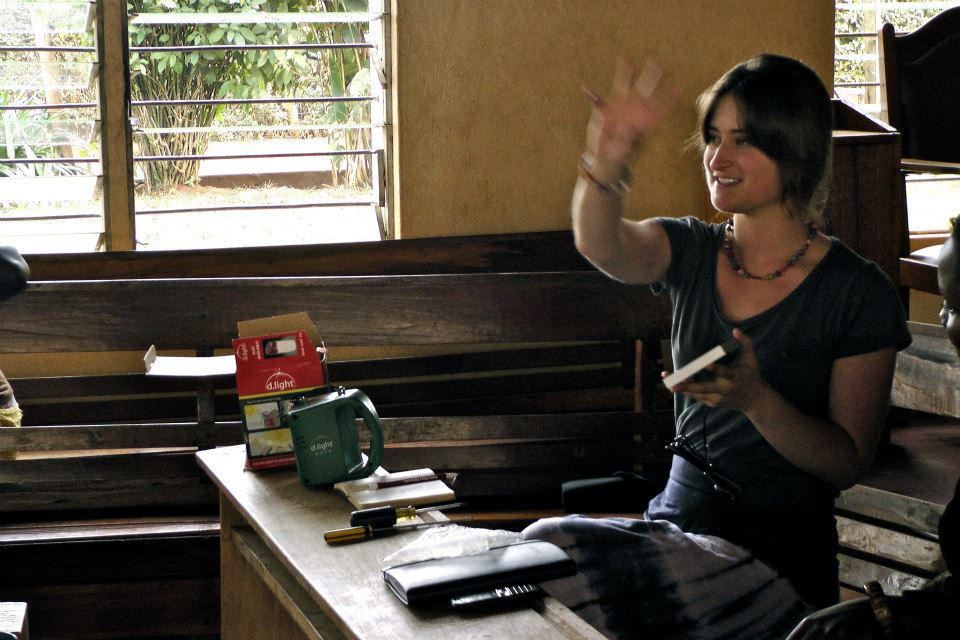
At the training session
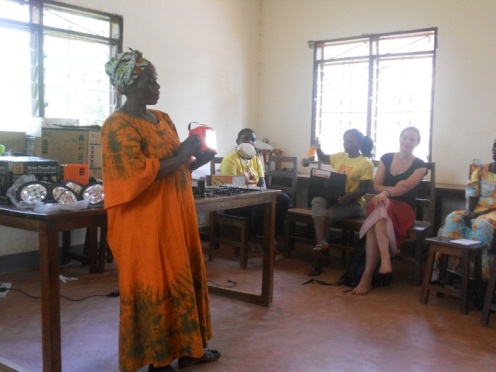
A new Solar Sister explaining a solar lantern
At the training sessions we attended, the women were interested in how these things work – and I found approaching the products like a circuit is very accessible. The panel connects to the battery which connects to the light or cellphone. The trainees wanted to take things apart – a hallmark characteristic of any engineer! At the training meetings women asked what to do if a battery dies, how to change it. The Solar Sisters are electing to learn more by collaborating, sharing best practices at meetings, and attending monthly training sessions, with new topics at each. The drive behind the Solar Sisters is of the same origin that I see behind the women scientists and engineers in our own school of engineering, and this is exciting.
Uganda is leapfrogging the United States in some sense – with Solar Sister’s focus on distributed power, increased adoption may prove an electrical grid obsolete. We met with the Rural Electrification Agency, however, and what stuck out to me the most from that conversation is how confused I was when the representative did not understand my question regarding the adoption of renewable energy sources vs. grid extension – I soon was informed that grid extension IS supporting renewable energy efforts as the grid in Uganda is run off of hydro-power – no coal plants here. That had not crossed my mind prior to sitting in the office of a government official in Uganda. Here I have been conditioned to associate the grid with non-renewable energy sources.
On one of our final days we visited the Nsamizi Center for Solar Devices in Mpigi to meet the students and teacher of Energy Made in Uganda. One particular girl – a college student studying Physics at a local university – demonstrated what appeared to be an inadvertent cross-cultural project in the form of a solar lantern. The solar panel, the LED, were all of western influence. The casing however, dried woven banana leaves in a wrapped cord-like fashion which she wove herself, looked traditionally Ugandan. She said she had been weaving as long as she could remember. This synthesis of cultures shows how ideas can be proposed and adapted, shared and improved upon. It was a beautiful light and in it I saw social benefit, a dialogue of cultures, and the power of the synthesis of women and technology
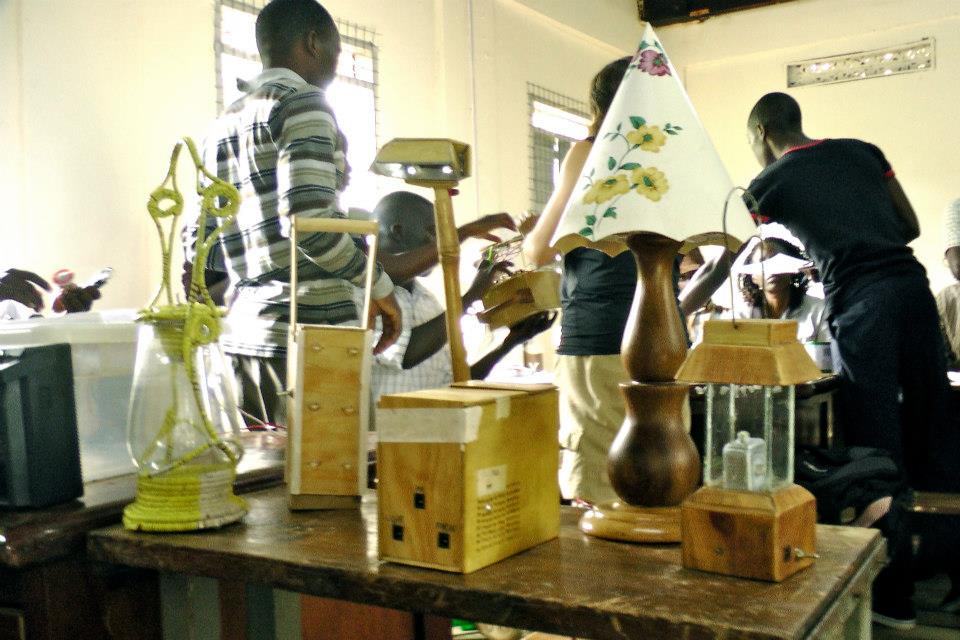
Solar charged lanterns made in Uganda
.