I grew up a Pacific Northwesterner with evergreen trees and the waters of Puget Sound close to my heart. I climbed trees by our cabin on Harstine Island,WA and walked through forests with my family, often trailed by our adventurous cat, Patches. “Home” for us moved several times, however, and Ispent a significant portion of my life in both Northern and Southern California and my mom always made a point of discovering all of the national parks and natural places of beauty along the way.
At 6 my life plan was to become a professional artist or professional soccer player; the latter plan abruptly ended with a move to Sacremento and practices took place in 100 degree weather. Perhaps as an alternate hobby I took up the clarinet. In middle school our second move, to Claremont, CA, strategically occurred just before a marching band playing test I was not even remotely prepared for. The clarinet days were over, unknowingly to open the door for what would become my first love; the bass. I picked up an electric bass in my freshman year of high school and from thereonout playing the bass brought me more joy that any other activity ever had. My band director encouraged me to join the ensembles and in a span of two years I learned to play not only the classic rock hits in the high school “garage band” but expanded into jazz and,after 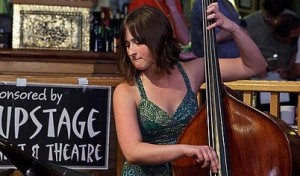 breaking into the world of the upright bass, classical and afrio-cuban music followed. Music became a vehicle through which I explored other peoples and cultures, from the hippie folk-music lifestyles I experienced in Darrington, WA to the traditional Cuban musicians of the the Buena Vista Social Club whose virtuosity I could only appreciate through documentary and recordings. One particular email from my orchestra director, however, opened my eyes to the social change possibilities inspired by music. The email contained a YouTube video about the Venezualean National Youth Orchestra and its transformative presence in the lives of at risk youths, and the effect of providing instruments for the students who could not afford them, thus making classical music accessible for any economic level.
My senior year I took Honors Physics. There were eight girls in a class of forty. With the help of one of my fellow physics comrades, we started a club, the Physettes, for all of the girls interested in the sciences and math. While we may have been content to going to Starbucks and doing physics homework together, we were fortunate to have the vision of our Honors Physics teacher as an advisor and mentor who proposed two goals for our inogural year; a three day trip by the name of AWGE, Astronomy Waves Gravitation & Energy, and participation in the Cool School’s challenge, a student-run energy audit of our high school complete with carbon-reducing and electricity bill-reducing suggestions. 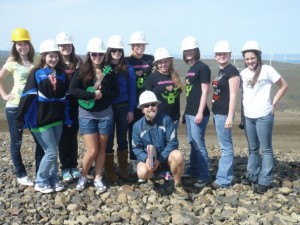 During the AWGE trip we visited LIGO, the Wild Horse Wind and Solar Facility, and the Tri-City Astronomy Club. Getting out to the Wind and Solar facility and standing amongst vast solar arrays and wind turbine fields I knew I wanted to be involved with that somehow. That exposure, paired with the comradery of fellow females in the sciences lead me to two conclusions, I wanted to be involved with renewable energy and I never wanted to give up the supportive community of women in the sciences.
Electrical engineering was, rather by chance, chosen as my path to renewable energy and Santa Clara University was decidedly my place to do it, inspired by its Solar Decathlon, the ability to participate in music ensembles as a non-major, and the overall inclusive and compassionate atmosphere. I sought out the Santa Clara University Society of Women Engineers section an thereafter became actively involved in it, forever holding the belief that women + technology = empowerment. 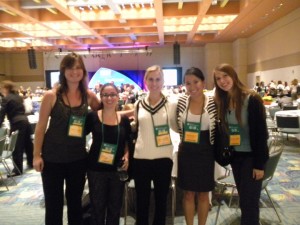 Contrary to my engineering theme, I took a course focused on ethnomusicology and continued to discover the magnitude of knowledge one can gain about a culture from their music and it was in this class I first heard the traditional Marimba music of Uganda. At the time I craved a connection to keep music and social change on my radar. The first year or so of engineering can be rather dry and methodical, and to be honest I occasionally lost sight of the bigger picture of why I was doing it. I took Spirituality and Sustainability and first learned the concept of vocation and how my skills in electrical engineering ARE needed, and that there is an ability to provide my skills as a resource for those in need. This notion, especially in times where the math and science abilities were not coming so easily for me, motivated me immensely. Shortly after, the weekend I spent with We Care Solar set my sights on the developing world. Through their workshop, “Stand Alone Solar Electricity for the Developing World,” I got the chance to build Solar Suitcases, a suitcase-sized solar module with an LED lamp designed for use by midwives in northern Nigerian maternal health clinics. That weekend I witnessed engineering with a purpose first-hand. It was clear; through attainable skills of significant interest to me, I could make a difference. I wanted in on this industry.
Immediately following, my goal was to immerse myself in renewable energy and sustainability and put my knowledge into action. The summer after my sophomore year I studied abroad in Copenhagen, Denmark. I focused on Scandinavian energy systems and sustainable technologies, gaining an international perspective on the workings of sustainable industry as well as the political and economic implications. Visiting local communities, however, was the greatest learning experience. Perhaps most unique was the time I spent in a municipality by the name of Hyldespjældet in Albertslund, Denmark, where the 800 residents have, from a grassroots level, introduced countless ecological innovations contributing to resource conservation and one of the strongest senses of community I haves experienced.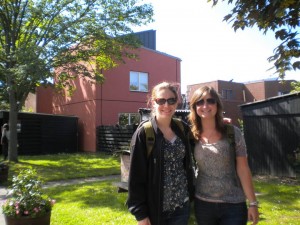 It was interesting to learn that just twenty years prior, Hyldespjældet was considered a “problem” neighborhood. They started with adding a hen yard, later a very elaborate recycling and reusing yard, then compost containers were added, clothes swap shop opened, an organic vegetable garden grew along with a community kitchen, and a plethora of energy efficiency changes took place including the installation of thermoplane glazed windows. It was a remarkable combination of social, economic, and environmental benefit. For the people I met during my stay in Copenhagen, sustainable practices just seemed second nature, from personal choices like biking instead of driving to governmental decisions like installing District Heating.
Now in my junior year, while I have no concrete plans, I can see my vocation unveiling from my passion for sustainable technologies which will hopefully contribute to a lasting positive impact in the lives of others and the state of our world. I owe much credit to those who have influenced and encouraged me along the way as well as to the chance opportunities made available to me.