A Future in Education

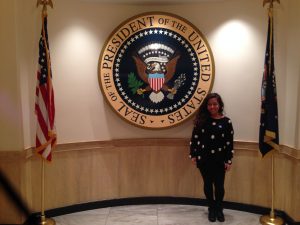
When I was in high school and would think about my future, I always thought I would work abroad or in D.C.  I wanted to save the world, or at least our country, but before beginning the fellowship, we watched a video about the ethics of international volunteerism,  “An African’s Message for America” by Cassandra Herrman.  In this video, Kenyan activist, Boniface Mwangi asks “Why don’t you start local before you go international?”

This question hit me hard.  I couldn’t quite name why I wanted to go abroad, I just knew I liked to travel and meet new people and cultures.  After some thought, I didn’t view his question as an outright criticism of international work; however, it is a question we need to ask ourselves as we navigate our vocational path. Why do we feel called to work internationally rather than domestically?  

As humans, I believe we have an obligation to help those living in poverty and unjust systems, but we must also be critical of the methods in which we choose to help others.  Will we truly listen to those who we aim to help?  Will we help give agency to our intended beneficiaries?  As I learned about social entrepreneurship, I felt that it was an approach that does these things.  Social entrepreneurship disrupts unjust systems, by listening and empowering those in poverty.  It believes that those at the base of the pyramid are fully capable of participating in the market and aims to include them.  Although I personally do not feel called to entrepreneurship, I found truth in this approach.    
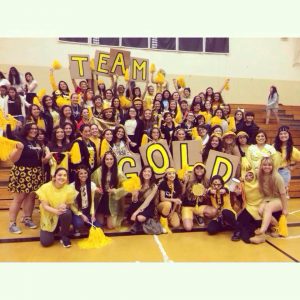
 

Ramona Convent Secondary School: One of the places that taught me to love learning and social justice

All my life, I have loved school.  I have parents who did whatever they could and provided everything I needed to do well in school.  I was motivated to do well, because I knew it would pay off, and I knew the sacrifices my parents and grandparents had made to get me to that point.  I had amazing teachers who believed in me, and my friends and I motivated each other.  I know this is not the case for everyone.  For some, school is a miserable experience.  There are different social, economic, and political factors that influence the education a child is able to receive.  I want to bring down these boundaries to ensure that every child is educated fully and that the whole child is educated, not just those aspects that can be shown through test scores.  I believe that the entrepreneurial approach is one way of achieving this.  By accepting that all children, regardless of color, socioeconomic status, language abilities, or academic performance can participate meaningfully in the school setting, we can begin to break down the boundaries that prevent students from learning.  

I’ve thought of different ways I can best advocate for children and their education.  I considered educational law, teaching, and school administration.  In fact, I am still exploring these paths.  Through my experience in the fellowship, I have learned how important it is to truly understand the cause you are fighting for and how important it is to be a good listener and observer.  I have decided that the best way to be an advocate for students is to teach, at least at first.  I know that later I will be called to advocate for students legally or through administrative roles in schools, or even at the state level.  I want to “disrupt the system,” but first I need to experience for myself, in the classroom, what students, educators, and parents face.  

Addressing the question of working domestically or internationally, I know that there are children, and especially girls, that need a quality education in different parts of the world, but I feel that I am called to do work here, at home.  I want to erase the myth that English-language learners, low-performing students, and poor communities are a burden on the educational system.  Educating all students reduces poverty, crime, and incarceration.  Besides the beneficial effects on society, it is a right all students have under law, one that I don’t feel is currently being fully upheld.  
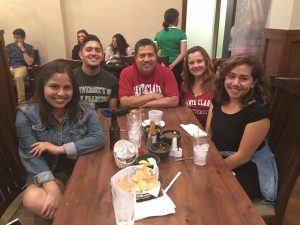
My family, featuring my parents proudly wearing their SCU t-shirts

One reason I feel called to work in California, and especially Los Angeles, is my family.  For me, family has always been number one.  Although I love traveling and experiencing other cultures, I also know how much family means to me.  Being away for a while, even months is fine, but I don’t like the idea of a permanent or even semi-permanent responsibility keeping me from responsibilities at home.  When I came to this realization, at first I felt disappointed with myself.  I have always considered myself an independent person.  Since high school, I’ve taken every opportunity to get out and see something new, and although I have cherished each and everyone of these experiences, a long-term obligation away from home doesn’t seem right.   I know that I can be successful on my own, it’s what I’ve been doing for the past three years at SCU.  I know that my family can survive without me, too, but part of what I have learned through the fellowship is that self-awareness is key and vocation is not just about a job.  For me, family is a part of my vocation.  
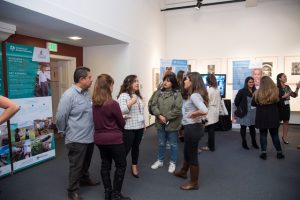
Explaining my research to my parents and sorority sisters

Another reason I have decided to stay in California is the specific community I wish to serve.  As the granddaughter of Mexican immigrants, I’ve always held my culture as a huge part of my identity, but my time with Sistema Biobolsa and interacting with people in Mexico City helped me realize that I don’t know everything about Mexico.  What I do understand more fully is the Mexican-American experience, especially inter-generationally.  My time in college has also made me aware of different experiences I previously knew nothing about.  I know that my background and interactions with others from diverse backgrounds can help me be a sensitive and culturally competent educator.  

I know that I started off by saying that I used to want to “save the world.”  Although I no longer have aspirations to be president of the United States or single-handedly cure world hunger, the fellowship has revived in me that “heroic ambition” we read about in Chris Lowney’s Heroic Leadership.  The fellowship has reminded me that there are different ways to make an impact.  In high school and college, I started to stray from pursuing teaching and education because people told me I was “too smart” to be a teacher and there were more prestigious and higher paying jobs.  (I now realize that none of the people telling me this were teachers.)  Through self-awareness, I have realized that I don’t care too much about money or prestige.  As a teacher, I will have the power to make sure our future is educated and compassionate.  To me, that sounds like just what the world needs right now.
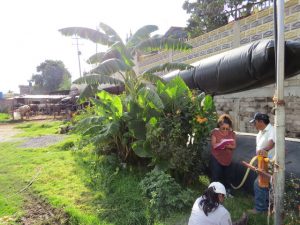
Lessons from the Field

When we speak about those living in poverty or in less developed areas, I think it is easy to fall into this idea that those living in poverty need charity or “saving.” Charity and donations do have a time and place, but they’re not the only answers and often, not the best answers. Rarely do we think about the poor as being able to participate as consumers in the market. Views range from “the poor need to work harder” to “the poor need charity.” Rarely do we think about the role that some businesses have in marginalizing communities and the responsibility and ability that all businesses have to empower consumers. In working with Sistema Biobolsa, I came to realize that they took this responsibility seriously and fully utilized resources to try to reach more customers that could benefit from their biodigesters.

One of the ways that Sistema Biobolsa recognizes their customers as being able to speak and act for themselves is through valuing their ingenuity. One of the questions in a monitoring visit survey asks about possible improvements they might have made to their systems. This question recognizes that the customers might have made improvements that no one else has thought of, improvements that could help Sistema Biobolsa serve other customers better. I observed this firsthand at the farm of a customer in Tlaxcala. Most customers use flexible plastic tubs provided by Sistema Biobolsa for a manure feeding area into the biodigester and another for collecting the fertilizer that the biodigester produces. This man instead build cement basins and added an electric mixer at the manure feeding side to better mix the manure and water before it was fed into the biodigester. He commented that this allowed the system to work more efficiently and produce more biogas.

This kind of improvement to the system can be costly and some customers might not be able to afford it, but what we learned is that he was able to receive a grant from a third-party to make these improvements. Usually, farmers are limited to one grant per farm, but when grantees saw that he also put as much of his own resources into his projects as he could, they were impressed by the improvements he was able to make. Since then, he had received funding for various other projects.

As I interacted with customers in the field, I tried to engage in a way that was appropriate and sensitive. It was hard to know exactly how I should act, but I focused on being a good listener. I took everything that they were willing to share with me and valued the time they gave me. I was honest about the goals of our interviews and how information would be used and was sure to show my appreciation for their time.

As I engaged with customers, I tried to be aware of my privileges. I had privileges simply because of where I was from. As students from the U.S., people listened to Katie and me. They were interested in what we were doing and what we had to say. I also had privilege because of my relative wealth. Some things that I own or want or view as “necessities” were unattainable to some of the customers who we spoke to. I learned that my privileges made me very self-conscious. One way that I try to reconcile with my privileges is to recognize them and use them to help others. Still, that isn’t a clear-cut solution. I still feel uncomfortable with my privileges, but maybe that is the point. One privilege that I was grateful for and actually made me feel more comfortable was my bilingualism. Because I spoke Spanish, I was able to communicate more fully with the customers we met and understand their stories.

My experience with Sistema Biobolsa taught me about one effective way to engage the marginalized in order to give them more agency in different aspects of their life. The customers utilize the resources that they get from the biodigester to improve their farm, quality of their crops, and quality of life. They make economic and other sacrifices to be able to obtain this product because they know it is an investment. Additionally, Sistema Biobolsa shows that they value their customers by providing a quality biodigester and a thorough system of monitoring and servicing.

To me, this experience really resonated with what I view my vocation as being. Since I was very young, I saw myself being involved in education. I loved school, I had an amazing educational experience, but I was aware that others did not have the same experience. There are kids who go to school hungry, who are bullied, stuck in overcrowded classrooms with outdated equipment and not enough educators. I view education as an investment, just like the biodigester is for these small- and medium-scale farmers. A quality and well-rounded education is a resource that will help youth unlock their potential and gain confidence. I emphasize quality, because under law, all students are entitled to a free public education, but what often lacks is the quality. All students should be valued and viewed worthy of a quality education, regardless of their background, socioeconomic status, intellect, culture, and talents. When students see that they are valued and cared for, they will also put in the work.

When I first embarked on this fellowship, I expected to receive an experience that would contrast with my career goals. I thought it was important to try something new, something that could possibly change my mind. What I found instead was that, although the activities were different, the goal and strategy for helping others was similar. Rather than adjust my perceptions about my vocation, this experienced affirmed for me what I am supposed to do.

A Mexican-American in Mexico

“If you’re from the US, why do you speak Spanish so well?”  This was a question I faced just about every time I met anyone in Mexico and Nicaragua.  Internally, I would think “how could I not?”  Not speaking Spanish would mean not knowing three out of my four grandparents who didn’t speak English.  Speaking the language made me feel connected to them and our roots.

In the US, “what are you?” is not an uncommon question (although a little rude, at times).  I was born in the US, sure, but I am Mexican.  It’s the defining category I check on forms and the experience that I live.  It’s what many see when they first look at me.  It also means culture, traditions, a way of thinking, food, and family.

Ni de aquí, ni de allá: neither from here, nor there, is a state that many children of Mexican immigrants are familiar with.  The feeling of belonging in neither culture can strain a sense of identity and self-acceptance.  As a second-generation Mexican-American, I am blessed enough to have felt this only rarely.  I have privileges such as citizenship, fluency in English, and others that make me more “acceptable” to the standards set by American society.  Still, the characteristics that make me more acceptable to American society can sometimes seem to be distancing me from my heritage.  Am I less Mexican because I’m vegetarian? Because I don’t understand a lot of the Mexican slang my peers speak and hadn’t visited the country in six years?

Interviewing a farmer in Tlaxcala Photo Credit: Santa Clara University

In the field in Mexico, in my Nike sneakers and unaware of local farming traditions, units of measurement, and local geography, I often felt it was glaringly obvious I didn’t belong.   Despite my efforts to retain my culture, in Mexico, I was American.  My grandparents might have been born in Mexico, but I was American.  When people looked at me, I was a foreigner.  The way I dressed, took pictures of every meal, and the Spanglish I fought to suppress exposed me.  The culture that I loved and felt coursing through my veins did not view me as its own.  It stung a little.  Still, instead of the skepticism that I expected, the people that we met welcomed us with open arms.  Sistema Biobolsa clients opened their homes to show us their biodigesters and animals, while potential customers shared their experiences and hopes for obtaining a biodigester.  They answered our surveys happily and even thanked us for choosing them to visit.  Not one person we visited refused to lend us their time or denied any questions.


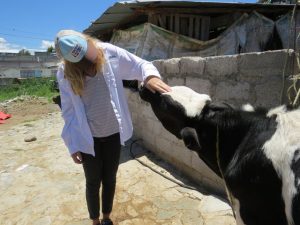
Cows don’t care where you are from as long as you are nice. Photo Credit: Santa Clara University

My status as an outsider that I assigned to myself didn’t affect the way the people I met treated me as much as I had expected it to.  Labels and backgrounds can play a huge role in who we are and how we feel if we chose to let them; however, I found that they don’t always affect how people treat you.  The farmers and Sistema Biobolsa employees that we met certainly didn’t let it affect how they treated us.

Learning in the Real World

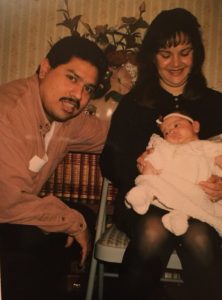
Mom and Dad, my first teachers

As long as I can remember, my life has revolved around learning.  As the daughter of a first grade teacher, this is probably fitting.  My mom knew exactly what a developing brain needed, so we played learning games and pointed out letters and colors wherever we went; but, she wasn’t my only teacher.  By the time I was in the first grade, my dad had taught me multiplication and would make me worksheets to do on the weekends.  I remember one day, he took me to the library.  We picked out an easy chapter book, but at that age it was difficult book to read.  Being the patient man that he is, we worked through that book for what seemed like forever, but I read it!  He was so proud of me, and I was proud of myself too.  I learned that hard work paid off, and I could do anything I wanted to.  I had no excuse not to do well in school, and so I did.

Our learning didn’t only come from books.  We would sing songs, go to the playground, paint and learn how to play instruments.  My brother, sister, and I also had a lot of freedom to play on our own and make mistakes.  A lot of times I was told to “figure it out.”  Although sometimes I hated it, I built valuable problem-solving and critical thinking skills and self-confidence.  

My early background in learning led to an intense curiosity.  I was always up for a new experience and a challenge.  As long as I thought I could handle it and kept my grades up, my parents never said no.  I did karate and basketball, theatre, student council, school trips, piano classes, part-time jobs and more.  

In Boston during Harvard Model Congress

During high school, my school sponsored a trip to Boston to participate in Harvard Model Congress.  I knew very little about congress and had never been away from home, but it was an opportunity for an adventure, so I went.  I loved every second it.  Being on my own away from my parents, going somewhere new, learning about something I knew nothing about, and meeting people from all kinds of different places was exciting, and I wanted more.  

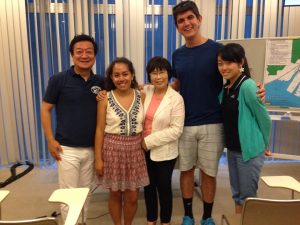
Then, I learned about a program through my hometown, Montebello, CA.  Montebello has a sister-city in Ashiya, Japan and sends two student ambassadors every year.  I applied, and in the summer of 2014, I traveled to Ashiya, Japan, met the mayor, did presentations at schools, represented Montebello at different cultural events, and built strong bonds with my host families and others from Ashiya.  Throughout my stay, I noticed the differences between an individualistic culture such as my own in the United States, and a more community-centered culture in Japan.  I appreciated the sense of order and not being wasteful.  

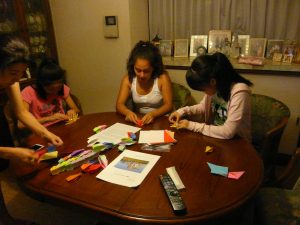
Making cranes to leave in Hiroshima as a sign of peace


Meeting a survivor of the atomic bomb in Hiroshima

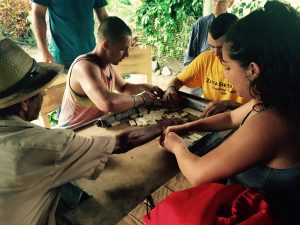
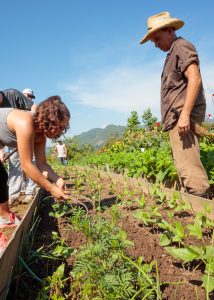
The next year, I went on an immersion trip to Cuba through the Food and Agribusiness Institute at Santa Clara University.  The purpose of our trip was to learn about organic agriculture in Cuba and how it can be sustainable for a large population.  The topic had nothing to do with my major, but I was interested nonetheless. I met people in the community, college students, families, farmers, and famous baseball players!  I loved their sense of community, openness, and creativity.  I noticed how so many things in life that I thought of as “necessities,” really weren’t.

Playing dominos with a tobacco farmer


Working on on an organic farm in Cuba


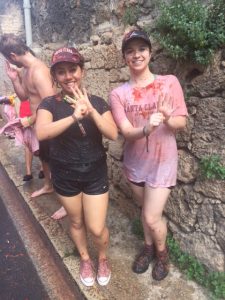
At La Tomatina in Spain

Last summer, I was inspired to take a trip on my own, outside of any kind of structured program like I had before.  While my sorority sisters studied abroad in Spain and France, I took advantage and went out to visit them.  I attended La Tomatina (a giant tomato-fight in Spain), saw countless landmarks, and had more setbacks thrown my way than I could count.  I had no choice but to be adaptable, spontaneous, and laugh through the pain.  These new experiences are what I love the best about traveling.  I took what I had learned in school and in the real-world, applied it, and learned more.  I was proven wrong about some things, challenged about others and had a lot of fun in between.  Throughout my life I’ve discovered that learning happens beyond the classroom, and no knowledge, however random, is useless.  

If it wasn’t obvious yet, I am passionate about learning and education, particularly because of its implications towards social justice.  When I heard about the Global Social Benefit Fellowship, it was a clear fit for me.  I want to do my part in creating a more just world.  I am excited to apply my talents, skills, and fresh perspective to a whole new field, one that can improve the lives of many.  

I have had an amazing education in my lifetime (and continue to do so), and I want to help as many people as possible have the same experiences in travel and education that I have had.  For that reason, I continue to be an active member and help raise funds for the sister-city association that sent me to Japan.  In the future,  I hope to become a lawyer in the field of education, and advocate for the rights of all students.  Along the way, I plan on traveling around the world and learning a whole lot more.