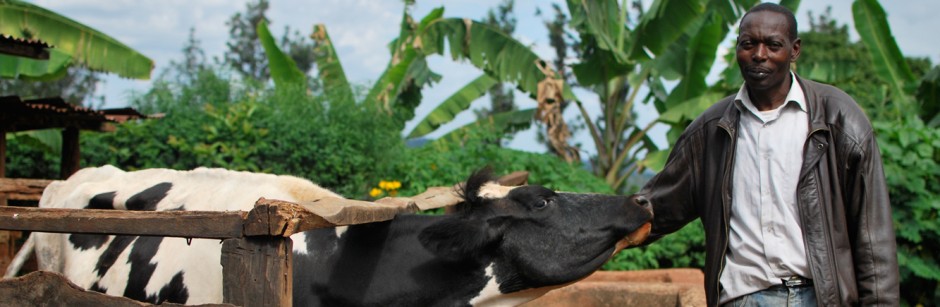
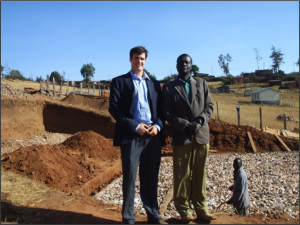
Juhudi Kilimo CEO Nat Robinson with a Kenyan farmer. Direct contact with clients ensures that client’s needs drive the services that Juhudi Kilimo offers (Source: Juhudi Kilimo ppt)
Social entrepreneurship – especially innovative microfinance – holds great potential in fostering sustainable, measurable, and inclusive development. Compared to bilateral and multilateral foreign aid, it promotes a ground-up development model, places the client at the center of its work, and is driven by individuals working for social advancement rather than the national interests of aid donors. This project will explore the potential of microfinance to advance livelihoods in developing countries. Specifically, it will examine Juhudi Kilimo and Kiva, two cutting-edge micro-finance organizations that are advancing the way microfinance is conceived. They both exemplify a commitment to livelihood development from the ground up, a human centric approach, and are driven by competent and passionate leaders. In their short existence, both organizations have had significant positive impacts: in less than five years, Juhudi Kilimio had supplied 22,000 wealth creating loans to fund rural Kenyan farmers,[ref]Juhudi Kilimo. Santa Clara University Social Benefit Resources (2013). Retrieved February 15th, 2014, from http://www.scu.edu/socialbenefit/resources/library.cfm?id=001F000000gFns5.[/ref] and since 2004, Kiva has enabled over US$530 million in funds to reach individuals in the developing world to start small businesses.[ref]Kiva. Statistics. Retrieved Feb 18th, 2014, from http://www.kiva.org/about/stats.[/ref] These two organizations have successfully bridged the gap between the realm of wealth creating technology and resources, and those in developing countries that need access to these resources more than ever before. Both have done so through innovative financial technologies and leveraging information communication technologies to have the greatest positive impact. These organizations, and many other forms of social entrepreneurship hold potential to transform the present-day use of bilateral and multilateral foreign aid as a means for development, which presents many inefficiencies and flaws.
These two examples of social entrepreneurship excel in four key areas neglected by bilateral and multilateral foreign aid: the failure of aid funds to penetrate local economies, a top-down approach, a one-size-fits-all development model, and prioritizing donor interests over recipient development.
- Aid funds from prominent bilateral donors (such as the US, EU countries, and Japan) and multilateral agencies (such as the World Bank, IMF, and UN Development Program) have a tendency to not facilitate domestic economic activity in the recipient country, as measured by the proportion of funds actually entering the local economy. By contrast, social entrepreneurship has the capacity to implement funds directly to the target communities.

Compared to Juhudi Kilimo’s on the ground approach to assess the needs of those it helps, the Word Bank and IMF (pictured) largely fail to integrate target communities into their work (source).
- Bilateral and multilateral donors adhere to a top-down, one-size-fits-all development approach that supports donor interests over recipient development. Traditional donors, by and large, adhere to the Washington Consensus of development, promoting economic liberalization, deregulation, and privatization. This reflects donor interests rather that recipient development. Further, aid funds from these donors are supplied either though donor-specified projects, or through the recipient government. In neither case do these funds directly enter the disenfranchised communities they are supposed to assist. Nor do these donors include the target communities in their development strategies.
Why should WE Care?
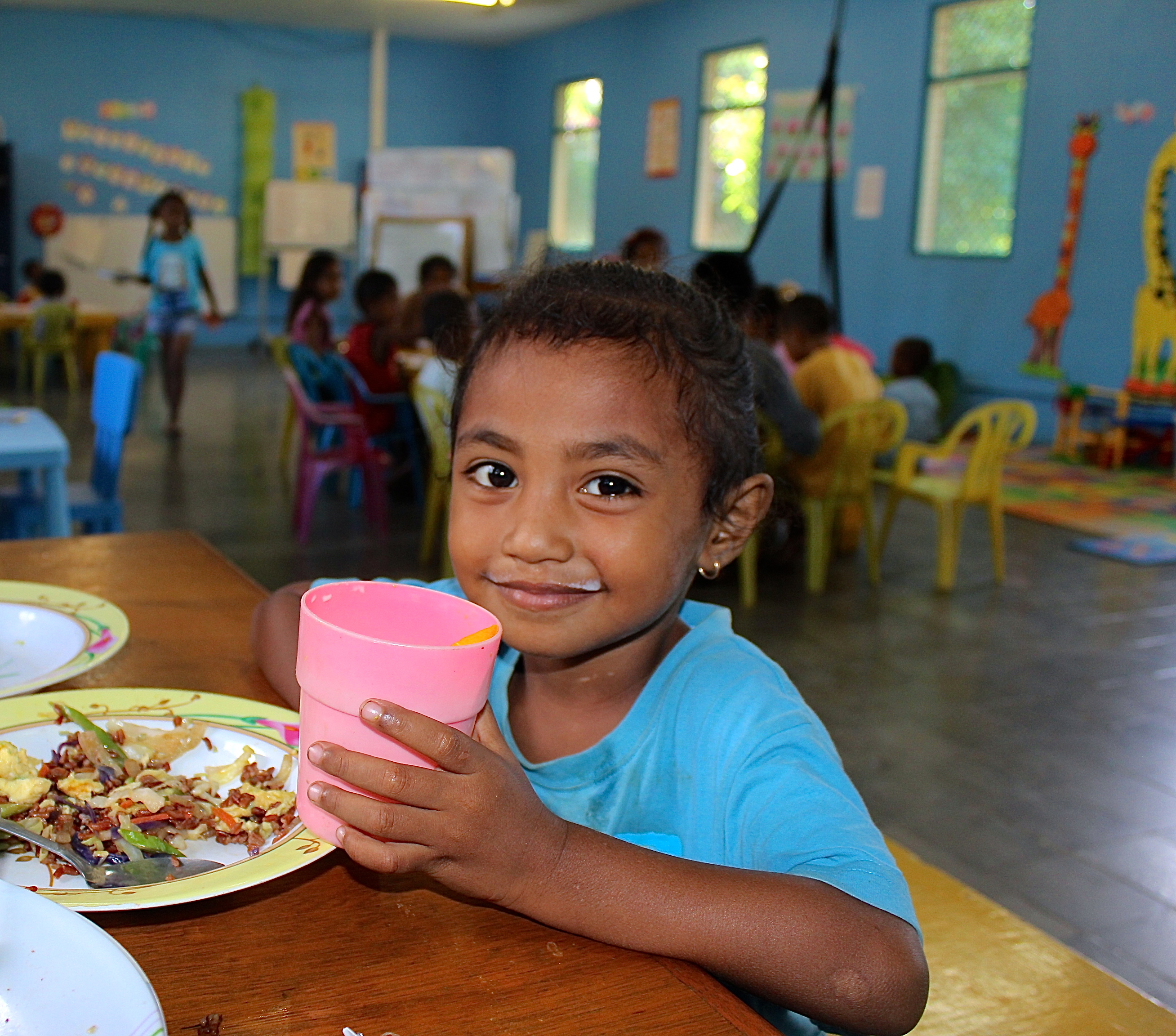
Timor-Leste experiences the third highest levels of stunting due to chronic malnutrition in the world. A concerted effort to understand how to alleviate these conditions is crucial to Timor-Leste’s development (source: author).
Currently, over one billion people subside on less than one dollar a day, and another 2.7 on less than two dollars a day.[ref]Millennium Project. Fast Facts: The Faces Of Poverty (2006). Retrieved February 11th, 2014, from http://www.unmillenniumproject.org/resources/fastfacts_e.htm.[/ref] But it goes further than a lack of amenities and material goods. Poverty has detrimental effects on health, hunger, education, livelihoods, and many other aspects of life we take for granted. For example, in 2010 it was determined that 870 million people – 12 percent of the world population – was suffering from chronic undernourishment. Of this population, the vast majority resides in developing countries, of which approximately 14 percent of the aggregated population is undernourished. The human consequences are severe: malnutrition is the single largest cause of child mortality, accounting for 45 percent of deaths in children under five.[ref] Millennium Project. Fast Facts: The Faces Of Poverty (2006). Retrieved February 11th, 2014, from http://www.unmillenniumproject.org/resources/fastfacts_e.htm. [/ref] In turn, the United Nations has made it a priority among its Millennium Development Goals to fight extreme hunger, focusing specifically on children under five as a critical period during which malnutrition causes the most significant permanent cognitive and physical consequences. The social consequences of hunger are extensive, and demand our most concerted efforts.
Significant steps have been taken to counter the prevalence of extreme hunger, largely by way of reducing poverty. The outset of the Millennium Development Goals in 1990 marked the first time in history that the international community came together to fight the myriad issues that face the developing world. Perhaps the most significant goals is MDG1: fighting extreme poverty and hunger on a global scale. In many ways, great achievements have been made. For example, the first target of MDG 1, ‘halve, between 1990 and 2015, the proportion of people whose income is less than $1 a day,’ has been met. This is a considerable success. Yet it remains that 1.2 billion people still live in extreme poverty. There is a great pitfall in this current model: it presumes that there is a clear correlation between poverty and hunger, and second, that poverty can be eliminated with aid. What this project intends to show is that instead, the relationship between poverty and hunger is far from clear, and that the reduction of poverty must focus on livelihoods more broadly conceived. The persistence of poverty and this affected population demands our attention. Commitment to the Millennium Development Goals indicates that the international community is willing to make laudable commitments to the fight against poverty. It is our imperative to make sure that our efforts target the most effective means possible to help those in need: innovative microfinance holds great potential.
Timor-Leste: Where Aid has Failed and Social Entrepreneurship Holds Great Potential
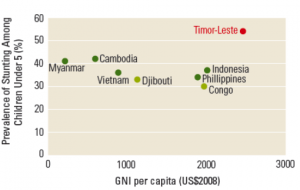
Timor-Leste’s large receipt of aid and comparatively small success at alleviating social and health issues suggests that the aid funds are not successfully targeting Timor-Leste’s real needs (source).
Timor-Leste presents a case that calls into question the oft-recited relationship between hunger and poverty as well as the effectiveness of international aid, reinforcing the need to employ alternative development models, especially in targeting hunger and malnutrition.Timor-Leste presents the third highest levels of stunting due to chronic malnutrition in the world, at 54 percent of the population under five years of age. A historical analysis does not indicate positive advancements: 40.6 percent of its population under five was moderately or severely underweight in 2002, and the same standards of measurement indicate this figure to be 45.3 percent in 2010.[ref]United Nations. Millennium Development Goals Indicators. Retrieved January 20, 2014, from http://mdgs.un.org/unsd/mdg/data.aspx[/ref]
Contrary to the conventional understanding of the poverty-hunger relationship at large, Timor-Leste presents the case of plateaued or deteriorating nutrition and hunger conditions despite an increasing GNI per capita. This is most clearly depicted in relation to regional trends, where Timor-Leste has a higher GNI than its many neighbors who nonetheless have lower levels of stunting. The failures to adequately address hunger and malnutrition in Timor-Leste have persisted despite substantial aid efforts on behalf of multilateral and bilateral donors alike. Between the end of Indonesian occupation in 1999 and 2009, Timor-Leste received in excess of 5.2 billion USD in bilateral and multilateral aid despite its small population of 1.2 million. The shortcomings of this seemingly positive deliverance of aid manifest in the inability of the aid funds to penetrate the local economy, with approximately 90 percent of all funds allocated to sources outside of Timor-Leste – namely salaries of international experts and administrators, supplies and other goods procured internationally, and security forces.[ref] La’o Hamutuk. How much money have international donors spent on and in Timor‐Leste (2009). Retrieved January 18, 2014, from http://www.laohamutuk.org/reports/09bgnd/HowMuchAidEn.pdf.[/ref] Our money can be spent much more efficiently, and to much better effect for those in need.
Innovative Microfinance
Our focus is on the use of innovative microfinance – exemplified by Juhudi Kilimo and Kiva – to better understand how to address the needs of those in developing countries. These two organizations are chosen not just for their success and dedication, but also because they display how different communities in developing countries present different obstacles to sustainable development that must be targeted in innovative and case-specific ways. Juhudi Kilimo focuses solely on rural livelihood development through the advancement of agricultural assets and production, and also incorporates innovative forms of education and technology. Kiva, by contrast, undertakes financing of small-scale businesses and enterprises more broadly conceived, and serves as a platform for donors to fund specific projects all over the world.