
Scaling is the process of increasing and expanding impact[ref]Uvin, Peter, Pankaj S. Jain, and L. David Brown. “Think large and act small: Toward a new paradigm for NGO scaling up.” World Development 28.8 (2000): 1409-1419.[/ref] In this, there exist a myriad ways for social ventures to scale. Our attention is focused on the forms of scaling known as ‘depth scaling’ and ‘scope scaling’ that pertain to Juhudi Kilimo and Kiva, respectively. An emphasis is placed on the relationship between between ‘actors’ and ‘artifact’ – a relationship that serves as the basis for scaling.[ref]Garud, Raghu, and Peter Karnøe. “Path creation as a process of mindful deviation.” Path dependence and creation 138 (2001).[/ref] In the context of these two organizations, depth scaling is the expansion of services and activities of an organization to its target population. Depth scaling does not preclude the organization from increasing is membership or client base, but its main focus for increasing impact resides in increasing the amount of services offered. Desa and Kosh describe this as a form of ‘horizontal diversification,’ whereby an organization “starts in one sector, and starts to add social service type activities, as reflected by the needs of the program recipients.”[ref]Desa, G., and J. Koch. “Scaling social enterprise: A comparative study of Naandi and Drishtee in rural India.” NYU Stern Conference on Social Entrepreneurship, New York, 2010.[/ref] Scope scaling, by contrast, is the form of scaling that increases an organization’s geographical impact or membership. Common to scope scaling is the tendency to “[increase] the organizational strength to improve the effectiveness, efficiency, and sustainability of their activities.”[ref]Desa, G., and J. Koch. “Scaling social enterprise: A comparative study of Naandi and Drishtee in rural India.” NYU Stern Conference on Social Entrepreneurship, New York, 2010.[/ref] While each organization presents a different form of scaling, they both use information communication technologies to advance their social mission and advance their product through scaling.[ref]Garcia, R., Acevedo-Ruiz, M., Kreiner, T. The Role of ICT in Scaling up the Impact of Social Enterprises (2013). Journal of Management for Global Sustainability 2 (2013): 83–105. [/ref] Both Juhudi Kilimo and Kiva will be examined in light of their divergent approaches to scaling, and discussion will be offered on the benefits and drawback of each.
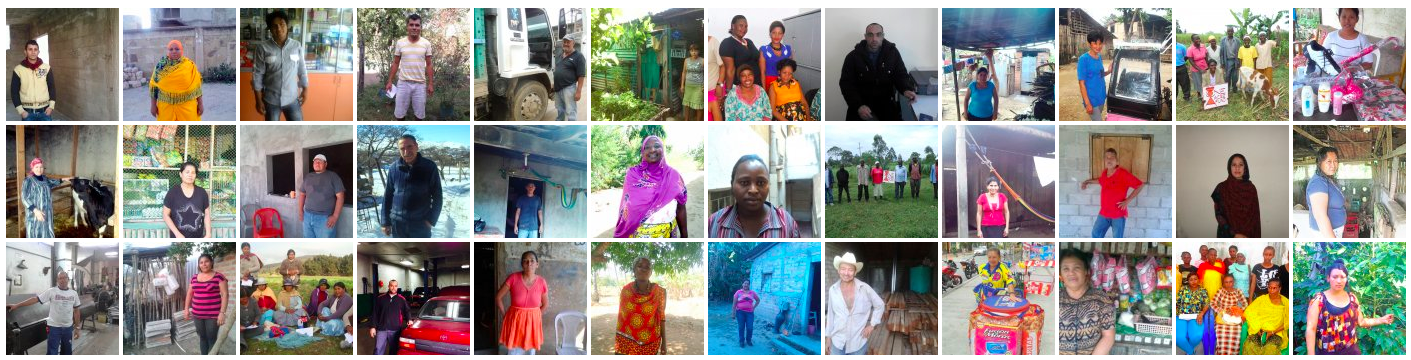
Kiva‘s ability to leverage the Internet as a lending platform enables it to fund small-scale entrepreneurs across the globe.
Juhudi Kilimo and Depth Scaling
Juhdi Kilimo exemplifies a case of successful depth scaling that appropriately addresses the evolving relationship between actor and artifact – in this case, Juhudi Kilimo and the rural Kenyan farmers as the actors, and the agricultural assets as the artifacts. Rather than just offer financing for agricultural assets to as large a population as possible – a trait that would constitute scope scaling – Juhudi Kilimo expanded its services and activities to include financing, group training projects, linkage to experts, insurance, a mobile phone hotline, and a tablet-based video education system. These additional services allow Juhdi Kilimo (an ‘actor’) and more deeply engage the farmers to receive greater benefit from their agricultural assets (the ‘artifacts’). When examining the progression of Juhudi Kilimo’s services, is clearly represents the process of scaling as ‘path dependent.’ That is, scaling is a non-linear path, and an organization’s activities must adapt to best assess the actor-asset relationship.[ref]Desa, G., and J. Koch. “Scaling social enterprise: A comparative study of Naandi and Drishtee in rural India.” NYU Stern Conference on Social Entrepreneurship, New York, 2010.[/ref] Juhudi Kilimo’s recent integration of mobile technologies into their services clearly represents this process and demonstrates the characteristic of depth scaling as an increase of available services.[ref]Garcia, R., Acevedo-Ruiz, M., Kreiner, T. The Role of ICT in Scaling up the Impact of Social Enterprises (2013). Journal of Management for Global Sustainability 2 (2013): 83–105.[/ref]
Juhudi Kilimo is currently introducing two mobile technologies that increase the benefit that rural farmers that derive from their agricultural assets. These technologies are based on a need for inspiration and support in Juhudi Kilimo’s services. It offers tablet-based educational videos on how to use their asset as a form of inspiration, and a mobile hotline to answer farmers’ questions to better support the farmers.[ref]Ideo and Juhudi Kilimo. A Platform for Learning (2013).[/ref]

Juhudi Kilimo’s use of technology helps farmers learn how to use their new assets. Isaac, a Kenyan farmer, teaches other farmers how to build a chicken coupe (source: Ideo/Juhudi Kilimo)
Mobile education: Since Juhudi Kilimo enables farmers to purchase higher quality assets, there is the possibility that the farmers will not fully understand the process of using and servicing the new assets. As part of its depth scaling model, Juhudi Kilimo launched an educational program to acquaint farmers with their new products. This educational program is based on a number of videos of other Kenyan farmers that have previously received a similar asset. The videos display the best practices about taking care of and using the asset. It was very well received by farmers, based upon extensive field trials that Juhudi Kilimo conducted.[ref]Ideo and Juhudi Kilimo. A Platform for Learning (2013).[/ref]

(source: Ideo/Juhudi Kilimo)
Mobile hotline: In order to lend support to the farmers, Juhudi Kilimo launched a mobile phone based hotline to answer any questions farmers might have. The help line is open five days a week, and an expert responds to messages once a week. Field trials found that the trained expert could answer the majority of calls, and that the service was successful in assisting farmers use their products for greater effect and also avoid costly mistakes.[ref]Ideo and Juhudi Kilimo. A Platform for Learning (2013). [/ref]
Kiva and Scope Scaling

Kiva’s online lending platform is an interesting take on the traditional model of ‘scaling as franchising.’ Scaling as franchising is based upon the idea that a program, once it creates its name and systems, can be replicated at multiple sites: “franchise organizations align the energy and investment of local entrepreneurs with the strength of a network that may encompass hundreds or even thousands of units.”[ref]Desa, G., and J. Koch. “Scaling social enterprise: A comparative study of Naandi and Drishtee in rural India.” NYU Stern Conference on Social Entrepreneurship, New York, 2010.[/ref] The exceptional scale Kiva has achieved through scope scaling is enabled by its partnership with 242 field partner MFIs in 73 countries. Kiva’s innovative online platform leverages the internet and the preexistence of these field partners, and brings them together to serve a vast population in the developing world: a process that is much less intensive than the work Juhudi Kilimo does by working directly with rural farmers. Avoiding risk furthers Kiva’s ability to scale: individual lenders bear the risk in case of default, not Kiva.[ref]Flannery, Matt. “Kiva and the birth of person-to-person microfinance.” Innovations 2.1-2 (2007): 31-56.[/ref] In turn, Kiva’s ability to scale isn’t constrained by its self-regulation of assets to avoid risk.
The scope scaling associated with Kiva displays how the mission and solution of an organization influence the type of scaling to ensue.[ref]Desa, G., and J. Koch. “Scaling social enterprise: A comparative study of Naandi and Drishtee in rural India.” NYU Stern Conference on Social Entrepreneurship, New York, 2010.[/ref] For example, Juhudi Kilimo works explicitly with smallholder farmers and funds agricultural assets – a resource intensive process that demands training when instituting new products and practices. By contrast, Kiva focuses on supplying small loans for business broadly conceived, anywhere in the world. In turn, it follows a path of scope scaling, whereby it can reach the broadest geographic and numeric population. The numbers prove it to be a success: US$536.2 million lent through Kiva’s online platform, to a total of 1.25 million borrowers. At present, Kiva’s online platform experiences only 4 seconds between every loan transaction, a remarkable feat (see real time loan transactions here).
Different Models, Different Scaling
Juhudi Kilimo and Kiva demonstrate how the most appropriate form of scaling is related to the organization’s model and intended outcomes. Most fundamentally, Kiva is a non-profit, whereas Juhudi Kilimo is a for-profit organization. This is largely responsible for Kiva’s choice to follow a much less resource intensive model — it is the platform upon which donations are made and then distributed by MFIs with resource intensive models. Juhudi Kilimo, having reached financial stability in 2011, has income generated from interest rates that enables it to implement resource intensive, technology driven education programs. By contrast, Kiva relies largely upon grants and foundation funds. The success of its model is also predicated upon its ability to leverage available resources, namely an Internet lending platform and use of PayPal (for which transactions PayPal charges to fees) to mitigate costs. With different forms of scaling, there are different possibilities for how both of the organizations’ models can scale for impact in new areas.
Different organizations must scale in different ways to ensure the largest positive impact for the new target community. As a relatively resource intensive and cutting-edge model, Juhudi Kilimo’s is best scaled through ‘branching.’ This would allow for the organization to retain significant central leadership.[ref]Dees, J. Gregory, Beth Battle Anderson, and Jane Wei-Skillern. “Scaling social impact.” Stanford social innovation review 1.4 (2004): 24-33.[/ref] Continued central leadership is key since the model of asset-backed financing is not yet commonplace in the MFI field. Further, much of Juhudi Kilimo’s success is predicated upon it’s numerous programs – from actual financing, education, to hotline services – that require quality control to ensure their integrity. Scaling through branching would allow for this, and enable it to retain its depth scaling model.
By contrast, Kiva would not be best served through a branching model of scaling, due to its resource intensity.[ref]Dees, J. Gregory, Beth Battle Anderson, and Jane Wei-Skillern. “Scaling social impact.” Stanford social innovation review 1.4 (2004): 24-33.[/ref] Kiva is unique in that further scaling of its online lending model is limited only by the MFIs it partners with, and operating costs. Neither branching to new locations, nor disseminating its model would enable it to reach a greater amount of field partners – it has full access to MFI field partners via its leveraging of the Internet. Both branching and disseminating would require additional resources. However, by growing on its current platform, Kiva still runs the risk of its operating costs (especially employee salaries) outgrowing its non-profit donation-based funding model. This risk could be mitigated by charging a small interest on its transactions, which is a plan the organization is currently moving towards.[ref]Flannery, Matt. “Kiva and the birth of person-to-person microfinance.” Innovations 2.1-2 (2007): 31-56.[/ref]
When considering scaling to new geographic areas, an organization must consider the local environment to ensure that its innovation is well received by the new communities. [ref]Dees, J. Gregory, Beth Battle Anderson, and Jane Wei-Skillern. “Scaling social impact.” Stanford social innovation review 1.4 (2004): 24-33.[/ref]Local culture, economics, politics, and specific needs must be considered in order to have the greatest positive impact on the communities. Timor-Leste will be used as a case study to examine the potential for microfinance to scale appropriately according to local needs and environment.