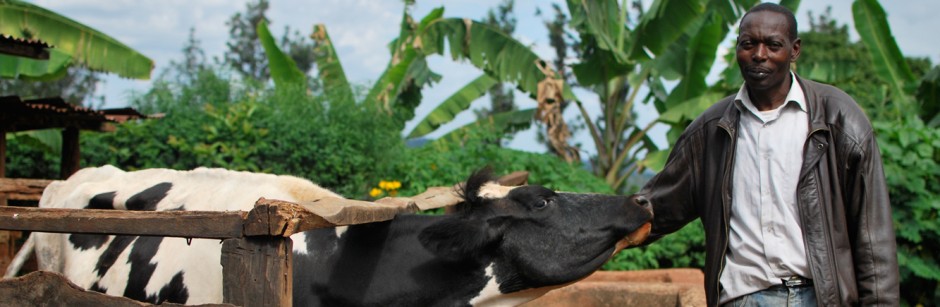
Case: Depth Scaling of Microfinance in Timor-Leste
Assessing the ability of an organization (or its model) to scale in new areas requires an appreciation for how the organization or technology will interact with local demographics, culture, politics, and economics. Timor-Leste, a country largely let down by international aid efforts, provides a unique case study to analyze the potential of both Juhudi Kilimo and Kiva to scale in light of Timor-Leste’s environment.
In context – Demographics: Timor-Leste is a small population of 1.2 million, with 74 percent of the population residing in rural areas.[ref]UNFPA Timor-Leste (2010). Retrieved February 22, 2014, from http://countryoffice.unfpa.org/timor-leste/2009/11/02/1482/timor-leste_democratic_republic_of/.[/ref]
In context – Technology: 60 percent of all households in Timor-Leste are serviced by at least one mobile phone, while only 49 percent of agrarian households have mobile phone access. 7 percent of the population uses Internet, but only 1 percent has in-home Internet access.[ref]United Nations Integrated Mission in Timor-Leste, Communication and Public Information Office. Timor-Leste Communications and Media Survey (2011). [/ref] Microfinance is in its infant stages, and there exist two MFIs in the country.[ref]Banking with the Poor. Microfinance in Timor-Leste (2010). Retrieved February 28 from http://www.bwtp.org/files/BWTP%20Industry%20Update%201%20-%20Microfinance%20in%20Timor-Leste.pdf.[/ref] However, the Asian development Bank reports an unmet demand for microfinance ranging between 275,000 and 400,000 individuals.[ref]Bankable Frontier Associates: The potential for New Technologies and Branchless Banking Models to Expand Access to Financial Services in Timor-Leste. Draft Jan 2009, ADB. [/ref]
In Context – economics and financial system: Timor-Leste experiences weak financial and economic infrastructures, and nearly an entirely cash-based economy.
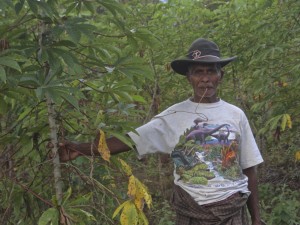
Timorese farmers don’t have access to advanced production equipment or inclusive financial systems. A depth scaling model could target both undersupplied demands (source: author).
Taking into account these aspects particular to Timor-Leste, it is apparent that Juhudi Kilimo and depth scaling are most applicable for Timor-Leste’s development due to its small and predominantly rural population, lack of financial institutions and infrastructure, and increasing access to mobile technologies. Its small population (with a MFI targetpopulation not exceeding 400,000) would be best served by a depth scaling MFI that seeks to bring as many beneficial services to a community as possible; ‘stacking’ the services, rather than ‘spreading’ the services, so to speak. Further, Timor-Leste’s cash-based economy would benefit from a form of financial inclusion that went all the way to the individual level to ensure repayment. Beyond ensuring repayment, this would also begin to develop a culture of financial responsibility.
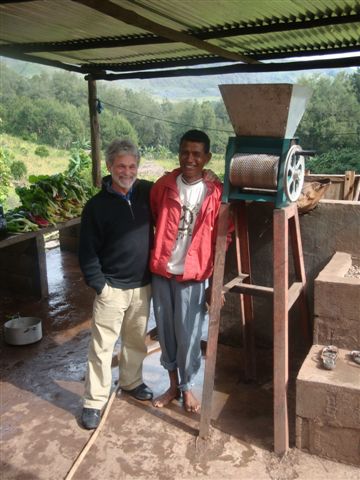
This depulper results in higher quality beans that sell for an increased market rate (source).
Funding productive assets could have a significant positive impact, especially in the agricultural and traditional production sectors.
- Funding more advanced forms of agricultural technologies could transform Timor-Leste’s coffee industry, which is its largest non-petrol economic sector and employs approximately one quarter of its population. At present, Timor’s coffee harvesting and production techniques are relatively poor by international standards, which limits the value of its beans on the international market.[ref]Amaral, Fernando Egidio. “Prospects for coffee development in East Timor.”ACIAR PROCEEDINGS. ACIAR; 1998, 2003.[/ref] Understanding ‘technology’ to be a far reaching concept, there is great potential for a microfinance operation to fund assets that increase Timor-Leste’s coffee harvest yields, production techniques, and marketing. Increasing coffee production capacity and export value is pivotal to Timor-Leste’s future, as its over-reliance on petrol will bring serious consequences as oil and gas reserves are depleted. Asset-backed microfinance has the ability to reach down to the farmer level in the most rural areas of Timor-Leste, whereas international aid donors’ are limited by being based in the capitol, Dili.
-
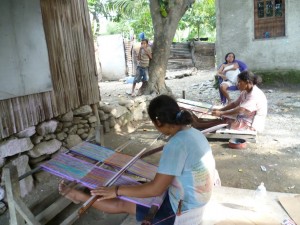
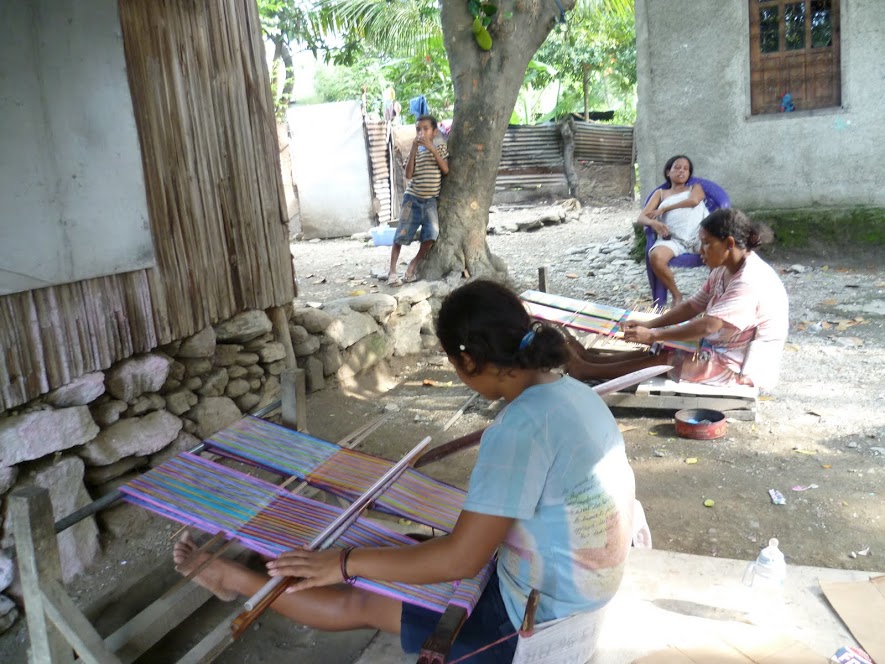
A women’s tais collective in Dili, Timor-Leste. More advanced production equipment and training of marketing could help remove the ‘middle-man’ that many collectives must use (source: author).
An asset-backed form of microfinance could also help develop tais production in Timor-Leste. Tais is Timor-Leste’s national fabric, and is worn by many women, used in Church proceeding and traditional ceremonies, and is the most common souvenir amongst tourists. Inefficient looms and resource intensive fabric production could be greatly advanced by loans to invest in better production equipment. The tais industry would be particularly fitting for this microfinance model, since tais production is already collectivized – womens’ tais cooperatives could easily serve as the community groups usually used by microfinance organizations to ensure repayment.
While a depth scaling model along the lines of Juhudi Kilimo is most appropriate for Timor-Leste today, there is also potential for Kiva’s platform to serve Timor-Leste. This will become possible when Timor-Leste boasts a more reliable set of microfinance agencies that can be connected to funders through Kiva’s online platform, much like Juhudi Kilimo does in Kenya. In this, Juhudi Kilimo’s depth scaling model can be seen as ‘priming’ the microfinance industry in Timor-Leste for future scope scaling.
If sustainable development is indeed the true goal of the aid and development community in Timor-Leste, social entrepreneurship and microfinance should be considered a serious option to serve Timor-Leste’s development process. Not only could it increase economic potential and advance rural livelihoods, but it could do so in a way that fosters economic inclusion, development non-dependent on aid, and fully takes into account the cultural and traditional economic environments specific to Timor-Leste.