I came to the fellowship largely to learn about, and get immersed in, social entrepreneurship. Early on, the simplest definition I heard about the field was that it was mixing for-profit business practices and social impact initiatives, creating companies that value profits and impact. Not only did this idea give me the lightbulb-illuminating-over-my-head feeling, but it also felt like it should be the obvious choice for most everyone to pursue vocationally. How could someone not be compelled by this? How could so many people want to enter the business world, but not want to incorporate, across different industries, positive impact on the world if they weren’t giving up the traditional monetary success to do so?
Nine months ago I wanted to be told and taught how to contribute to this field. I was still glowing with a certain electricity after feeling like I had found like-minded peers, hungry to change the world, and I was confident that this was an experience that would shape me forever. Done were the immersion and service trips which provided a social change high that faded quickly over the following months. I was ready and eager to get pulled into an experience that I couldn’t shake; pulled into a field that I could never turn away from.
Over this time I’ve had so many perspective changes its hard to recall exactly where I stood beforehand, or to really focus on one over another. One thing that’s obviously clear is that I had an imperfect impression of both social entrepreneurship as a field, and how the fellowship experience would affect me. While social entrepreneurship results in amazing companies and action-driven change, it also isn’t close to perfected. The field is clearly still figuring itself out. Its like we’re trying to smash an oval peg (social entrepreneurship) into a round hole (the capitalist market), which just isn’t quite built for social impact to be incorporated inline with profits and monetary valuations (yet, more on this later). Two realizations built that opinion. The first is that the work doesn’t stay with you as much as I thought it would. It absolutely changed how I view my role in the world and how I view business forever, but its not as different from an immersion or service trip as you may think. As corporations around the Bay Area started their recruiting processes and my experience got further and further away, I could feel the high start to subdue. It wasn’t as if I couldn’t imagine pursuing a career outside of social entrepreneurship, or couldn’t get intrigued by different entry level jobs in tech or consulting—these still made me excited and hopeful and nervous. Now I was just trying to find any way (even if it was a stretch) to convince myself that taking the corporate position wasn’t selling out or bringing me irreversibly away from the social entrepreneurship field.
I think this has a lot to do with the second realization, which is that there isn’t a clear career track with social entrepreneurship. I expected to be funneled through the fellowship program into a set path towards next-step jobs in my search toward social impact, but instead the next step is incredibly ambiguous. Of course, it’s impossible to have a job or job category that fits widely diverse skill-sets and interests, but the ambiguity and uncertainty of where to place myself in the field is intimidating, especially in the face of big name companies’ recruiting and friends signing full time offers. I don’t mean to sound like I’m not impressed by and drawn to the field, but rather I want to introduce my changed vocational pursuit, and the frustrations that formed it.
The big question that I’m currently facing is the big one that everyone faces coming out of the fellowship: do I pursue social enterprise work immediately or do I go get trained at a big company and come back to the field later on? And these previously mentioned realizations make the question incredibly intimidating, because I know the social impact high could fade. The jump into an uncertain field and career is scary in a way, but so is the idea that I could get lost in the corporate track as responsibilities build with age and the developing country experience gets farther and farther away. Through this thought process, I’ve come to understand how much I want to tackle the bigger, systematic changes. Go after changing the field and making it work with the capitalist market, rather than trying to find work around or adopt idealistic views. My changing understanding about social entrepreneurship has built into an opinion that I want to aim at addressing throughout my career: Social benefit can’t continue to be a burden for careers or businesses.
It can’t be a trade-off where often businesses are left sacrificing sales or prices or valuations and the most talented people in the world often have to sacrifice prosperity and more esteemed careers in order to positively impact the world and tackle injustices. Somehow we have to change how we value companies. Get rid of the notion that increasing profits is the only way to increase value, and affirm the idea that social impact is a measureable form of value as well. There will never be the same level of talent, flood of entrepreneurs and disruption-seekers, or capital investment than what we see around us in the Bay Area within the social entrepreneurship otherwise, and that’s the type of rapid, hard-fought change needed. And before taking the view that I am taking any sort of cynical view of humanity let me note that I am only saying this out of an intense realization that very few get the same opportunity to, especially on an international level, see the problems, learn about solutions, and meet the change-makers that I, and many of you reading, get. And even worse, that call to action can fade in people that get the experiences! We need that clear career track, that obvious choice for people to pursue vocationally.
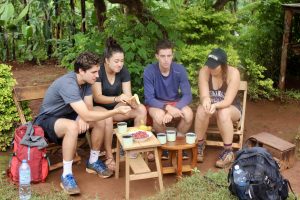
This experience has given me the opportunity to meet amazingly talented people working tirelessly toward social impact, people who are changing the lives of many people and foregoing those traditionally high-profile careers in the process. The more I meet, and the more about them I learn, the more I take on the opinion that these are the people that are leading the world toward change. There just isn’t enough of them, yet.
Included in these people are my fellow fellows and the professors and mentors from the Miller Center. Talk about amazing people that are going to change, or already are changing, the world. Like I mentioned at the beginning of this post, I came into the fellowship because of the people and they have irreversibly changed the way I view the world. Special thanks to Lauren for letting me ramble to her for nine months about the most and least important things in life. Best 2017 TAMTF GSBF partner ever.