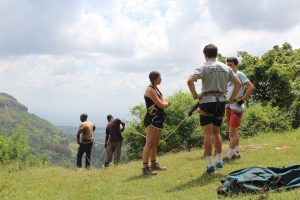
Wow the fear of heights was kicking in with a vengeance. I had just seen Lauren and then Will disappear down and off the edge of Sipi Falls facing Grace and I and holding on to a rock climbing rope bolted into a bare part of the grassy cliff near my feet. We hadn’t even come to Sipi to repel down its largest waterfall’s 100-meter face. I was promised coffee tours and hike and… ground. Safe, solid, comfortable ground. Not supported-by-a-harness-with-feet-on-side-of-cliff-type ground. But, with sweaty hands and nervous laughs, I too let the guides attach my harness to the ropes, leaned back off the cliff, and began my way down. After 30 meters of staring at the rock wall in-front of me and focusing on controlling my speed, the rope began to make me spin and the rock disappeared. What I saw was far reaching, jungle-filled hills on one side, and a massive waterfall on the other. I’ve had my breath taken away by nature before, but this was something different. This was complete shock and awe. As I dangled off the side of a cliff an all-important question came to mind: What the hell am I doing here? And thus my reflection began with the work Lauren and I had done up until that moment.
The Work
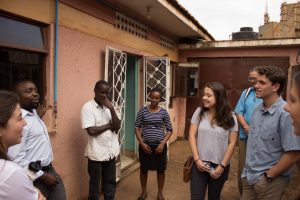
Our research is split between two categories. Visiting schools that work with Teach A Man To Fish and meeting Ugandan social businesses that operate in our areas of product research (solar lanterns, water filters, alternative cooking fuels, and sanitary pads). The school visits have taken us all around the country. While many of the schools are in the central region around Kampala, many more have led to trips of five, six, seven hour drives to different parts of the Ugandan border. One visit the week prior was taking us so deep into rural, northwestern Uganda that we were compelled to check Google Maps to ensure that we were still in Uganda, not the DRC. We were. (But only by a couple miles.) During the school visits, we have received an odd, inflated level of ethos that feels welcoming, empowering, and uncomfortable all at the same time. The teachers, principals, and students are always ecstatic to see us. Once an entire primary school stopped what they were doing entirely to herd around us yelling “mzungu” (white person) as we exited the car. A school the week before told us that students didn’t believe their new TAMTF club was a real, organization-backed program, but that us arriving that day was all the credibility they needed and that the turnout tomorrow would be enormous. While the negatives to the treatment are, of course, entirely internal, the visits never fail to leave me unsettled with the undeserved reception and appreciation we receive.
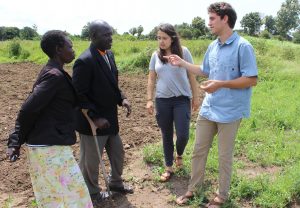
The social business side of the research has been vocationally inspiring, even more so than I expected. This part of the work has been extremely autonomous in that Lauren and I are reaching out to the social businesses, scheduling meetings, and discussing partnerships and company operations on our own accord. It has even been similar to the school visits in that companies treat us with a higher level of respect and credibility than I’ve been accustomed to through various internships. In this regard it’s particularly nice to know it isn’t because of our ethnicity, but rather it’s stemmed from our preparation and the green-light provided by TAMTF. The meetings have led us into the door of executives at many of the most prominent social enterprises operating in Uganda, and each one has been a new opportunity to hear a perspective of another entrepreneur dedicating their life to social entrepreneurship. Seeing the diverse backgrounds of people that have dropped many of the promising, traditional careers that I am considering in order to work on the ground in Uganda’s social enterprise movement validates the career path for me. Not only do incredibly smart, driven people dedicate their careers to this, but they move away from top-tier companies to do so.
The Career Development
I’m often considered a laid-back person, but maybe I’m angrier than I thought. Something happens when social business is involved that forces any passivity out the window. I find myself judging social enterprises with a much more critical eye than typical companies; I think it’s because I see them with a much greater responsibility, and therefore much less room to have inconsistent leadership or underdeveloped products. There was a moment after a visit with Yunus Social Business, a large impact investing firm, that I sighed, turned to Lauren, and articulated a realization that I could never work for a social enterprise. The Yunus employees had offered yet another perspective that added yet another layer to the complex, problem-riddled ecosystem of Uganda’s developing market. They had argued that while the social products we were researching had good intentions, the firm had turned its focus to making agriculture more prosperous, as the workforce is primarily dependent on farming and the root cause of these various problems is the lack of capital to purchase a water filter, solar light, cooking stove, sanitary pad, and so on. But, I argued back, successfully doing so would only result in an even further dependence on farming as a means for income, though I saw their point as well (as well as the complex duplicity that we were facing). It wasn’t that I didn’t want to work in the field of social entrepreneurship, or work toward change. It was that I knew I am too opinionated, angry, big picture-looking, and overwhelmed by the huge scope of the problem when working in this field to ever be satisfied working in a role. I’d have to start my own enterprise or work toward the large, systematic changes to ever maintain my sanity. How could anything ever truly change if there isn’t a fundamental shift? Can people really be expected to save up their limited cash to spend it on a product that partly satisfies only one of the many huge needs? Questions danced in my head as each problem seemed endlessly more complex the further it was looked into—my career development is looking the same way.
The Country
To switch tone completely, the country is different and more astounding than I expected. Dense, green jungle (and the noises that come with it) intertwine with streets in Kampala, just as much as they do dominate the countryside. The country is packed full of breathtaking nature in every corner, whether it be the Nile, waterfalls, mountains, or game parks that are empty of tourists but full of huge animals.
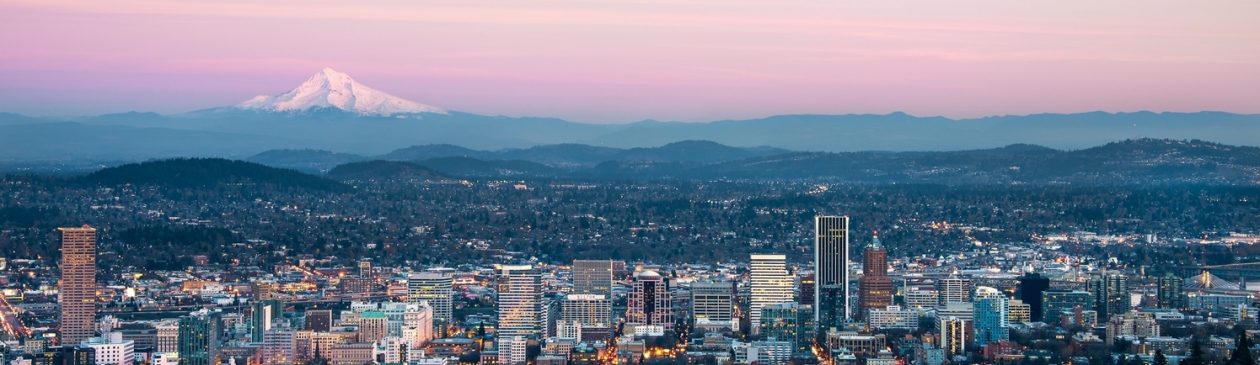
The patriarchal and less progressive nature of society can be harsh, uncomfortable, and in-your-face, but its also combined with an incredibly friendly and energized population—which also draws to mind how many people there are here. When driving out to the countryside, there are small towns and trading centers seemingly every half hour. Each is almost identical to any other, in that they all consist of short buildings surrounding and facing only the main road running through. The buildings are all painted as colorful company advertisements (companies who, if their advertising goal was enormously high frequency and repetition, are doing fantastically). The road is always surrounded by people, whether that be people selling chicken-on-a-stick in Coca-Cola zip-up collared shirts, or just locals playing games and buying airtime. The way I’ve been putting the population density in perspective to myself is that Uganda is roughly the same size of Oregon, but outnumbers it in population 39 million to 4 million. Of course some areas of Kampala are overflowing, but the country feels more moderately full of people everywhere, rather than truly as crowded as the statistic suggests. (This is also a good indicator of the importance of last-mile distribution, rather than just serving the urban population.)
The most striking thing about the society has potentially been the distrust in police. That has manifested itself into my experience as police stopping our cars to ask for bribes just to keep driving, as well as an extremely hectic experience of getting two Ubers stopped and the cars confiscated by policemen, who didn’t explain anything to us, just as an effort to promote taxi use over Uber. Drivers talk of policeman as purely a nuisance. We’ve even had a driver clip a boda boda while getting pulled over by traffic police, only to have the policeman shrug and chuckle as he examined if there were any scratches on our driver’s car.
The one thought I can’t shake, which keeps nudging into the present moment every time I visit a school or repel down Sipi Falls or just take a moment to reflect and look at the city, is that this experience is special. It’s crazy. I’ve done immersion trips, I’ve traveled to developing and developed and in-between countries, I’ve lived abroad. But living, working, and exploring a country as foreign as Uganda is something my parents have never done (who are my baseline measure of people who have traveled a lot) and only few friends and family can say differently. At this point, there’s something laughable about the idea of me working in an investment bank this summer as originally planned—I have a feeling that will forever stay ridiculous. The feeling makes me feel infected in an irreversible manner, more uncertain as I’ve ever been about my life path, and completely satisfied about those two ideas.
My train of thought was broken by the heat being created by the quickening rope against my gloved hands. Maybe the gardening gloves weren’t the best choice for this, I thought to myself as I had a memory of the other, much thicker glove options I had decided against 80 meters ago. I was nearing the bottom of the falls and increased my pace further in excitement to feel the happiness (and safety) of completing the task. I was received by our guides that had gone before me and ran across the grass and rocks to the natural swimming pool at the base of the falls to join Will and Lauren in the feeling that is only describable as a mix of pure relief and a throbbing adrenaline rush. After a minute, I submerged myself into the pool and remained treading water while watching Grace undergo her descent.