One More Time

How do you begin to describe something that has changed how you look at yourself and perceive the world around you? I believe I will need more than nine months to process my experience, but I have realized what kinds of social engagement that are best suited to my skills and talents; used the fellowship make critical vocational decisions; and changed how I engage with the world.
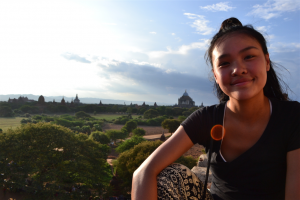
Sitting on a temple in Bagan, Myanmar to watch the sunset.

One year ago, I had no concept of social entrepreneurship. I remember sitting in class with my hands clasped under the table, hoping that no one would ask me to explain what business models and revenue streams were.

One week ago, I comfortably conversed with academic leaders, parents, and students about these terms and the mechanics of business.
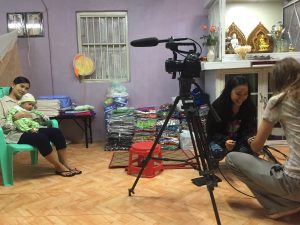
Setting up camera equipment with my partner, Emily Alonso.

Throughout the past nine months, I have not only learned the importance of these terms, but also how to use my own strengths to work with direct beneficiaries. My time in Myanmar has affirmed my belief in the fundamental connections between humans, regardless of social, economic, and physical constructs. By writing the impact assessment report and opportunity report, I was able to document the stories of the people I met and share them with others. I was able to use my passion and expertise to craft deliverables that would not only benefit Koe Koe Tech, but also maymay users and their families.

When I reflect on my experiences, I recall The Promise of a Pencil by Adam Braun. I read this book last spring, when I was preparing for my summer in Myanmar. In retrospect, my experiences remind me of the lessons in Braun’s book. His professional career began at a global management consultancy that promised financial security and practical skills, but he craved something more: social impact. His experiences abroad encouraged him to pursue his interests, and he eventually left his job to begin a non-profit with a mission that aligned with his skills and talents. In my mind, I see similarities in how he used his past experiences to inform his vocational discernment.

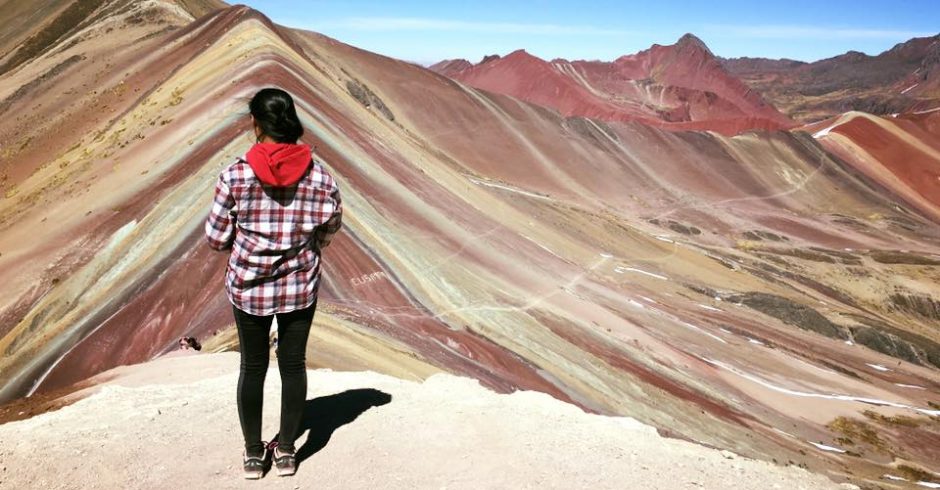
This year, I have to make a number of decisions related to my future. I am applying for international fellowships and other opportunities that would place me in direct contact with disadvantaged communities. Even though application processes are stressful, I am grateful for these experiences. I have been able to consider the impact of this fellowship and how it influences my personal and professional development. Altogether, pursuing social justice initiatives in Peru and Myanmar have truly highlighted why I want to continue these experiences at home and abroad.
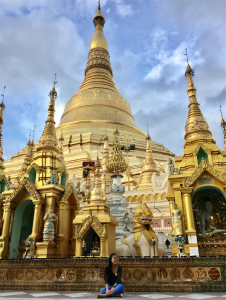
Exploring Shwedagon Pagoda in Yangon, Myanmar.

I believe that this fellowship has drastically altered how I interact with the world and how I understand myself. As I said before, I have seen the thread of humanity that connects people together in my encounters across the United States, Peru and Myanmar. I believe that these experiences have made me a better advocate for immigrants, minorities, and women. I also know that I have the resources to help me access my potential and create the impact I wish to see. Furthermore, I have transformed how I engage with others to make sure that my interactions with them are more intentional and meaningful.

Lastly, these experiences have also taught me a great deal about myself. I have learned to embrace not only loneliness and sadness, but also independence and strength. As I continue through my senior year, I am reminded by a quote from Adam Braun: “The world has far too many problems, and you are way too smart and capable not to help tackle them. Your time is now.” Even though I am uncertain about what the future holds, I am confident that I will pursue my personal and professional goals with the utmost tenacity.
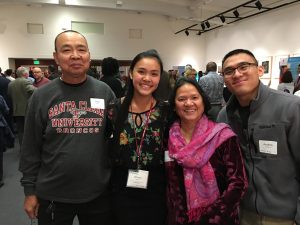
Sharing a special moment with my family at the Action Research with a Mission event.
Posted in Uncategorized | Leave a comment

Contemplation

Amongst the flurry of academics, extracurricular activities, and my social commitments, it can be difficult to find time to sit down and reflect. Now that I am back in the United States, I have fielded countless questions about the weather, the people, and the food in Myanmar; however, I cannot seem to find the words to encapsulate my transformative experiences with Koe Koe Tech.

At first, seemingly meaningless memories come to mind. For instance, I recall spending countless hours in bumpy taxi rides and seeing motorcycles zipping around cars. However, I have more significant memories of mentally preparing myself for every interview. I would sit silently in the car and consider how these interviewees were going to share a glimpse of their lives with me. This was most obvious after the formal questions were answered and my notes were tucked away; there was always a subtle change in the atmosphere. The room seemed to collectively sigh as we all relaxed and enjoyed our time with each other. In these moments, I saw elements of my father, mother, and brother in everyone I interacted with. For example, I remember the outstretched hands of a baby as she reached for me. I remember the father who proudly looked on and smiled as his wife spoke about her pregnancy and their family life. I remember the mother who was so overjoyed that she wanted to drop everything and spend all of her time with her baby. I remember the older brothers of these children, who insisted on gingerly carrying their little siblings and looked adoringly at them.

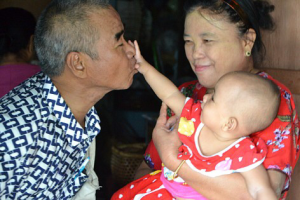
A grandpa plays with his grandchild in the arms of her grandmother in Mandalay, Myanmar.

These moments happened in a matter of seconds, yet they are imprinted into my mind. I vividly recall the feelings of familiarity. Even though I was thousands of miles away from home, I felt like I was sitting with my own family. In fact, two memories in particular have solidified my belief that the thread of humanity links us all.

First, while conducting interviews in South Dagon Township, I met a family of six. They answered my questions with enthusiasm and were excited to have me in their home. One daughter was eager to practice her English with me. Even though I was with a translator, she insisted on answering my questions in English. Her determination was evident, and the family was visibly proud of her. After she answered my questions, she introduced me to her grandparents, her parents, and her siblings. We sipped tea, chatted about television shows we liked, and relaxed in sturdy plastic chairs. This experience reminded me of my home, where grandparents, parents, aunts and uncles, siblings, and cousins gather together to eat and have casual conversations. The simple act of being with others and sharing this experience is something I have always craved when I travel abroad and I treasured these beautiful moments with those I interviewed or met on a whim.

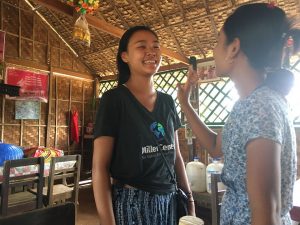
Second, I met a girl who spent her whole life in a small village in Bagan and taught herself English through her interactions with tourists. As she accompanied us around the village, she shared her life story and introduced us to other people in their workshops and homes. At one point, she turned to me and said, “You have a ‘Myanmar’ face.’” She then offered me thanaka, a beauty product and sun block that is common in Myanmar. I was delighted by her generosity and thanked her profusely. She then grabbed some materials nearby, grinded the paste together, and applied it on my face for me. Afterward, we continued to stroll around the village, meet more people, and lounged around in woven chairs while eating peanuts. The next day, I visited the village again just to see her and spend more time with her. Together, we ate more peanuts, talked about Myanmar, and enjoyed each other’s presence and company.

My friend in Minnathu village puts thanaka on my face in Bagan, Myanmar.

To me, these experiences stood out not only because of the relationships I formed, but also because they highlighted the life I would have lived if my parents never fled Vietnam. For example, it could have very well been my own home, with faded photos of my family members framed and hung on the woven bamboo walls. It could have been my plastic chairs worn from use and knick knacks full of personal meaning scattered around the house. It could have been the smell of my mom’s cooking in the kitchen, the warmth of the tea radiating through the small porcelain cup, and the steam rising to greet my face as I held the cup to my lips. In those moments, I saw the juxtaposition between my privileged life and the lives of those surrounding me. Each time I left the homes of those I formed friendships with, I felt conflicted.

In common, we came from similar cultures and I saw the mannerisms of my family members in these people. The divide became evident when I stepped on the plane to fly home, whereas those that I met in Myanmar continued where they left off.

Amidst the chaos of college, I use my experiences with social justice at home and abroad to keep me grounded. These moments have strengthened my perspective of myself and how I engage with the world around me. Furthermore, it has shown me that our thoughts, emotions, and idiosyncrasies are all facets of the human experience.

Altogether, these memories and relationships have affirmed that I want to spend my life serving and accompanying others. I have come to realize that assisting others does not mean implementing programs and leaving shortly after, but rather staying alongside those who need help and following through. As Paul Farmer wrote in Foreign Affairs, “true accompaniment…requires cooperation, openness, and humility.” Now, I know this is what I am capable of and what I am committed to.

Posted in Uncategorized | Leave a comment

The Calm Before the Storm

Preparing for the Global Social Benefit Fellowship in the spring was brutal. I balanced my extracurricular activities with my classes, this fellowship, and my social life. When I boarded the plane bound for Yangon with my teammates, Emily Alonso and Esther Bartlett, I was eager to embark on a journey solely focused on conducting action research.

As I arrived in Yangon, Myanmar, the first thing I noticed was the heat and humidity. While the weather may be different than what I am used to in sunny Santa Clara, my experiences with Koe Koe Tech, a social enterprise, and the relationships I have established in Myanmar have shaped my perception of this beautiful country and its people. After weeks of conducting research, my heart soars because I know I am interacting with people whose lives have been positively impacted by Koe Koe Tech.

Within the first couple weeks, my two team members and I had the opportunity to travel to Twante Township, which is near the Hlaing River. The homes and shops that we visited were constructed from bamboo and other various dried vegetation to make patchwork roofs and walls. In this area, we encountered a woman with a baby, a woman who was seven months pregnant, an older woman, and a handful of men. As we conducted our interviews, we found that the absence of electrical resources and scarcity of nearby health clinics contributed to the lack of access. For instance, we interviewed one woman who claimed that she had never been to a clinic and depended on traditional medicine her entire life. As we interviewed these individuals, we could tell that the resources we wanted to offer them were in demand. As we walked back through the muddy dirt path back to the truck, I could feel my brow furrow in critical thought. For ten weeks in the spring at Santa Clara, I conducted research on how Myanmar’s health infrastructure impacted the lives of people who lived in urban, per-urban, and rural areas. Here, I was face-to-face with these individuals and I had the opportunity to associate their faces with their respective stories and struggles. Through these interviews and interactions, I encountered the thread of humanity that connects all of us to one another.

Conducting interviews with one of our translators and an employee of Koe Koe Tech, Aung Nyein Chan.

Two weeks ago, we interviewed a mother with twins in Mandalay. Before we arrived, we composed questions on how maymay, Koe Koe Tech’s mobile application, impacted her pregnancy and influenced her decisions as a new mother. While we came ready to ask questions, nothing could have prepared us for the family’s hospitality and enthusiasm. When we arrived, we were surprised to find that the entire extended family had come for support. We spent hours talking and sharing personal stories with them. After the formal interviews concluded, we visited a cafe with some family members. Once again, our connections with one another blossomed despite linguistic and cultural barriers. Altogether, I am grateful to be a part of such a diverse and talented team.

Playing with one of the twins in Mandalay.

My experience in Myanmar has been further enriched by my relationships with not only my Santa Clara colleagues, but also with Misja Ilicsin and Steele Burrow. Misja is a Santa Clara University graduate and former Global Social Benefit Fellow. Her expertise in fellowships and Koe Koe Tech’s operations has been instrumental to our success here.

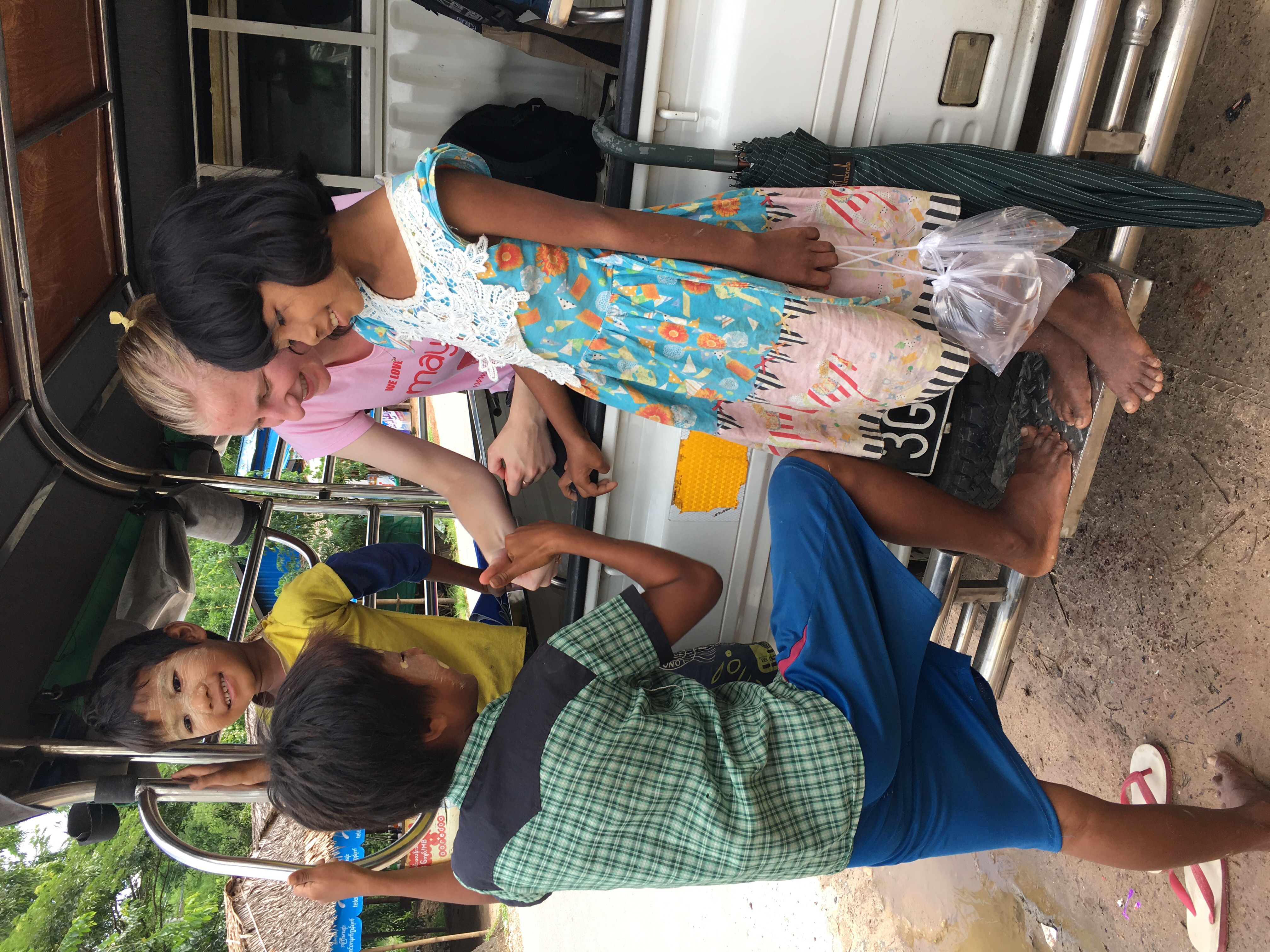
Misja playing with children in Twante.

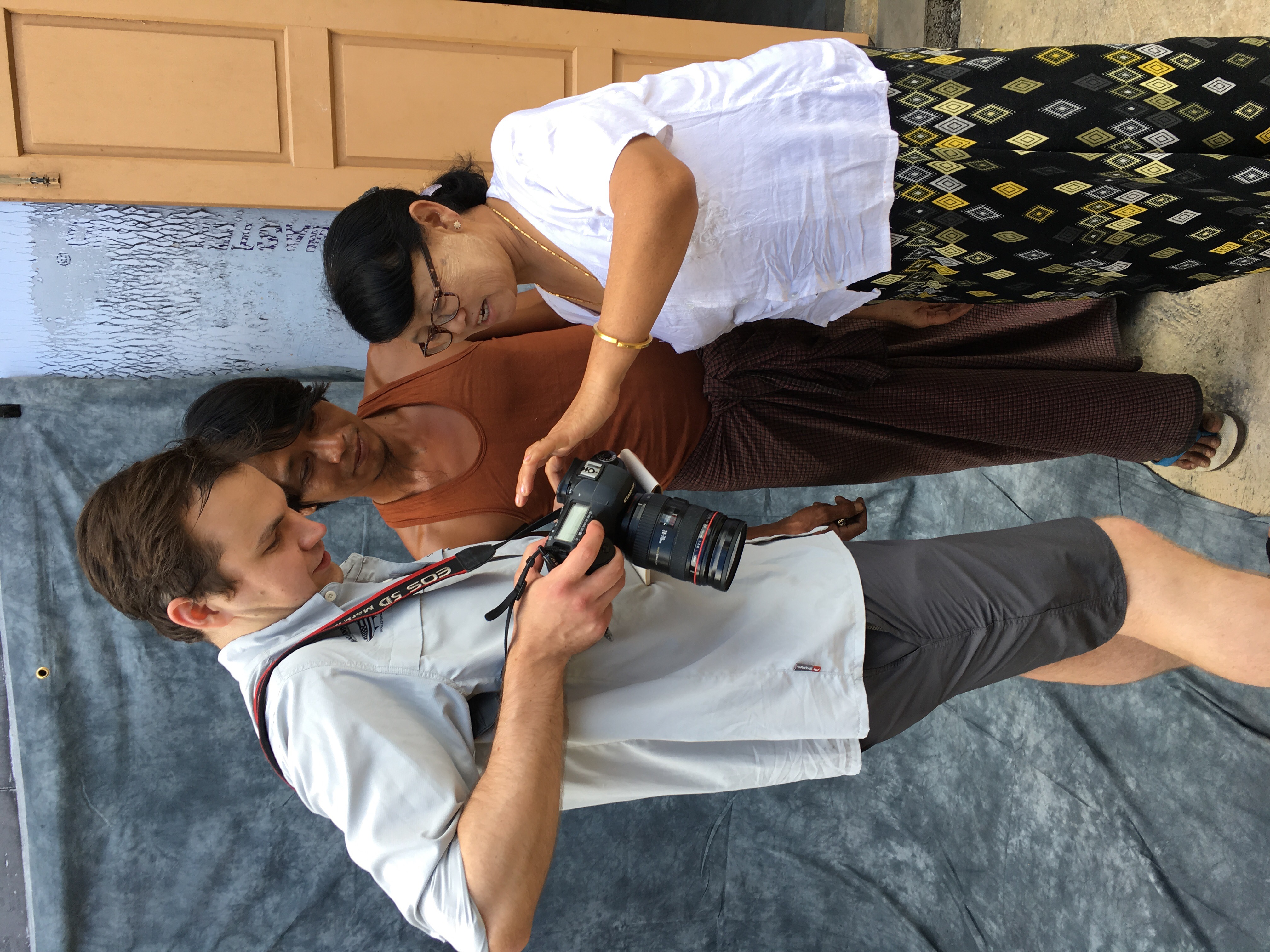
Steele is a graduate student in foreign policy at the Edmund A. Walsh School of Foreign Service within Georgetown University. His stunning photos and videos have provided us with a way to capture the essence of a person’s story in beautiful portraits.

Steele sharing his portraits with people we met at Inle Lake.

Altogether, each unique research project is improved by our relationships as coworkers and friends.

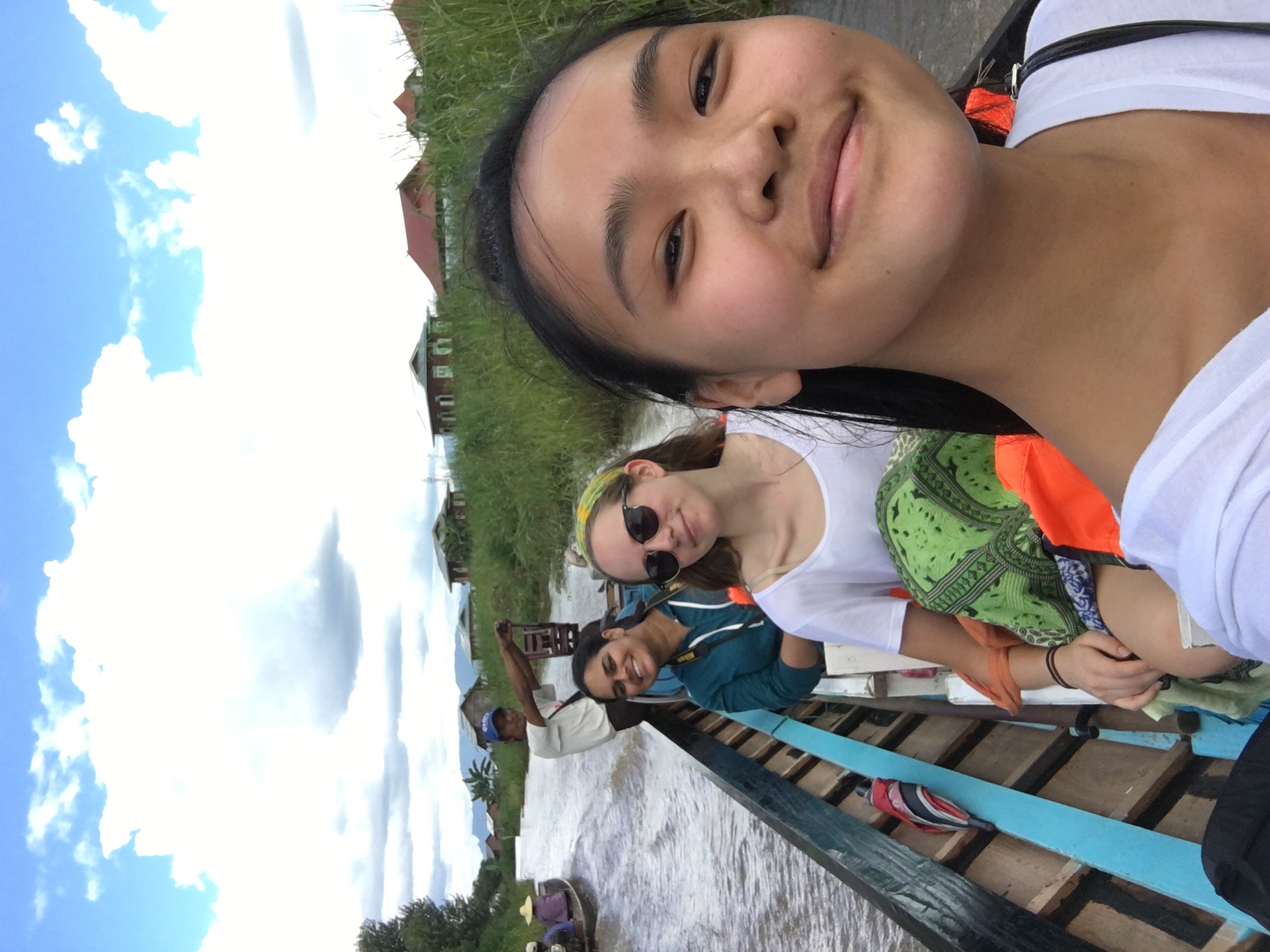
The SCU team riding on a boat at Inle Lake.

After our journeys to Twante, Mandalay, and Ayeyawady, we have scheduled more interviews for our last few weeks. In retrospect, my experiences with action research have taught me how Koe Koe Tech’s mission to revolutionize health systems operates under Myanmar’s rich history and cultural context. As I mentally prepare myself to return home, I am ready to face the whirlwind of classes, extracurricular activities, and social engagements. While the chaos of fall quarter is fast approaching, I am eager to produce deliverables that not only benefit Koe Koe Tech’s operations, but also affect the lives of others.

Posted in Uncategorized | Leave a comment