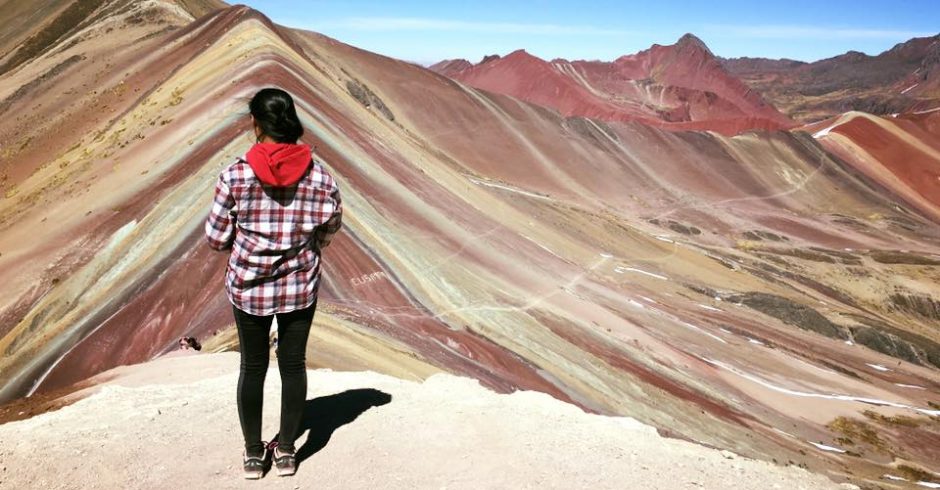
Upon reflecting on my acceptance as a Fellow, my mind flipped through my memories like pages in a book. I settled on three transformative moments that occurred during my childhood and my Fellowship experience in Peru. Truthfully, no written work can capture the depth of my love for my family or the experiences I had in Peru. These encounters have shaped how I see the world and have led me to the Global Social Benefit Fellowship (GSBF).
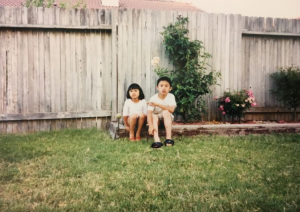
My brother and I grew up in a simple household, but my parents did everything in their power to make sure we were happy and healthy.
First, as a child of Vietnamese refugees, I grew up with the understanding that I was immersed in privilege. If my parents did not flee Vietnam soon after the fall of Saigon in 1975, my access to opportunities would be different. However, I was here, growing up with my brother in the US with food on the table and clothes on my back. I remember my selfless parents pooling together their resources so my brother and I could pursue our interests in art, extracurricular activities, and academics. I am grateful to my parents for teaching me the values of a rigorous work ethic, encouraging my pursuit of happiness, and instilling a commitment to education. Nonetheless, I grew up with a culture clash, where I absorbed Vietnamese values at home, but learned about American traditions in the classroom. In high school, for instance, I communicated with my parents and sought their advice for practically everything I did; however, my peers did not inform their parents about their extracurricular and academic activities. I realized that the communitarian values that I learned at home were different than what I observed at school. I recognized that my life would always contain conflict between my parents’ meaningful roots and my childhood in America. In fact, I became so engrossed in my parents’ experience that I produced a paper in my first quarter at SCU on culture clashes; I interviewed my parents and did extensive research to understand how their experiences profoundly affected my upbringing. Not only did it help me grasp the academic explanation behind our culture, but it also gave me the opportunity to bond with my family on a deeper emotional level. I did not know it at the time, but it was one of the first steps in my journey towards the GSBF because I discovered the importance of cultural context; it helped me draw a connection between my personal experiences with my family and my parents’ experiences in Vietnam.
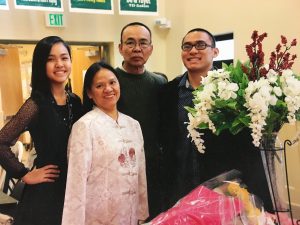
This photo was taken after my family and I celebrated mass together.
Second, as a Jean Donovan Fellow in Cusco, Peru for the summer of 2016, I worked with the Missionaries of Charity at an orphanage and recovery facility for people with special needs. While I was in Cusco, I witnessed a mother formally relinquish her son to the orphanage. The child was a five year old boy who was temporarily living in the orphanage already. He was severely underdeveloped physically and cognitively, and was unable to speak. One day, while I was feeding him, a woman I had never seen before approached me and waved me away. I respectfully left her with the child, and I went to assist one of the nuns. While I sat with her, she began to explain to me that the woman was the child’s mother. The nun told me that she had come to permanently surrender him because she already had two other children and could not afford to care for him at home. As I glanced over, I watched her gently lift him from his wheelchair in a blanket she brought from home and cradle him as she spoke sweetly to him. Her love for him was palpable, and it saddened me to think that she lacked the resources to care for her own son. When I came back to SCU, I returned to the classroom to delve into the sources of marginalization in Cusco, with a particular emphasis on social, political, and economic factors such as income inequality and cultural stigma. I realized that in order to truly enhance and understand my experiences, I needed the support of an institution that would not only prepare me to challenge unjust social equilibriums, but also support my insatiable curiosity and passion for issues such as social inequality and adequate access to healthcare.
Third, while I have a plethora of memories from Cusco that range from challenging to exhilarating, there was one particular experience that humbled me. One incidence that I remember is sharing a spiritual encounter with the Missionaries of Charity. Because I worked with the Sisters regularly, I shared stories of my personal life including my love for my family and my struggle with faith. One day, the nuns invited me to join them for mass before my shift. I nervously told them I would consider it because it was early in the morning and I was startled by their generosity. The next week, I anxiously entered the small chapel and chose a seat in the back corner. As mass began, I felt relaxed as I recognized various prayers and religious traditions. I can recall every detail of this mass in vivid detail: I remember the hardness of the wooden bench; I remember the voices of seven nuns reciting prayers in unison; I remember the texture of my scrubs against my skin; I remember looking at the prayer book and seeing where the pages were worn from the fingers of nuns who had used that same book before me; I remember my quivering voice as I recited the prayer of St. Francis, the patron saint of my high school; and I remember the tears as they rolled down my cheeks. I was overwhelmed by the magnitude of that experience, and overcome with tears. I realized that despite the different nationalities and languages that we spoke, the nuns welcomed me into their spiritual home to share this intimate experience.
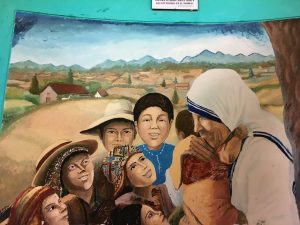
This is a mural at the entrance of the orphanage that I worked at in Cusco, Peru.
Looking forward, I am certain that my upbringing and my experiences at home and abroad have not only humbled me, but also intensified my passion for social justice. I am eager to embark on this journey as a Global Social Benefit Fellow and see what the future has in store for me.