
Amongst the flurry of academics, extracurricular activities, and my social commitments, it can be difficult to find time to sit down and reflect. Now that I am back in the United States, I have fielded countless questions about the weather, the people, and the food in Myanmar; however, I cannot seem to find the words to encapsulate my transformative experiences with Koe Koe Tech.
At first, seemingly meaningless memories come to mind. For instance, I recall spending countless hours in bumpy taxi rides and seeing motorcycles zipping around cars. However, I have more significant memories of mentally preparing myself for every interview. I would sit silently in the car and consider how these interviewees were going to share a glimpse of their lives with me. This was most obvious after the formal questions were answered and my notes were tucked away; there was always a subtle change in the atmosphere. The room seemed to collectively sigh as we all relaxed and enjoyed our time with each other. In these moments, I saw elements of my father, mother, and brother in everyone I interacted with. For example, I remember the outstretched hands of a baby as she reached for me. I remember the father who proudly looked on and smiled as his wife spoke about her pregnancy and their family life. I remember the mother who was so overjoyed that she wanted to drop everything and spend all of her time with her baby. I remember the older brothers of these children, who insisted on gingerly carrying their little siblings and looked adoringly at them.
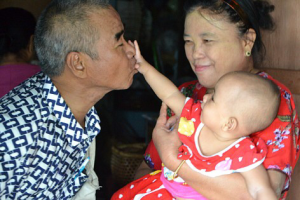
A grandpa plays with his grandchild in the arms of her grandmother in Mandalay, Myanmar.
These moments happened in a matter of seconds, yet they are imprinted into my mind. I vividly recall the feelings of familiarity. Even though I was thousands of miles away from home, I felt like I was sitting with my own family. In fact, two memories in particular have solidified my belief that the thread of humanity links us all.
First, while conducting interviews in South Dagon Township, I met a family of six. They answered my questions with enthusiasm and were excited to have me in their home. One daughter was eager to practice her English with me. Even though I was with a translator, she insisted on answering my questions in English. Her determination was evident, and the family was visibly proud of her. After she answered my questions, she introduced me to her grandparents, her parents, and her siblings. We sipped tea, chatted about television shows we liked, and relaxed in sturdy plastic chairs. This experience reminded me of my home, where grandparents, parents, aunts and uncles, siblings, and cousins gather together to eat and have casual conversations. The simple act of being with others and sharing this experience is something I have always craved when I travel abroad and I treasured these beautiful moments with those I interviewed or met on a whim.
Second, I met a girl who spent her whole life in a small village in Bagan and taught herself English through her interactions with tourists. As she accompanied us around the village, she shared her life story and introduced us to other people in their workshops and homes. At one point, she turned to me and said, “You have a ‘Myanmar’ face.’” She then offered me thanaka, a beauty product and sun block that is common in Myanmar. I was delighted by her generosity and thanked her profusely. She then grabbed some materials nearby, grinded the paste together, and applied it on my face for me. Afterward, we continued to stroll around the village, meet more people, and lounged around in woven chairs while eating peanuts. The next day, I visited the village again just to see her and spend more time with her. Together, we ate more peanuts, talked about Myanmar, and enjoyed each other’s presence and company.
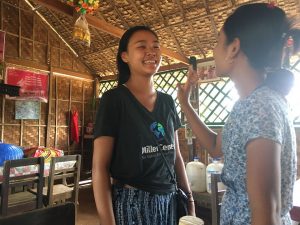
My friend in Minnathu village puts thanaka on my face in Bagan, Myanmar.
To me, these experiences stood out not only because of the relationships I formed, but also because they highlighted the life I would have lived if my parents never fled Vietnam. For example, it could have very well been my own home, with faded photos of my family members framed and hung on the woven bamboo walls. It could have been my plastic chairs worn from use and knick knacks full of personal meaning scattered around the house. It could have been the smell of my mom’s cooking in the kitchen, the warmth of the tea radiating through the small porcelain cup, and the steam rising to greet my face as I held the cup to my lips. In those moments, I saw the juxtaposition between my privileged life and the lives of those surrounding me. Each time I left the homes of those I formed friendships with, I felt conflicted.
In common, we came from similar cultures and I saw the mannerisms of my family members in these people. The divide became evident when I stepped on the plane to fly home, whereas those that I met in Myanmar continued where they left off.
Amidst the chaos of college, I use my experiences with social justice at home and abroad to keep me grounded. These moments have strengthened my perspective of myself and how I engage with the world around me. Furthermore, it has shown me that our thoughts, emotions, and idiosyncrasies are all facets of the human experience.
Altogether, these memories and relationships have affirmed that I want to spend my life serving and accompanying others. I have come to realize that assisting others does not mean implementing programs and leaving shortly after, but rather staying alongside those who need help and following through. As Paul Farmer wrote in Foreign Affairs, “true accompaniment…requires cooperation, openness, and humility.” Now, I know this is what I am capable of and what I am committed to.