After a challenging, humbling, and rewarding nine months, the fellowship has officially come to an end. Every step of this process has been a positive learning experience and has given me a stronger understanding of social entrepreneurship, others, and myself. Although I am still discerning the concrete career path(s) for me post-college, the fellowship has certainly played a significant role in shaping my desire to serve others and engage in creative work that is personally meaningful to me. The Solar Sister and social entrepreneurs whom I met and read about through this program have particularly impacted me. Many of them are not well-off in the traditional sense of typical Silicon Valley entrepreneurs, but each of them is extremely passionate about his or her work, demonstrating innovative thinking and tenacity to pursue their goals. Although they are young, the fellows in my cohort possess this same type of spirit. Simply surrounding myself and interacting with such dedicated people has further affirmed my desire to seek a profession that I truly, wholeheartedly believe in, regardless of financially superior alternatives out there. I look forward to carrying out this goal moving forward and seeing what the future will bring.
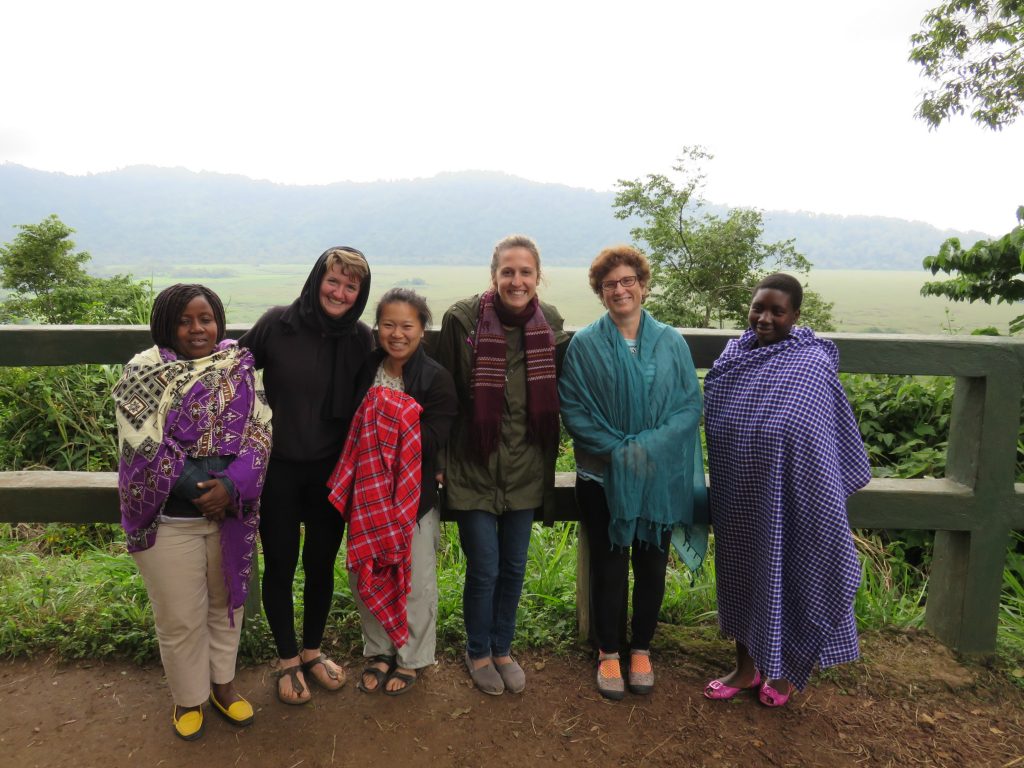
I’ve learned so much from working with this talented team!
Through this fellowship, I have also concluded that although international social entrepreneurship remains a field that I admire and respect deeply, it is not the route for me. My exposure to social entrepreneurship has certainly allowed me to gain new cultural awareness, greater compassion, better understanding of those living in poverty, and hope for the future, but at the same time, I am realizing that I am more equipped to impact my fellow neighboring Americans living in poverty before I can make a real contribution anywhere else. I struggle with this, because perhaps people are generally much worse off in other countries and I should commit to addressing that. However, I also feel the need to be honest with myself about the skills that I do possess, the best way that I can apply them, the difference that I am capable of making, and the reality that Americans need help too. This is not to say that people should not go out into the world to help people in other places, as they certainly should if they can. However, for me, I feel that it is important to live in a host country and familiarize myself with its society first in order to be an effective agent of change. Otherwise, I won’t understand the very people that I am trying to help.
There were so many things that I didn’t know in Tanzania, including how to speak Swahili, how to get around, where places were, what people ate, and general cultural customs. My lack of knowledge in all of these areas held me back from being efficient and fully incorporating myself into the local community. Because I couldn’t communicate with many Tanzanians, it was hard for me to build strong relationships and perform the research in a timely manner. In many ways, the research assistants were much better at conducting surveys because the participants trusted them and they could at least hold a conversation. On one of our days in Tanga, I did around 10 surveys compared to Revina, one of our research assistants, who did 18–nearly double–in the same amount of time, and this type of occurrence was not uncommon. As much as I loved being abroad, I’m not sure I had much to offer to the people there besides being a companion and friend, unless I was there in the long-term. Even though the focus of this fellowship was to produce deliverables in service to a social enterprise, and I wasn’t there necessarily to “change the world,” overall it seemed to me that instead of doing this type of work ourselves, maybe our focus should be to train locals to do it, as they might be more capable and productive than foreigners.
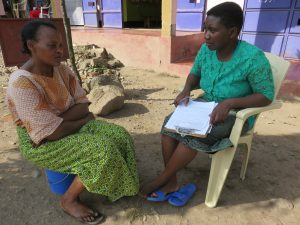
Revina conducts an interview with a Solar Sister customer in Swahili.
Furthermore, the fellowship has caused me to reflect a great deal on how I can help people fulfill their spiritual needs. My experience with social entrepreneurship thus far has focused primarily on addressing basic material considerations for the poor. Lately I’ve been wondering that if people are only being nourished in this way without regard for the state of their souls, then is there really any deeper meaning to what we’re doing? I’m not sure how social entrepreneurship currently plays and/or would play a role in a more spiritual sense, but it’s definitely something to think about. To me, spiritual needs are even more important than physical ones (John 6:27). Recently, my pastor prayed at the end of a sermon, “God, we know that we aren’t just here to survive.” That statement really stood out to me, because it immediately made me think about the Tanzanians that I met this past summer–a lot of whom lived humble lifestyles on minimal resources in rural villages without electricity. When my pastor spoke that sentence, I thought to myself that indeed the rural poor in Tanzania aren’t just alive to survive, because life isn’t just about surviving. They exist for a reason, though in fact, many of them are simply trying to survive. Their futures are filled with uncertainty as they live day by day just getting by. In my mind, this world that they know can’t possibly be it for them. There must be hope, and while I do believe that the mission of development work is good, I am beginning to wonder if it is enough.
A couple of weeks ago, I passed by a bookstore downtown that featured Anita Moorjani’s What If This is Heaven? While I haven’t read the book so I don’t know its content, the title at face value brings up a good point, because some people do live like this world is it, like the problems that people face in this world are their most pressing need. I, on the other hand, believe that this is not the case. There’s no way that earth is the end. If this world is it, then how can living in poverty be all there is for some people? If that were the case, then life would be a grave injustice in that certain people are simply born into prosperity while others are not. There has to be something more. (I would be curious to know what some of the people who I met in Tanzania would say about this.) Being in a developing country likewise led me to think about questions such as: how can a good God exist if He allows suffering to happen? While I’m not at all a reader, I did end up buying C.S. Lewis’s The Problem of Pain at a bookstore in Uganda on the way back home this summer and would highly recommend anyone interested in this question to look into it. I’m not quite sure where I’m going with this, but I guess that these are just a few thoughts that I am still wrestling through and exploring further. Nevertheless, one thing that I have settled on is that I’m not perfect and I can’t meet anyone’s spiritual needs, but I know someone who can, and His name is Jesus. I want to take part in meeting people’s earthly needs but beyond that, also take an active role in pointing people to the truth, which I believe is spiritually fulfilling and embodied in John 3:16, which says, “For God so loved the world that He gave His one and only begotten Son that whoever believes in Him shall not perish but have everlasting life.”
As a result of this fellowship, I feel that volunteering and working for an organization with social programs/initiatives are the best kinds of social engagement for me, as nothing can replace face-to-face connections with others, which can be fruitful and meaningful to both the receiver(s) and giver. While I didn’t exactly volunteer in Tanzania, I did spend a lot of time with people from different backgrounds, and just being with them gave me joy. Even though I wasn’t able to develop very profound relationships during my time abroad, I loved listening to people’s stories and learning about their culture. In fact, as President of UNICEF Campus Initiative at SCU this year, I decided along with the rest of the leadership board that our club would incorporate volunteering as part of our focus in addition to existing fundraising efforts. Based on my personal experience, I believe that serving people and spending time with them provides value to all involved.
Moreover, humanitarianism is no longer an extraneous part of my life that I pursue only if I have free time or when I am doing well. Living out a lifestyle focused on altruism and achieving greater good in Tanzania compelled me to believe even more that in all circumstances, it is essential to consider others as best as I can, as that is one of God’s major purposes for my life. As a result, I am very interested in finding a job after graduation that allows me to engage in nonprofit work. I am specifically considering working on a company’s community outreach team, leveraging my communication writing and marketing skills. I do not know exactly what this will look like, but using my professional career to promote causes that are personal to me, such as community engagement and education, appeals to me very strongly.
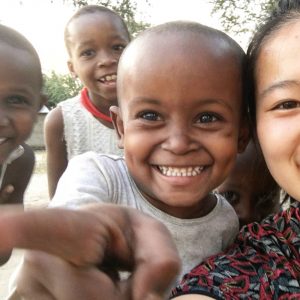
After we finished our research in this village, we had some time to play with the kids and take fun selfies. I absolutely loved hanging out with them!
Another vocational route that I would like to explore at this time is teaching. Although I never envisioned myself as a teacher growing up, I started considering it as a possibility after working with Tanzanian research assistants over the summer who were good at English but still learning. In reviewing their surveys every day and teaching them the meanings of certain phrases and words, while trying to understand their notes as well, I discovered how much I enjoyed sharing with them about the English language and seeing the light bulbs go off in moments of understanding. When I returned home, I was inspired to research various teaching English as a Second Language (ESL) abroad programs in addition to teaching programs in general. I ended up applying for an ESL teaching assistant scholarship abroad and signed up to teach children’s Sunday school at my church in December for the first time. I’ve never done teaching before, but I’m excited to try something new and see how these opportunities turn out.
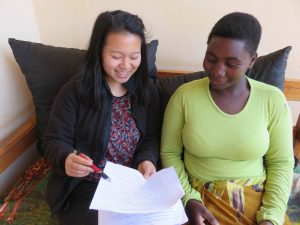
At the end of each day in the field, I reviewed Revina’s surveys and would go over them with her the next morning to make sure that we were always on the same page. Throughout the process, I was able to teach her more about the English language and better understand how she was thinking about the survey.
When people ask me about the fellowship, I always think back to spring quarter of sophomore year, because that’s when I truly began this journey and first learned about social entrepreneurship. I was enrolled in HNRS 120AW: Entrepreneurship for Social Justice, where Dr. Kreiner introduced me to the ways in which social entrepreneurship differs from charity. Now that I’ve been involved with social entrepreneurship and witnessed how it works through Solar Sister, I have come to believe that both charity and social entrepreneurship are necessary for addressing the world’s problems, and that one is not better than the other. Being in-country allowed me to identify up close the imperfections of social entrepreneurship, as well as recognize how philanthropy can fill in the gaps and provide the necessary resources. Social entrepreneurship, in theory, is ideal, but its real-life implications revealed to me some of its practical shortcomings. Charity is needed to start and fund social enterprises, at least initially, though sustainable solutions are what truly create long-term change.
In terms of what has evolved since the beginning of the fellowship itself, I feel like so much has changed. I’ve grown so much as a person from this experience and did so many things that I didn’t think that I was capable of doing, such as traveling internationally alone, temporarily managing a major research project, contributing to a pending white paper, keeping up with such accomplished research partners, learning a little bit of Swahili, meeting so many new people, and surviving the workload of the fellowship. At the same time, I now see that the world is a much more broken place than I previously thought, and thus, many opportunities exist for me to make a difference. I’ve always heard about poverty and environmental issues in Africa, but I admit that previously it was difficult for me to feel connected to the people there affected by these issues. Visiting Tanzania has made me feel far less removed, reminding me that these issues do exist and showing me how they play out. It’s as if I’ve always had a blurry understanding in kind of knowing about these things, but for the first time, I actually put on my glasses and saw for myself how people in another part of the world live.
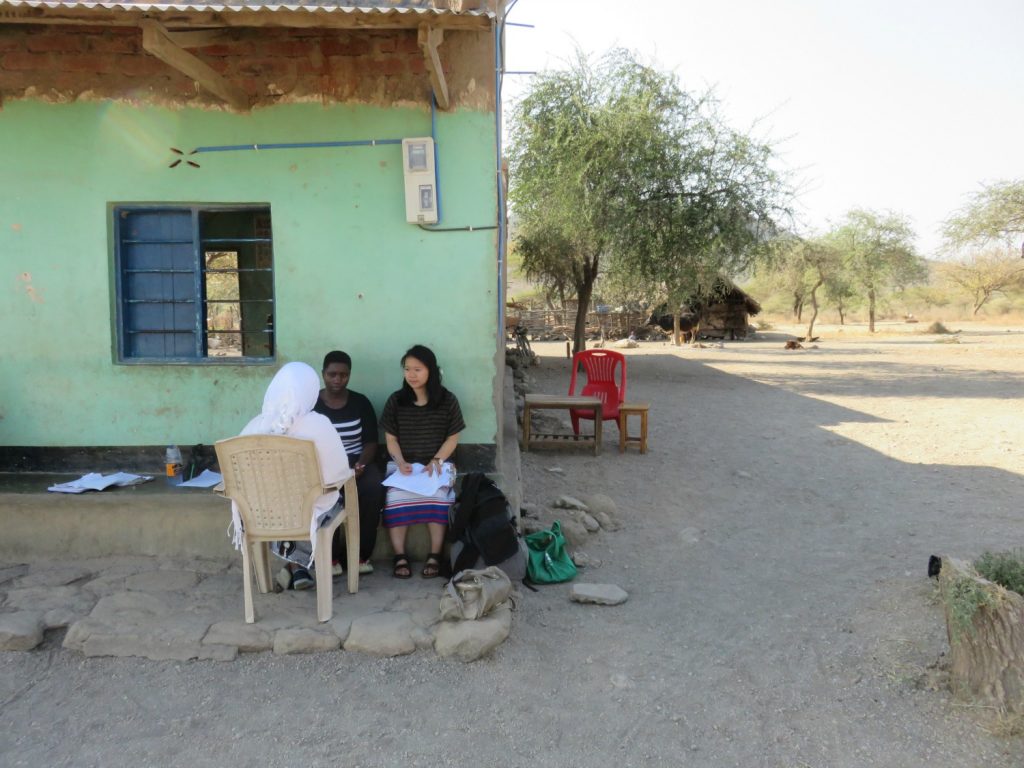
In this picture, Revina and I are surveying a Solar Sister Entrepreneur in Karatu. We conducted the interview outside of her restaurant. Not only does she manage multiple jobs but she also takes care of more than 10 orphans.
I firmly believe that we cannot stay in our Silicon Valley bubble, living a comfortable life without dedicating any attention or action towards addressing the fact that there are people suffering greatly, and yet call ourselves good people. Serving humanity doesn’t necessarily have to occur through social entrepreneurship specifically, though I do believe in the value of social entrepreneurship in helping people. Considering what I witnessed and experienced in Tanzania, it’s impossible for me to come away from this fellowship unchanged. Especially now that I have seen with my own eyes the reality outside of my little world, I feel a responsibility to do something about it. I can’t continue living the life that I have and pretend that I never saw anything. As I come away from this fellowship, I am humbled by the blessings that I do have, the opportunity to perform meaningful research, and the chance to immerse myself in a new culture and country. While I don’t know what’s next for me after graduation, through this fellowship I have learned to be much more comfortable with this uncertainty. No internship or class could replace how the GSBF program has transformed me, and while it was by no means an easy fellowship, it has given me a much stronger sense of who I am, what I care about, and what I’m looking for in life.
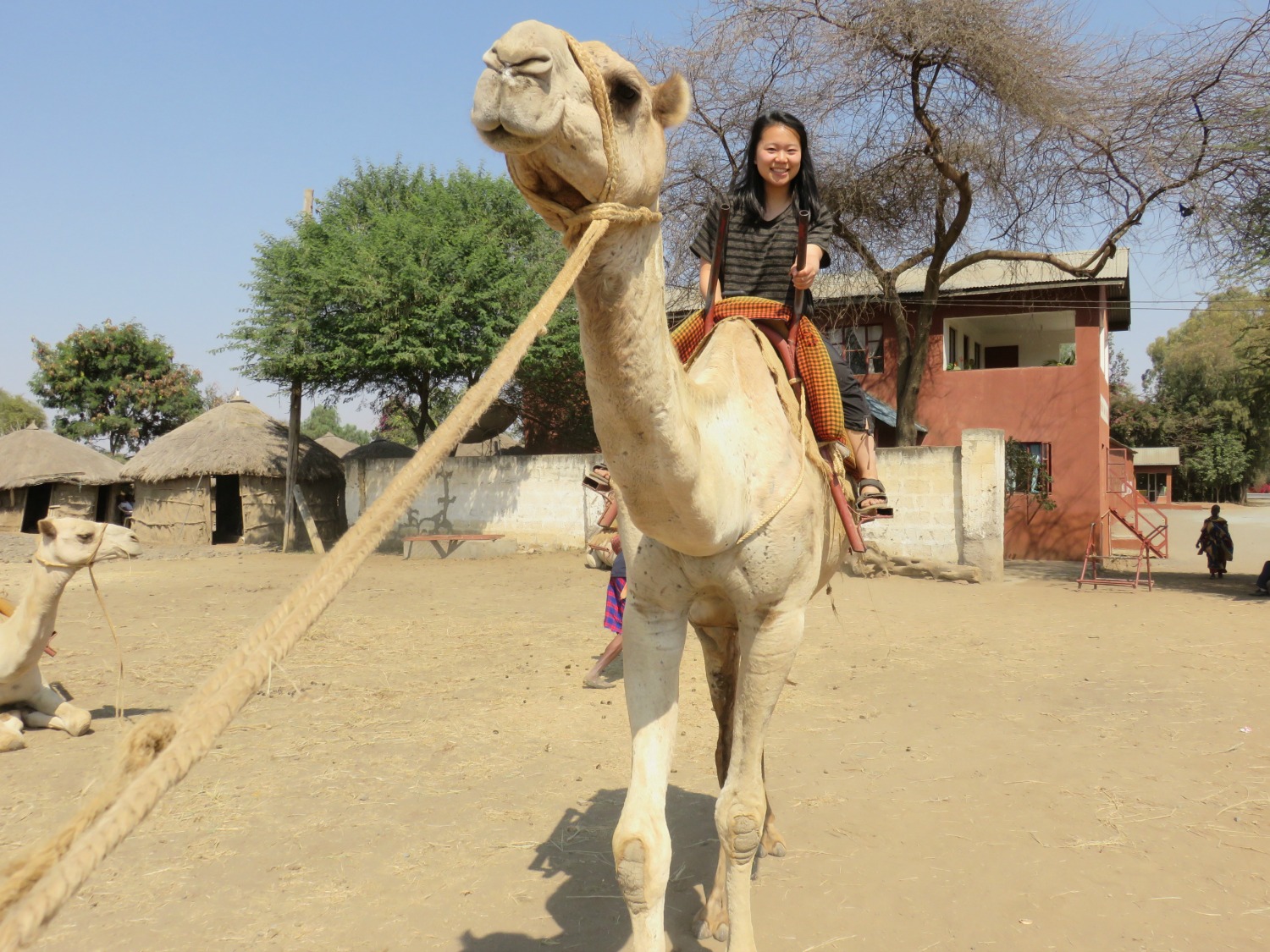
Last but not least, I would like to give a huge thank you to the Miller Center for Social Entrepreneurship, Keith, Thane, Solar Sister, Dr. Gray, Spencer, Alaina, and the rest of my fellowship cohort. Each and every one of you has been a major part of my GSBF experience. It’s been a pleasure.