
Am I Ready for the Future?

Full Circle

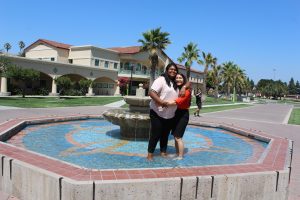
One of my first days at Santa Clara University

Almost four years ago today, I was in the midst of the college application process. Living in Tokyo made it challenging to sign up for tours or visit schools in the U.S. while living across the Pacific Ocean. So I constantly signed up for email and paper newsletters from universities. I wanted to gather as much information as possible before the application process. The summer of my junior year of high school, I was at home in Washington. One day during the summer, my dad put an admissions booklet from Santa Clara University on my nightstand that highlighted undergraduate students’ experiences abroad in becoming global citizens, an important quality that I was looking for in a university. He marked a page that described a Global Social Benefit Fellow (GSBF) fellow that worked with a social enterprise in Latin America. I remember reading the article and being amazed by this kind of work. I was very interested in this opportunity for undergraduate students but also a little confused, because I didn’t know anything about social entrepreneurship.

Now, this would have made a great story if reading about GSBF in an admissions booklet had been the reason I chose to come to Santa Clara. Unfortunately, that isn’t the case. A few weeks into the fellowship during a meeting with Keith and Nithya, I realized I had heard about GSBF well before starting my first day at Santa Clara; it was from a Santa Clara admissions booklet prior to the application process. Reflecting back on the fellowship now, my life at Santa Clara seems to come full circle. GSBF has been one of the most positive and transformative experiences during my time at Santa Clara, and I can’t even begin to imagine how my life here would have been different without it.

Community is Everything
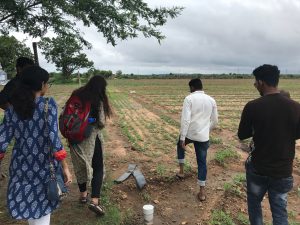
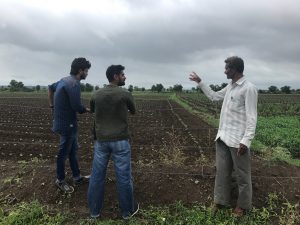
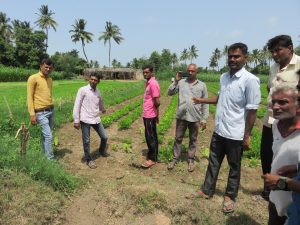
Walking towards Imran Bhai’s farm house

This fellowship has helped me discern how much I enjoy living in and working with communities. Growing up in an international community, I consistently met new people through friends or friends of friends in the most random places (airports, conferences, college, restaurants, etc.). I loved exchanging stories and building relationships with students from other international schools about sports tournaments and vacation destinations. Even though the international community is scattered across the globe, it always feels smaller and more close-knit than many would think. Then coming to Santa Clara, once again I admired the strong community. This was one of the main qualities of the campus environment that made me fall in love with Santa Clara. Through my experiences, students and professors are willing to go out of their way to help one another succeed. I also love how campus is filled with recognizable and new faces. I feel lucky to be apart of the Santa Clara community now and forever.
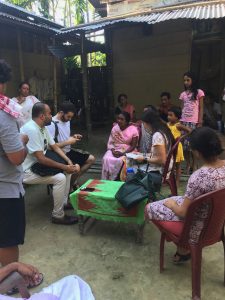
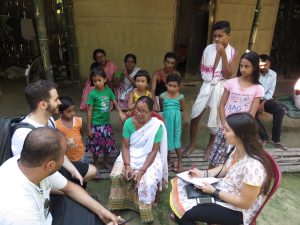
Interviewing Pranita in Assam with her family standing nearby

However, it wasn’t until my GSBF experience that I truly understood how important community is to me. During field visits, Nithya and I visited two to three villages per day in a specific region of India. Since we needed to gather lots of data, we interviewed hundreds of individuals in rural communities. The conversations usually lasted around 15-20 minutes depending on how talkative the interviewee was feeling. But, there were some interviews that lasted longer. Sometimes interviewees would show us their home, their parent’s home, and their friends’ home. These were my favorite interviews, because I felt like I had a better understanding of how these people engaged with one another and in their respective communities. It was especially intriguing to see how families set up their homes. I noticed that many families had open spaces to seat groups of people. They owned numerous cups, chairs, plates, and mats in case people came to visit for casual or special occasions. These communities felt welcoming and open with everyone in the village. I loved that aspect of these rural villages and felt more comfortable being in them. Wherever I end up in the future and whatever I am doing, I know that I want to immerse myself in a strong community.

What’s Different?
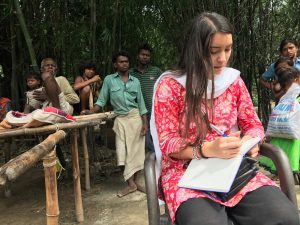
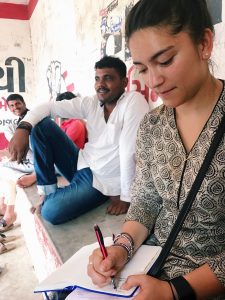
Taking ethnographic field and interview notes in a rural community in Bihar

This fellowship has been both an incredible and challenging experience. I have learned so much about myself and my role as a global citizen. Since being involved in GSBF, I have once again learned the power of individual reflection. In elementary and middle school, I used to keep a journal. Although I didn’t write in it everyday, I would write an entry if something impactful happened like when my dad surprised me with a puppy at the airport or my best friend moved away to Washington D.C. It helped me reflect and process how I was feeling at the time. Then in high school and college, I felt too busy with school, extracurriculars, friends, and family to have a journal for reflection. But these vocational essays have helped me process my experiences and my attitude towards these experiences in a beneficial way to fully understand them. This introspective process is sometimes difficult for me, but I think it helps me learn more about myself. While I won’t have any vocational essays due after GSBF, I purchased a journal to continue reflecting on my life, how I perceive it, and what I hope for myself in the future.
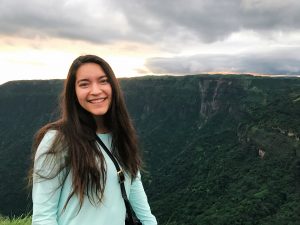
Visiting Nohkalikai Falls in Shillong

Not only have I learned the importance of reflection, but I have recognized my abilities as a leader. Ever since I can remember, I’ve thought of myself as a “follower.” To me, a leader tended to be a confident, commanding, and popularly recognized person. In addition, it would be clear who was a leader and who was a follower, and those roles would be static. Now looking back, my definition of a leader was unbelievably narrow. Heroic Leadership, a book by Chris Lowney about leadership principles to create lasting success, has helped me better grasp what it means to be a leader. He claims that self-awareness, ingenuity, love, and heroism are the four guiding principles for successful leadership. My biggest takeaway from Lowney is that all of a person’s daily actions and encounters towards others add up to to make them a leader. By shifting my mindset and being mindful of my everyday acts, I believe I too can become a good global leader.

Lastly, after 20 weeks of Monday/Wednesday classes at 3:30 PM and 8-weeks in India, I’ve gained 17 amazing friends and 3 phenomenal mentors. I will be forever grateful for this experience and for everyone who supported me along the way.
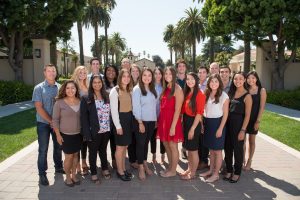
What a great cohort! (Emily not pictured and dearly missed)

Uncertainty
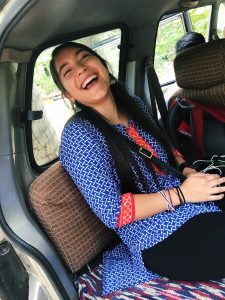
Smiling through the uncertainty of my future

As GSBF is wrapping up and the end of senior year is near, I am faced with the uncertainty of the future. I have questioned my vocation many times over the past nine months, which has been both challenging and valuable. However, this fellowship has strengthened my desire to work in the field of international development. I want to immerse myself in a community, learn about a different culture, and work directly with people. After returning from India this summer, I decided to apply for an English Teaching Assistantship through the Fulbright Program. While I’m uncertain if I will be awarded with this wonderful opportunity, I know I will strive to pursue a career in international development in one way or another.

Posted in Uncategorized | Leave a comment

What I Learned After Being in India for 8 Weeks

8 weeks later – Nithya and I are still best friends

55 days since Nithya and I were living in India for the summer. While my life now seems to be filled with class, work, and extracurricular activities, I miss the long van rides to field visits, lunches in the Awaaz.De office, and countless interviews with friendly rural villagers. My experience in India was unforgettable, and over the course of eight weeks, I learned many important lessons about life and myself.

  • My love for India continues to grow.

Although it had been eight years since I had been back to India, I felt more at home than ever. All of the sounds, smells, and sights came rushing back to me even after taking my first step off of the plane in Ahmedabad. There are so many things I love about the history, environment and culture of India, but it is the people that really make it special. While I still keep in touch with friends from growing up there as a child, I’ve been able to develop new friendships. India will always have a special place in my heart, and I will continue to return back.  

Exploring Kumbhalgarh, a fortress in Udaipur


  • Certain problems are insignificant compared to those of others.

Ifran Bhai pointing out his new cotton crops after the previous ones were damaged by a pink worm

Since returning from India, I have noticed that the problems people are concerned about are little things compared to the daily of those I encountered in India. Some people may worry about or get upset over things like spilling coffee on a new white shirt or cracking their iPhone screen. While at the same time, individuals halfway across the world may not have access to a secure home or access to clean water. Some of beneficiaries I interviewed constantly needed to overcome obstacles. I remember a farmer in Gujarat named Ifran Bhai explaining that a pink worm contaminated his cotton crops causing a 30% loss in outputs and profits. We visited his farm and he showed us all of his replanted cotton crops, which were late and costly. The man explained that his family would have to make sacrifices on other things in their lives like food choices or a child’s education to make up for the agricultural loss. Additionally India struggles with high rates of impoverished individuals. During our daily commute, Nithya and I usually saw a little girl in dirty and torn dress come up to our auto and beg for money. She would stare up at us, lift her small hands to her mouth, and then tap our knees to gain our attention in hopes of receiving a few rupees for food or water. These moments puts problems in perspective. I am so fortunate to have the life that I do. But seeing how other people must live has shown me that I have a huge responsibility to help others in need.

  • Communities are stronger than they seem.

Because Bihar is known for high rates of crime and government corruption, our families were nervous upon hearing that we will soon visit it to document the use of Awaaz.De’s technology by JJSS. Shortly after arriving at our hotel, the manager exclaimed we couldn’t go outside because the Nepalese border was only 14 km away. Incredibly confused, we looked at each other and then back to the manager. When he learned we were American, he immediately called the police to inform them of our upcoming stay in his hotel.

Needless to say, Nithya and I got spooked about spending a few nights in Bihar. The next day before going out into the field, we dressed as conservatively as possible and brought along pepper spray and a whistle (thank you Mr. Vemireddy) for protection. But, our worries flew away after our first interview. Through our conversations, the voice messages supported a strong sense of community

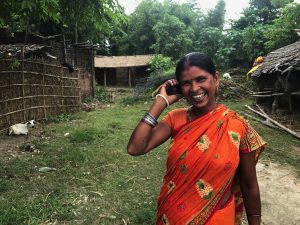
Asha Devi using her feature phone to listen to the voice messages

A woman named Asha Devi shared a story about how a few months ago, land dispute nearby led to the deaths of two villagers from the poorest caste in front of police officers. She elaborated how a voice messages informed the members of JJSS that an organized protest will happen in response to the police officer’s’ inaction.

So one of the voice messages reported that there was an organized protest against these government officials. People came from all different villages, and Asha Devi brought forty people from her village to protest together. Many of the villagers probably did not know the two people who were killed, but still they supported one another and the larger community that was mourning the loss of those lives. This story showed me that despite issues of crime and corruption, there are still strong village communities that will not tolerate injustices and will defend the safety of individuals. After hearing countless stories like this one, I felt safer in the rural villages than the urban areas.

  • A sparked interest in social entrepreneurship and the potential it has to create positive social change.

Ever since I was little, I have had a strong personal commitment to help others in any way possible. Throughout middle and high school, service was my primary approach to accomplishing this goal. I was heavily involved in service trips abroad by raising money and traveling to rural communities in Costa Rica, Cambodia, and Indonesia to construct homes, paint hospitals, repair school buildings, and provide donations. Although I met many wonderful people, these trips lasted around a week, which was never enough time to feel fully connected to the community. Although I helped to make a positive impact through physical work and charitable donations, I felt like I was inserting myself into these people’s lives for a short period before quickly leaving soon after. There were few opportunities to learn about why the social injustices existed in these disadvantaged communities.

Interviewing a woman in Assam about financial literacy and Awaaz.De’s voice messages

However, my experience with Awaaz.De and social entrepreneurship was completely different. Nithya and I conducted interviews with the beneficiaries of Awaaz.De’s mobile technology platform. In talking with the end users, we learned about their daily lives, personal experience with the voice messages, and suggestions for improvement. Although people were shy at the beginning of the interviews, eventually they spoke up more and appeared comfortable sharing their opinions. I loved being engaged in the community to have a better understanding of their daily struggles and how they tackle different types of problems. Taking notes on these issues to give back to Awaaz.De will not only help individuals but larger communities in India too, so that Awaaz.De can improve the content or technical aspects of the voice messages. I think this type of research empowers people and opens them up to sharing, because they are more aware of their role in sparking long-lasting positive change. I felt like I established more relationships with people and communities. Through my experience with this fellowship, I hope to continue my involvement in social entrepreneurship in the future.

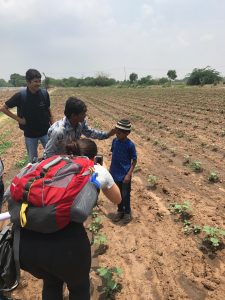
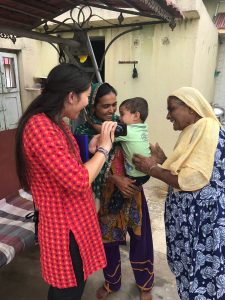
Taking photos of a farmer’s son in Gujarat


Posted in Uncategorized | Leave a comment

8 Years Too Long

Since departing California in late June, Nithya and I have traveled to three states, four major cities, and over twenty rural villages for field visits in India. We’ve been on all kinds of trains, planes, and automobiles at all hours of the day to reach certain villages. Even though the transit routes are long (and Nithya took dozens of sleeping selfies of me), it has been worthwhile to meet new people in various places and to talk to them about their experiences using Awaaz.De’s voice messaging technology.

Taking notes after interviewing a farmer named Imran Bhai from Chotila, Gujarat

Depending on the village, we either try to meet in a central location or sit down at a beneficiary’s house. After starting the interview, a crowd containing of adults, elders, and even young children will form around us curious to see what is going on. They either greet us with warm smiles, a small bow, a classic Indian head bob, or a combination of the three, and people will always always always offer us chai. Men and women will quickly race to pour the hot chai in a small cup or round plate, but it will undoubtedly be extra sweet because of the numerous spoonfuls of sugar they add. This kind and thoughtful gesture from the beneficiaries and their families not only warms my stomach but also my heart.

Farmers in Kodinar, Gujarat giving us a tour of their groundnut fields

My favorite part of this experience has been getting to know the beneficiaries and their families better. Most of the interviews last around 15-20 minutes. However, there are some beneficiaries who are particularly invested in using Awaaz.De’s technology, so they talk longer and invite us to their homes. For example, on the first day in Kodinar, Gujarat during our Ambuja field visit, while conducting an enriching group interview with six male farmers, they gave us coconuts that they handpicked from their farms. Even though there are language barriers, we all sat around laughing and sipping on refreshing coconut juice. Then, the farmers showed us their farmland and newly built homes. We ended up walking around three different properties to see their bedrooms, kitchens, mangers, wells, and crops. Many of their wives and children, hiding from the heat by sitting in their homes with fans, would interact with us. They would point out new additions to their farms like tractors, irrigation systems, or livestock that they were able to buy after saving money. Proud of their own accomplishments, these farmers loved explaining each location.

Showing a grandmother, mother, and son a photo I took of them

I have some wonderful memories of interviewing people in the field. There are many people I’ve met with contagious smiles or a fun sense of humor that I’ll never forget. Generally all of the villages we have visited have been incredibly friendly. After understanding the purpose of our visit, beneficiaries are willing to answer our 25-question survey by sharing statistics, stories, their experiences, and providing suggestions for improvement. Some beneficiaries at the end of interviews tell us, “We feel so lucky you came to our village.” But really, Nithya and I are the lucky ones. These people have welcomed us into their homes without hesitation so that we can learn more about their lives.

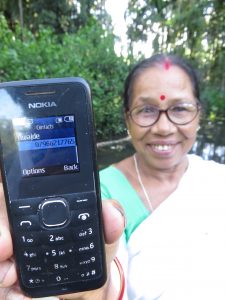
One of my favorite experiences working in the field with Awaaz.De was during the CRISIL field visit. We were going to different villages near Guwahati and asking women questions about a financial inclusion program that used Awaaz.De’s technology as a supplemental piece to the program. Throughout our field visits Awaaz.De’s team members have been the ones translating for us, because many of them can speak multiple languages. For this visit, Drishty from the Engagement Team, and Elliot and Chirag from the Business Development Team came with us. On the second day, we talked to a particularly chatty women’s self-help group. As we were asking questions about the voice messages, the women became more enthusiastic to share what they had learned. Then we asked if they had saved the number. I’ll never forget the happy looks of surprise on the member’s faces when the women said they had the phone number saved under Awaaz.De. They both looked at one another and completely lit up. Then a few women pulled out their phones and showed us the contact name. As Dristhy and Elliot were reading Awajde or Ahwazde from the phone, they could not stop smiling with excitement. They were so happy with the responses from the women. Some women had saved the phone number and a few had even memorized it. It was a moment of surprise and gratitude in which they realized their hard work at the office was making a difference in people’s lives. Awaaz.De’s team members truly care for the use of their technology and its impact on others.

Kungalata showing her mobile phone with Awaaz.De’s number saved

An interesting part of this journey is coming back to India after having left for 8 years. Even though I was able to travel across the country while growing up in New Delhi, there were still many areas I had never been to. India is filled with hundreds of dialects, cultural norms, landscapes and ways of life. I’ve loved the opportunity to explore new cities, states, and villages. Spending time in Guwahati, Assam felt more like Southeast Asia rather than India because of the lush greenery and people’s distinct facial features. The towns of Chotila and Kodinar in Gujarat were heavily influenced by communities’ livelihoods of agriculture and livestock. Finally in Araria, Bihar, although known for crime and corruption, it seemed like the communities were strong and supportive of men and women wanting to work. These are only a few of the things I noticed during our travels. These experiences have furthered my understanding of how diverse India is as a country and the billions of people that live here.

With only a few days left, I’m trying to soak in all of the sounds, smells, and sights around me. It seems like 6 weeks have flown by in a heartbeat, and I’m suddenly reminiscing about all of sweaty interviews, 3-hour road trips, and long office days. Although I’m not quite ready to go back yet, I’ve had an unforgettable journey here in India. This experience has introduced me to hundreds of new people and challenged me in new ways. I can only hope that it won’t take me another 8 years to come back to this wonderful country.

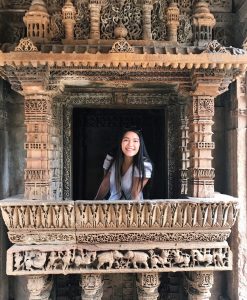
Exploring Andalaj step well near Ahmedabad, Gujarat

Posted in Uncategorized | Leave a comment

Hello world!

Welcome to Blogs@SCU Sites. This is your first post. Edit or delete it, then start blogging!

Posted in Uncategorized | Leave a comment