Full Circle

One of my first days at Santa Clara University
Almost four years ago today, I was in the midst of the college application process. Living in Tokyo made it challenging to sign up for tours or visit schools in the U.S. while living across the Pacific Ocean. So I constantly signed up for email and paper newsletters from universities. I wanted to gather as much information as possible before the application process. The summer of my junior year of high school, I was at home in Washington. One day during the summer, my dad put an admissions booklet from Santa Clara University on my nightstand that highlighted undergraduate students’ experiences abroad in becoming global citizens, an important quality that I was looking for in a university. He marked a page that described a Global Social Benefit Fellow (GSBF) fellow that worked with a social enterprise in Latin America. I remember reading the article and being amazed by this kind of work. I was very interested in this opportunity for undergraduate students but also a little confused, because I didn’t know anything about social entrepreneurship.
Now, this would have made a great story if reading about GSBF in an admissions booklet had been the reason I chose to come to Santa Clara. Unfortunately, that isn’t the case. A few weeks into the fellowship during a meeting with Keith and Nithya, I realized I had heard about GSBF well before starting my first day at Santa Clara; it was from a Santa Clara admissions booklet prior to the application process. Reflecting back on the fellowship now, my life at Santa Clara seems to come full circle. GSBF has been one of the most positive and transformative experiences during my time at Santa Clara, and I can’t even begin to imagine how my life here would have been different without it.
Community is Everything
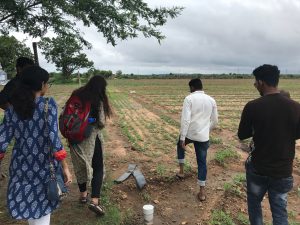
Walking towards Imran Bhai’s farm house
This fellowship has helped me discern how much I enjoy living in and working with communities. Growing up in an international community, I consistently met new people through friends or friends of friends in the most random places (airports, conferences, college, restaurants, etc.). I loved exchanging stories and building relationships with students from other international schools about sports tournaments and vacation destinations. Even though the international community is scattered across the globe, it always feels smaller and more close-knit than many would think. Then coming to Santa Clara, once again I admired the strong community. This was one of the main qualities of the campus environment that made me fall in love with Santa Clara. Through my experiences, students and professors are willing to go out of their way to help one another succeed. I also love how campus is filled with recognizable and new faces. I feel lucky to be apart of the Santa Clara community now and forever.
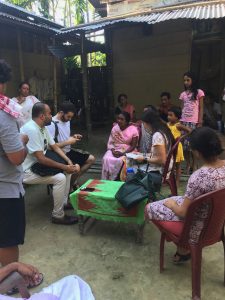
Interviewing Pranita in Assam with her family standing nearby
However, it wasn’t until my GSBF experience that I truly understood how important community is to me. During field visits, Nithya and I visited two to three villages per day in a specific region of India. Since we needed to gather lots of data, we interviewed hundreds of individuals in rural communities. The conversations usually lasted around 15-20 minutes depending on how talkative the interviewee was feeling. But, there were some interviews that lasted longer. Sometimes interviewees would show us their home, their parent’s home, and their friends’ home. These were my favorite interviews, because I felt like I had a better understanding of how these people engaged with one another and in their respective communities. It was especially intriguing to see how families set up their homes. I noticed that many families had open spaces to seat groups of people. They owned numerous cups, chairs, plates, and mats in case people came to visit for casual or special occasions. These communities felt welcoming and open with everyone in the village. I loved that aspect of these rural villages and felt more comfortable being in them. Wherever I end up in the future and whatever I am doing, I know that I want to immerse myself in a strong community.
What’s Different?
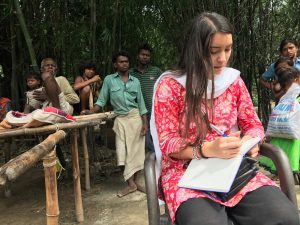
Taking ethnographic field and interview notes in a rural community in Bihar
This fellowship has been both an incredible and challenging experience. I have learned so much about myself and my role as a global citizen. Since being involved in GSBF, I have once again learned the power of individual reflection. In elementary and middle school, I used to keep a journal. Although I didn’t write in it everyday, I would write an entry if something impactful happened like when my dad surprised me with a puppy at the airport or my best friend moved away to Washington D.C. It helped me reflect and process how I was feeling at the time. Then in high school and college, I felt too busy with school, extracurriculars, friends, and family to have a journal for reflection. But these vocational essays have helped me process my experiences and my attitude towards these experiences in a beneficial way to fully understand them. This introspective process is sometimes difficult for me, but I think it helps me learn more about myself. While I won’t have any vocational essays due after GSBF, I purchased a journal to continue reflecting on my life, how I perceive it, and what I hope for myself in the future.
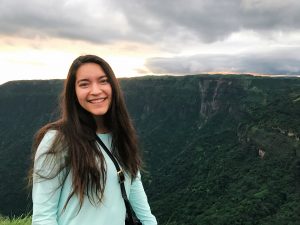
Visiting Nohkalikai Falls in Shillong
Not only have I learned the importance of reflection, but I have recognized my abilities as a leader. Ever since I can remember, I’ve thought of myself as a “follower.” To me, a leader tended to be a confident, commanding, and popularly recognized person. In addition, it would be clear who was a leader and who was a follower, and those roles would be static. Now looking back, my definition of a leader was unbelievably narrow. Heroic Leadership, a book by Chris Lowney about leadership principles to create lasting success, has helped me better grasp what it means to be a leader. He claims that self-awareness, ingenuity, love, and heroism are the four guiding principles for successful leadership. My biggest takeaway from Lowney is that all of a person’s daily actions and encounters towards others add up to to make them a leader. By shifting my mindset and being mindful of my everyday acts, I believe I too can become a good global leader.
Lastly, after 20 weeks of Monday/Wednesday classes at 3:30 PM and 8-weeks in India, I’ve gained 17 amazing friends and 3 phenomenal mentors. I will be forever grateful for this experience and for everyone who supported me along the way.
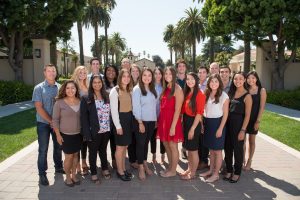
What a great cohort! (Emily not pictured and dearly missed)
Uncertainty
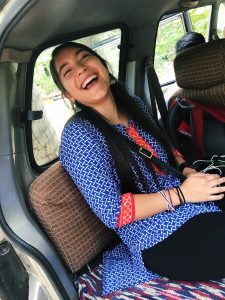
Smiling through the uncertainty of my future
As GSBF is wrapping up and the end of senior year is near, I am faced with the uncertainty of the future. I have questioned my vocation many times over the past nine months, which has been both challenging and valuable. However, this fellowship has strengthened my desire to work in the field of international development. I want to immerse myself in a community, learn about a different culture, and work directly with people. After returning from India this summer, I decided to apply for an English Teaching Assistantship through the Fulbright Program. While I’m uncertain if I will be awarded with this wonderful opportunity, I know I will strive to pursue a career in international development in one way or another.