The chaos of the Coimbatore streets stops as soon as you enter the Sankara campus. The organization and efficiency of the hospital are apparent in every detail. Ramps connect the four floors of the hospital to make it easier for the elderly, sight-impaired patients to navigate through the different stations. Blue sari clad nurses walk briskly up and down the halls leading groups of patients through the different stages of treatment. All patients are either referred to as “Patti,” grandmother, or “Ta Tha,” grandfather, while nurses and vision care technicians refer to each other as “sister.” Although the separation between the paying and free patients is clear, it isn’t extreme. The ground floor of the hospital is devoted to paying patients, the second floor houses areas for both customer segments and the top two floors are dedicated almost exclusively to the free patients. Even though I read the statistics on the numbers of patients that Sankara treats many times before coming here, seeing their system in action is very different. When I heard that patients moved through the surgery process in groups, I envisioned groups of ten, not over a hundred. We have been here for almost three weeks now and I still can’t believe the massive number of patients that easily move through surgery each day.
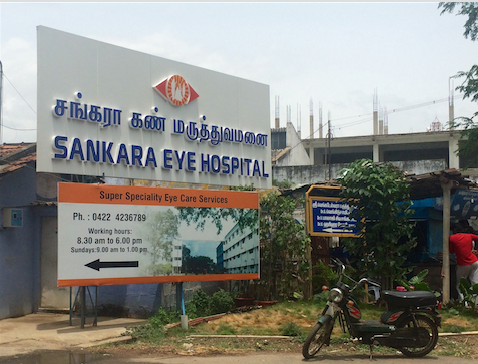
We’ve done a lot in our few weeks here. Everyone has been extremely welcoming and is curious about what our project and how we ended up at Sankara all the way from California. On our first day, Pooja, our in Sankara research mentor, introduced us to as many as people as possible. This ended up ranging from meeting with the Sankara founder and the head of the outreach department to the lab technician and kitchen staff. At the end of our first week, we attended a local eye camp in Coimbatore. This camp was pretty quite and mostly just so we could get to know how the camps work.
While our second week at Sankara started off relatively quietly, it certainty did not end that way. The big news of the week was that our project had changed from just case studies to a more comprehensive social impact study. Jana and I figured this out about thirty-six hours before leaving for the weekend to go two eye camps where we were supposed to start surveying patients, so the pressure was on to write and test our survey.
The eye camps we traveled to for the weekend were held in South Tamil Nadu, about a six-hour drive away from the base hospital in Coimbatore. Driving to the camps was an adventure in and of its self. The town centers we passed were full of action. Endless storefronts and various vendors lined the narrow streets; carts pulled by oxen practically outnumbered cars, there were even a few camel and monkey sightings. When we arrived at the first camp the next morning, there were already lines of people waiting to be screened. Although this looked like a ton of patients to me, when I mentioned this to one of the nurses, she laughed and proceeded to tell me this was way fewer people than normal. Like the hospital, the camps operate in a way that allows a shocking number of patients to be screened, diagnosed and selected for surgery in a short amount of time. Within fifteen minutes of the first patient being registered all eight stations of the camp were in full swing. We sat down with our translators, two Vision Care Technicians, and got to work. When we got to the camp on Sunday, I immediately saw why the nurse was saying the previous camp had been small. Because this camp was also a review camp for patients who received surgery a month ago, there was an even larger group waiting when our Sankara van pulled up.
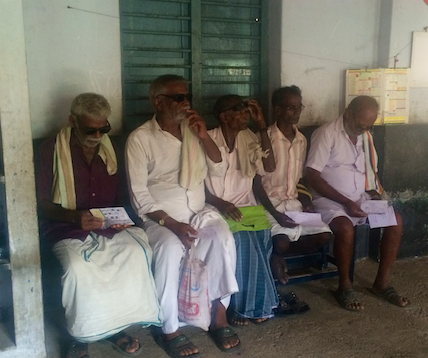
Now that we are back at the hospital, we are continuing our interviews with the patients from the recent camps. In addition, we are working on revising the post-op survey that we will give to patients at the review camp in one month. I am quickly learning that creating a survey that will produce meaningful data is pretty tricky. By far the most frustrating aspect of our data collection has been the fact that we have to rely on translators and we can’t speak directly to the patients. I think we are probably missing out on a lot of valuable information because of this. There has definitely been a learning curve in figuring out how write questions that we can explain to the VCT helping us that she can then explain to the patient being interviewed without losing too much meaning. I’m sure that our team’s struggle is not unique to anyone trying to collect data in a region where they do not speak the language, but it definitely takes some figuring out. I’m looking forward to taking what we have learned conducting this survey and applying it to our post-op and VCT program surveys. While this process has been slow and tedious at times I can’t wait to continue learning the ropes of social impact assessment over the next five weeks here.