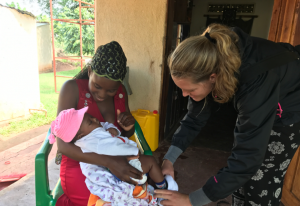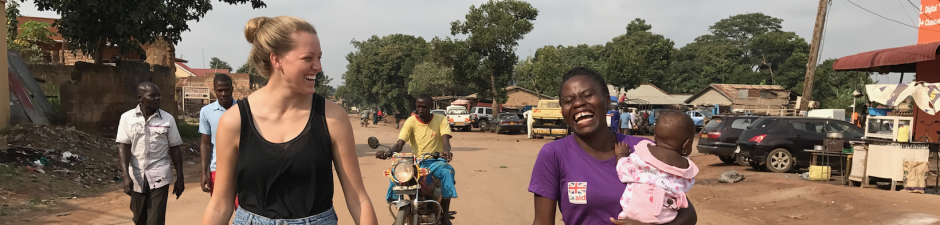
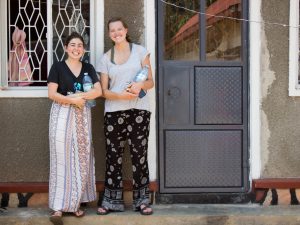
It has been seven weeks since Christine and I returned from the Uganda, and I can’t say that I’ve completely re-immersed in American culture. By the time it came to return home, I developed a renewed appreciation for organized public spaces, recycling and trash disposal services, safe driving conventions, timeliness, the good ‘ole American entrepreneurial spirit and dedication to hard work reached a new level. Yet, I fondly recall the laid-back mindset and simplicity of life in Uganda. The avocados here aren’t nearly as large or delicious—not that the avocado shortage really helps. And I never thought I’d say this, but sometimes I turn down the hot water because I miss cold showers.
After spending time around the mothers at the birth house, I picked up on the indifferent and even uninterested attitude of mothers who were both expecting to deliver or had recently given birth. The lack of visible joy that we often associate with new mothers and families welcoming a new life into the world puzzled us. Through several conversations, we discovered that the situations both before and after birth in Uganda are significantly different from a highly-anticipated birth in the United States. Here, mothers plan for months (or even years) to become pregnant. They often have the financial means and familial support to purchase furniture, clothing, food, toys, diapers—you name it. After birth, the outlooks for survival of both the mother and infant aren’t just good, they’re great. However, the circumstances in Uganda drive high rates of maternal and infant mortality. And mothers don’t typically have children according to a thought-out plan. In one of our very first interviews, a teen girl reported that “money brought the pregnancy.” Pregnancy is often a result of prostitution, rape, or teen marriage without family planning; this is one way in which the Nsassi village community suffers from poverty and injustices. Understanding this context illuminates the reason for the difference in attitudes around pregnancy and birth. I find it disheartening that there is less outward joy surrounding births in Uganda, and I believe that women and families deserve to be able to celebrate bringing a new life into the world.
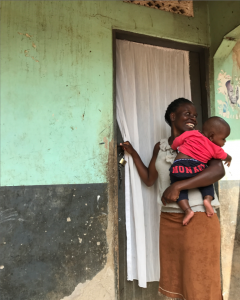
Amidst the nonchalance around having a family, a few women stood out—the most memorable of which is Jackie. Jackie is 22 years old and she has a 2-year old son and 6-month old daughter. During a visit to Jackie’s home, we learned about her personal initiative to begin a garden after attending a Gardening Workshop at the birth house. Jackie proudly toured us around her garden where she grew greens and potatoes. While teaching us to make sweet potatoes, she spoke of her vocation as a mother. She has made the decision not to have any more children and pursue fashion design school in the coming year. She recognized how “spacing” her children and limiting the size of her family enabled her to afford school fees and manage a household. I was also encouraged to see her husband come home during his lunch break (he is a teacher at a local primary school) to say hello to his family and give his children a big hug. This was one of the only instances when I witnessed a father or husband show affection and physical involvement in with his family members. This interaction sticks with me—especially in contrast with the prevalence of unattended children we passed everywhere we went at all times of the day. I believe that strong families are fundamental to the prosperity of humanity and the forming of wholesome and ethical individuals. Just as women need female role models and mentors, so do men. I think that men play just as important a role in reducing infant and maternal mortality as women. Jackie and her family serve as an exemplary family effectively impacted by Shanti Uganda.
In our interviews, we explored what degree of agency the women had over their reproductive health. When we asked who made decisions surrounding family planning and contraception, the women often indicated that they themselves did. Their husband or boyfriend may have been included in the conversation, but ultimately the women made decisions regarding their body and use of family planning. The notion that these women are fully human drew me to this fellowship; hearing that decision-making power regarding family planning within a household isn’t a significant barrier is encouraging. Not only do these women have dignity, they have agency. Mothers are able to speak and act for themselves, and the midwives encourage them to do so. This trend is encouraging, especially in light of the Women Rising movement.
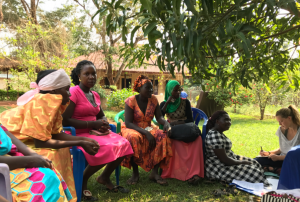
At the same time, many people in rural Uganda do control the poverty, marginalization, and injustices from which they suffer. The prevalence of contraception and Christianity didn’t entirely make sense. In the following anecdote, I ask that you set aside your belief in the morality of contraception and consider the bigger picture.
Ugandans are devout in their faith and proclaim it in lively celebrations, but they adopt the use of contraception without much hesitation or debate. When asked how she reconciles using birth control and the pro-life teachings of the Catholic church, one woman remarked, “Birth control helps me today; the church doesn’t help me today.” Her response indicates the short-term mindset of people living in poverty. They are concerned with getting food on the table today so that they can live tomorrow. Because immediate needs are not always met, people sideline secondary considerations like family planning, financial savings, and preventative health care measures.
This interview also highlighted my privilege: I can think about long-term matters. Without wondering about my next meal, shower, or paycheck, I can meditate potential career trajectories, time management for school projects, financial planning, books I read for pleasure, and advanced concepts I learn in the classroom. When I pray, I regularly thank God for a hot shower, comfortable bed, fully stocked grocery stores, and my health. One of my friends taught me to say thank you for my brain. Now, however, I also thank God for the ability to use my brain to think critically about more than primitive concerns. I believe that every human is worthy of that capacity, and efforts (whether they are non-profit organizations, government aid, individuals, or social enterprises) to take care of basic necessities should be prioritized.
This consideration led me to consider the circumstances the enable my critical thinking. As previously mentioned, I began to miss organization, cleanliness, timeliness, regard for hard work, and trust in public safety authority while in the field. On the Fourth of July, Christine and I “celebrated” with sliced watermelon and country music. In reflecting on the core values that make us American, the first that came to mind was freedom (how stereotypical). Although the American freedom is historically associated with liberty from the British, freedom holds a deeper significance. I like how Pope John Paul II puts it when he says, “Freedom consists not in doing what we like, but in having the right to do what we ought.” Yes, my privileges enable me to do what I enjoy (spend time with friends, go skiing, study what interests me, eat yummy food), but my life in America allows me to do what is right. I obey my parents, assist my friends in times of need, attend my classes, complete assignments, and help others whenever the opportunity arises.
Ugandan Christians and Catholics feel they have no choice but to transgress the Church’s teachings in order for their family to survive. They lack the freedom to (theoretically) do what is “right” (per living in full accordance with their faith). Thus, my I must use my freedom to virtuously. I can use my education to empower others and make ethical decisions. In following God’s will for my skills, talents, and experiences, I can enable those who lack freedom to do what is right.
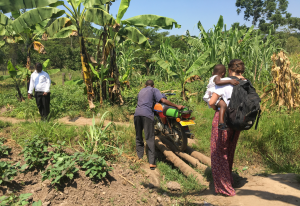
Although I am not entirely sure how I will ultimately do that, I am increasingly confident in my vocation as a healthcare provider. Small instances in which I had the opportunity to provide medical assistance still nag at my heart. Each day on our walk to the birth house, Christine and I passed the same family. One morning, we said our hellos and continued walking. Our translator Edward remained behind to speak with the mother. A few moments later, he called our names and told us that the mother requested our help. Her two-year old daughter Julie had a maize kernel lodged in her nose and she was in discomfort. As a certified EMT, I was tempted to remove the kernel myself. But I knew we risked pushing the kernel further back and potentially blocking her airway. Christine retrieved tweezers and disinfectant wipes from our compound and accompanied Julie and her father to the birth house where a midwife assisted Julie is blowing out the kernel. We celebrated the release of the kernel and embraced Julie with hugs and laughter each day we saw her after that. I began to carry around a first aid kit everywhere we went and even put some Band-Aids to use on small children’s cuts.
I have experienced similar scenarios in the past, and each time I leave the situation longing to have done more. I am confident that my skills (medical knowledge and understanding) and talents (inherent compassion, patience, and ability to connect with other) would make me a good physician or physician assistant. I am reaffirmed in my calling toward one of those roles, and I know that I will be fulfilled by helping people in a hands-on way each day that I “work.” At the end of every day, I cherish the celebration of love among my family and friends, I am grateful for the entrepreneurial “American dream” and privilege to freedom, and I aspire to bring those values to others.