When I, as a freshman, first read about three fellows who went to Banapads on the GSBF website, I thought “I want to do that.” I could see myself contributing to Bana’s intersection between science, technology, business, and women rising. I even pondered the possibility of becoming a social entrepreneur after graduation. My dad always encouraged me to think entrepreneurially, and he challenged me to imagine how I might apply lessons learned at a job under a manager to a company of my own one day.
When I took Keith’s class “Innovation for Social Justice” sophomore year, we learned how technology can address the world’s most pressing needs through social enterprises. Having absorbed some basics of starting small businesses through watching Shark Tank, I wondered how a social enterprise operates financially to become self-sufficient. When I asked, Keith chuckled and said, “That’s a far more complex topic for a later time.” Unsatisfied with that answer, I remained intrigued with social entrepreneurship and called to explore it further.
In identifying the social engagement or work environment that is best for me, I have identified two important aspects: the people and their attitude about the organization’s mission. I seek to work on teams of diverse, disciplined, ambitious, and conscientious people who share a common goal. These kinds of team complement my appreciation for openness to different perspectives, unifying/mediator leadership style, passion for human-centric design, and drive to have impact. I also recognize my desire to work with people who genuinely believe in the company’s mission and strive to make it a reality throughout their everyday roles and responsibilities. This characteristic is inherent in social enterprises (and healthcare) whose impact model and business model are intricately related; however, perceiving the legitimacy of a company culture passionate about its mission is more difficult.
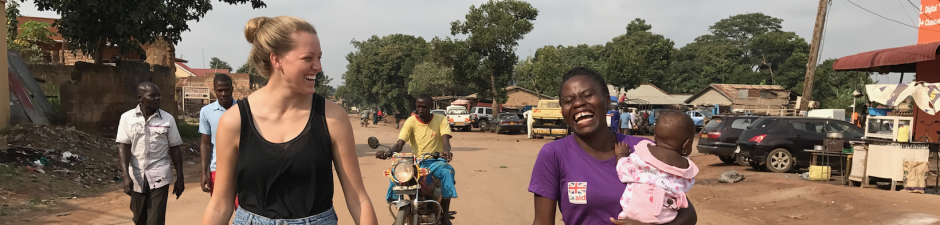
At Shanti Uganda, the employee’s dedication to the mission was blatantly apparent. When we asked the head midwife Sister Josephine why she liked working at Shanti Uganda, she said, “[The founder’s] goal is also my goal; we are moving on the same page because we are working on saving mothers from dying and reducing maternal and infant mortality.” I think that investing the time and effort into researching this mindset through informational interviews—like the one with Sister Josephine—will be worthwhile in my job search.
Yet, my intrigue is not fully satisfied with the answers we discovered this summer, and I recognize that I need a fuller understanding of business operations. Before engaging in social entrepreneurship in a truly impactful way, I strive to develop skills and knowledge that equip me for a meaningful role. I know that I will not pursue social entrepreneurship right out of undergrad. However, I plan to return to the movement after gaining more healthcare experience and a deeper understanding of effective and efficient business operations.
As a bioengineer, I believe that technology can solve problems—that’s pretty much a given, I suppose. I can trace this belief back to seventh grade, when I responded to a prompt that asked me to write about a legacy I hoped to leave behind. I will never forget my aspirations to “be remembered for improving lives in developing countries through a technological medical solution” (or something unreasonably lofty like that). My teacher commented, “Good luck, it only gets harder from here!” How encouraging. This reality check was countered by my dad’s alma mater’s maxim “Believe deep down in your heart that you’re destined to do great things.” It still motivates me in times of doubt. This balance between a utopian and realistic vision is something that I wrestle with both personally and when it comes to technological solutions.
In a homily a while ago, I remember the deacon saying that “being Catholic is simple, but it’s not easy.” I think that this is a lot like using technology to solve the world’s problems. In theory, a product is a quick fix; but, in reality, the local context makes effective adoption of the product a lot more complex and maybe even impractical. In fact, much of our research as fellows investigated the motivations and barriers to obtaining a product or receiving a service.
Throughout my discernment, I tossed around this idea of engineering products and eventually finding my way into the business side of things, knowing that I’m more of a people person than a technical one. Recently I came to terms with the idea that I’m more of a people person because I’ve seen human interactions have a greater impact than any piece of technology ever has. People are the reason I was drawn to this fellowship. People are the reason I decided to apply. People are the reason I maintained perseverance and motivation in the field.
This realization led me to believe that, for me, solving some of the world’s greatest problems is as simple as providing healthcare. When Christine and I asked Sister Josephine what made her happy, she responded, “I just want to save lives. That’s all.” That’s all. Her statement reflects the simplicity that I have come to terms with. Sure, technology has a place in addressing problems, but I think that people are a lot more effective at change. Through human connections as a healthcare provider, I can contribute to Sister Josephine’s compelling vision: “If mothers are well-fed and looked after, we will have a bright future. If mothers are educated, we will have a changed nation. If we put health as the first priority, we can build the future of a bright nation.”
For now, I do not know what I will do after graduation and before applying to medical/PA school. And I am okay with that. Thanks to “Africa time,” I have a persistent patience and renewed trust that things will work out. Heck, we received the district data hours before leaving Shanti Uganda after (politely) pestering the biostatistician for two months. As a Myers-Briggs personality type ESFJ, I know that I am a data-oriented person who likes to collect as much data as possible before making a decision. So, hold on while I collect and organize all that data (thank you for the experience, Shanti Monitoring and Evaluation team). I will turn to my vocational “toolbox” to discern my next move and maintain self-efficacy.
A year ago, I would have told you that I just wanted to help people in my career, but I couldn’t explain why. A few weeks ago, I spoke with a student athlete at SCU who felt it was her calling to play soccer on behalf of the young Iranian girls who could not to play soccer and pursue their dreams. She said that although she was raised in Silicon Valley, she had found her “why” in playing on the Iranian national team. Through that discussion, I realized that the young children, babies, and mothers in Uganda were a part of my “why.” Though I do not share an ethnic background with them, I now have shared experiences and tangible relationships with people needing care indicative of their dignity.
I am a big fan of “head fakes” (coined by Randy Pausch in his “Last Lecture”) in which apprentices unknowingly learn a lesson different than the apparent knowledge taught by a mentor. For example, I learned the value of teamwork under the direction of a demanding soccer coach instructing formation. While I am excited to continue unfolding the “head fakes” taught by this fellowship, one head fake that stands out is a spiritual one. In a letter to the Philippians, Paul says:
“Not that I say this because of need, for I have learned, in whatever situation I find myself, to be self-sufficient. I know indeed how to live in humble circumstances; I know also how to live with abundance. In every circumstance and in all things I have learned the secret of being well fed and of going hungry, of living in abundance and of being in need. I have the strength for everything through him who empowers me.” (Philippians 4:12-13)
Just as Paul lived in humble and abundant circumstances, so have we. We have an inherent resilience within us to overcome whatever challenges—whether literal or spiritual—we face. When I was struggling with reverse culture shock and reconciling life in Silicon Valley and in rural Uganda, I found consolation in this passage. God provides me with the “daily bread” I need to live out his will no matter the circumstances. At the same, this strength manifests in hard work. St. Ignatius of Loyola is credited with saying, “Pray as if everything depended on God and work as if everything depended on you” (Catechism of the Catholic Church, IV.2834). We encountered God ceaselessly throughout our time in Uganda, and working with Christine has deepened my relationship with God. Through Him, social entrepreneurship harnesses fundamental human relationships to bring out his vision for a better world and for me.