For a foreigner Indonesia might first appear welcoming because of its tropical weather and white sandy beaches, but almost immediately one discovers that the inviting atmosphere truly exists because of its people. I have never met friendlier, more welcoming people than those of Indonesia, and I am continually in awe of their genuine excitement towards us as foreigners. Meghan and I have already been lavished with beautifully handmade gifts and invited to two traditional weddings. We want to thank the local people in whatever ways we can, with their request being that we simply pay it forward.
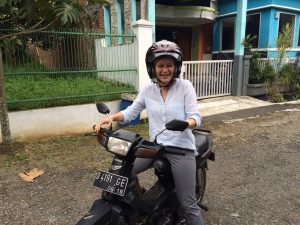
Learning how to drive sepeda motors.
So far we have ventured through Jakarta, Bandung, Yogyakarta, Kupang, and most recently Sabu Island. I have probably consumed more rice during my four weeks here than in the rest of my life up to this point – cultural note: Indonesians eat rice two to three times a day. Half the time we have no idea what we’re eating, but usually we love the food we cannot put a name to. I had never lived in a muggy climate prior to living in Indonesia, and I’ve noticed that when in the shade I don’t always realize how hot I am until I notice the sweat seeping through my clothes, just from sitting there.
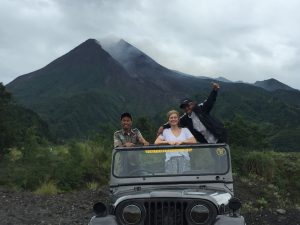
A jeep tour of Mount Merapi (a volcano) in Yogyakarta.
Living in Indonesia is different from the life I know in the U.S., and I hope to approach the differences with an open mind. So far we’ve seen oyster shells the size of our bodies, cockroaches, spiders nearly as big as my hand, beautiful temples, gorgeous beaches at sunrise and sunset, an active volcano, a traditional performance by village leaders, walked across unimaginably busy streets, and learned how to drive “sepeda motors” (motorbikes). There have been difficult language barriers despite our six days of language class, and learning the language was definitely helpful navigationally but only gets us so far conversationally. For this reason we are very lucky to have Wenty, our local translator, with us for translation and for navigation.
Our work began in Bandung, where we met Nazava founders Lisa and Guido. We worked in the Nazava office while in Bandung and discussed our itinerary and work plans that would take place in the next seven weeks. Guido introduced Sabu Island to us; a small remote island where Nazava has recently began selling filters. Our task was to meet with different points of contact and organizations on the island to help Lisa and Guido understand the communications and distribution model that exists there. In doing so we would hopefully help Nazava be able to replicate the working model across other islands to further its impact. After a few days in Bandung we took a scenic trainride to Yogyakarta, where we spent a week learning the language. Language school was challenging at 6 hours a day, but we appreciated being able to discuss directions, transactions, numbers and restaurant/market terminology. Truthfully I was not very motivated to learn the language at such an intense pace, so I somehow always managed to get my teachers to talk with me about food and recommendations for places to eat. Still applicable though, right? Through the school we also met people from the U.K., France, Australia and the U.S., many of whom were doing research of their own. After Yogyakarta we went to Kupang and then Sabu.
Sabu Island; traveling to and from the island was an experience all on its own. Going in we knew we needed to find a ferry from Kupang to Sabu, and that there was both a 15 hour ferry and supposedly an “express” 3 hour ferry. Suddenly our reliance upon the internet as a source for all answers became blaringly apparent since there was not only extremely limited information about the island itself, but a ferry terminal was seemingly nonexistent. Nonetheless, we figured out a way to trick the system thanks to Google Maps. I looked up Kupang on the map and zoomed in to where I could see what appeared to be boat navigation lines leaving Kupang. One of them led to Sabu Island (which on maps was actually referred to as Savu, since the Island apparently could be called Sabu, Savu or Sawu – only to add to our confusion). We figured the meeting point of these lines on Kupang must be a ferry terminal of some sort, so we wrote down the address and prayed that it would include the “express” ferry – if any at all. We woke up early on June 26th and got to the mysterious ferry terminal well in advance. Miraculously we had found the right place! Wenty helped us buy the right tickets and after a few hours of waiting we made it on the ferry that just hours before we had prayed existed. Going in I half expected the boat to be a small fishing canoe that we often see along the beach shores, but the boat was more like a paraclete and thankfully air conditioned. Sometimes the waves were pretty rough and most of our cabin got seasick on the ride back, leaving me to pray that the 15 hour ferry our friend Tethy was on wasn’t as rough (later to discover it was like that for 13 hours).
More importantly, though, we had an incredible and humbling experience on the remote island called Sabu. We met a wealth of inspiring people involved with water sanitation for the community, each deeply committed to bettering the standard of living for the local people. First there was the main reseller on the island, Ibu Tri. This strong little lady could not have been an inch over four foot ten, but her determination to improve water sanitation exposed her strength and tenacity better than any extra inches could offer. Ibu Tri took it upon herself to connect Sabu with Nazava’s water filters, and she is the main point of contact for getting the filters to the island and then to the people.
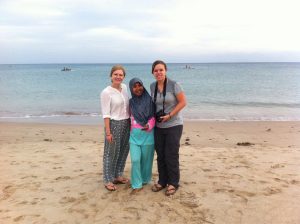
Ibu Tri took Meghan and I to a beach for sunrise on our last morning on Sabu.
Ibut Tri is then connected to a plethora of organizations, both governmental and nongovernmental, that help with distributing the filters on Sabu. We met with each of these organizations and gradually came to understand the complex but successful system of communications and distribution that exists on the little island. Immediately we noticed the excitement in the people’s responses to Nazava, naming it the answer to the government’s call for improved water sanitation and water related health. After many interviews and surveys we confirmed with the people that the filters are able to eradicate all waterborne illnesses for users. I feel immensely blessed to be working with a company that is so evidently making a difference in people’s lives, and I tried as much as possible to step back and learn from the people that truly know the way it all works on Sabu. We left the island full of gifts that Ibu Tri and her family and friends had made for us, but mostly feeling an even deeper determination to help Nazava further its impact on the island. Our initial task from Nazava was to understand the communications and distribution model there so that the enterprise can replicate the model across other islands, and we will still offer this information to the entrepreneurs, but we also hope to emphasize the importance of capitalizing upon the company’s existing relationship with Sabu so that the impact there can further improve. Everyone we met with was so genuinely excited about Meghan and I doing research on the island, so I will do all that is in my ability to communicate their needs to Nazava and others that might offer a way of supporting Sabu. Likewise, I hope to continue the rest of our journey in Indonesia with hard work and dedication towards being in the present – both learning from people and offering all that I can.
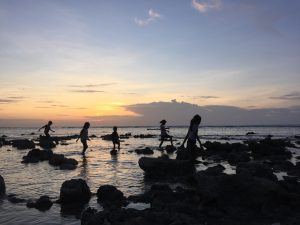
Local kids on Sabu, passing by as we watched the sunset.