I only recently realized that my trip to Nicaragua represented my first visit to a country unaccompanied by someone who had already been there. Despite having been to other Latin American countries, I felt as though I was starting from scratch in Nicaragua. Every question that popped into my head about my surroundings was not immediately answered. The time it took to put the pieces together required patience, which is not exactly my forte. Naturally, patience ultimately became the underlying theme of my trip.
Some of my most pressing questions about the culture, politics, and history of Nicaragua could be quickly answered using Google (thanks Google). But other insights had to be observed and felt. For instance, I found art to be useful universal language. Estelí is covered in murals and graffiti, which proved to be a great source of information for me. For example, the status of women in society could be observed in social situations in addition to the countless pieces of street art supporting women’s rights and calling for an end to violence. Their bright colors and strong words exposed a society in transition, where women publicly push for equality and respect and yet still face many dire challenges.
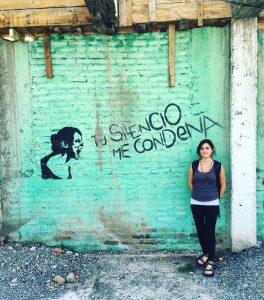
“Your silence condemns me”
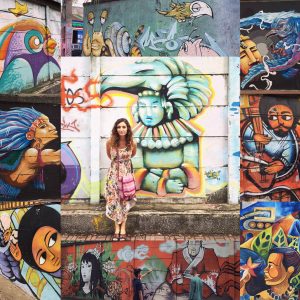
Murals in Esteli
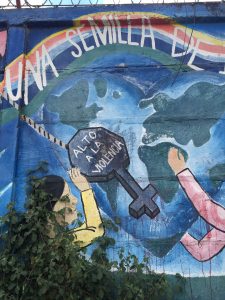
“Stop the violence”
The writing on the walls helped me in the countryside as well. In many homes, schools, farms, and little cafes in the rural areas, I noticed signs that promoted a sophisticated kind of environmental consciousness. Not simple messages like “No littering!”, but rather “For a better future, please do not litter.” These signs foreshadowed the many conversations I would have with rural people in which they demonstrated a deep understanding of ecology and need for nature preservation.
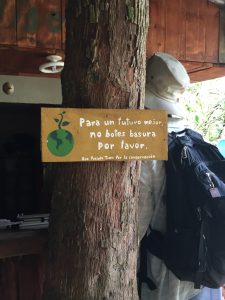
“For a better future, please don’t litter”
One particular interview stood out to me with a man in the village of Daraili. Over the course of nearly an hour, he echoed ideas and concepts I’ve learned in everything from environmental studies classes to the Pope’s encyclical Laudato si. He understood the interconnection of environmental health, human health, and economics in addition to a spiritual component, which I had not previously been exposed to. I found it to be equally inspiring as it was heartbreaking. He knows that he has very little power to make sure that the world will be better for his children and grandchildren. Yet he responds by doing whatever he can every day. He talks to his neighbors about saving water, picks up garbage from the road, and even recycles plastic into planters or art pieces. Everywhere I went I saw recycled material being used in ingenious ways. In the U.S., I’d expect us to be much more earth conscious. However, the most recycled water bottle planters I see at home are on Pinterest.
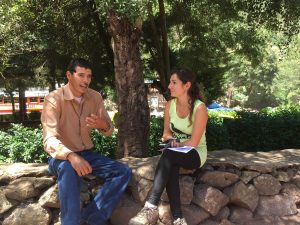
Interview with a farmer in Daraili
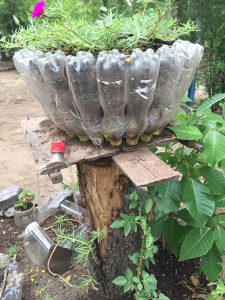
Recycled water bottle planter in someones yard
Speaking of ingenious, we visited the home of another farmer who had constructed two water-powered generators. These seemingly simple contraptions blended into the jungle surrounding his home and were able to power the new TV in their modest living room featuring a dirt floor. While this man had no formal education, he had to be one of the wisest, most resourceful people I’ve ever met. His daughter is studying at the university in the city to become an engineer.
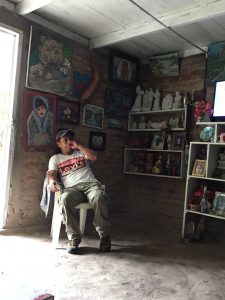
Raul lounging in the living room at the coffee farmers’ house
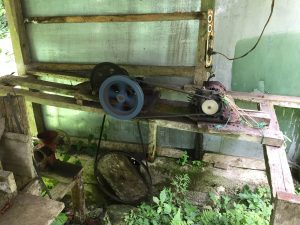
Hydropower generator
I struggled to keep up with the over-60-year-old farmer as he also showed us around the rest of his property. As I looked over the rows and rows of coffee crops heavy with beans, I couldn’t help think about how removed this experience was from standing in line at a Starbucks. It reminded me of what Raul had told us from the beginning; the great irony is that while coffee is one of the most lucrative crops, there is typically poverty wherever it is grown. This imbalance in economic power mirrors, or rather, follows the imbalance that we have created in nature.

David contemplating nature
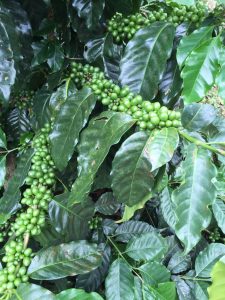
Coffee beans
It’s nearly impossible to come back from 8 weeks in a foreign country with a tidy little list of what I learned as it relates to my life and vocation… but here it is anyways:
- Never assume that I know more than anyone else. Yet at the same time don’t undervalue my own abilities and contributions.
- Art needs to be much more than just a hobby in my life. It can serve as a priceless form of communication, movement, and power. I should consider my creativity to be one of my marketable skills.
- Google can’t answer everything. Some questions need to be solved completely on my own.
- Trust my senses, trust my gut, and trust those who have put trust in me.
- I don’t want to chop at the branches of systematic issues like lack of access to clean water or poverty in general. I want to get as close to the root as I can. To do that I have to know exactly what the root consists of and what tools are needed to remove it.
And lastly…
- Whatever I end up doing it must involve direct communication with people and a healthy mental and physical relationship with the Earth.

My future plans also include owning a goat farm