I was born into a fortunate world. Not just in terms of affluence and opportunity but I was lucky to be surrounded by a wealth of cultures and diverse backgrounds in the form of my extended family and friends. My maternal grandparents immigrated to the U.S. from small villages in Mexico and my father immigrated from Iran during the Islamic revolution. My parents met in San Francisco during college and got married, bringing together two families from vastly different backgrounds. Many of my aunts and uncles similarly married spouses who were immigrants from the Philippines, Russia, and Argentina to name a few. In case that doesn’t make my family unusual enough, they all lived within an hour radius of me while I was growing up. Consequently, at birthday parties we sang “Happy Birthday” in at least three different languages before getting to blow out the candles. Besides making me think it was normal to taste melted candle wax along with frosting, my family taught me the values of openness and generosity. They provided unconditional love, a close support system, and instilled in me an appreciation and compassion for different cultures and the people that comprise them. Of all the fortunate elements of my life, my eclectic, warmhearted family is the one for which I am the most grateful.
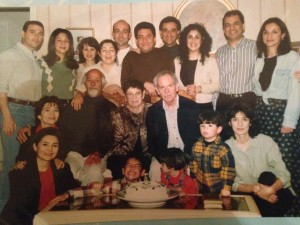
My second birthday. Most of my cousins hadn’t been born yet so we could all still fit comfortably into the photo frame.
As with most upper-middle class upbringings and despite my being exposed to many cultures, I was a fairly sheltered child. The only traveling I had done before the age of seventeen was in the form of family vacations to Mexico every summer. We always stayed at nice hotels on the beach and only ventured beyond the touristy sites for an occasional day trip. While it was always tempting to stay and lounge by the pool all day, I found that my most enjoyable moments were those spent on an outside adventure. Over the years, we zip lined over rivers, rode donkeys in the mountains, and paddle boarded in the ocean. These activities required us to stray from the comfort of the resort and even then we were still catered to by some sort of tourist organization. However, it was during these outings that I noticed the stark difference between the Americanized resort world, and the realities of a developing country. Just beyond the walls of the resort, the majority of people were living in poverty. As I grew older and my understanding of this contrast grew as well and I found that lounging by the pool in Mexico became less and less satisfying.
During February of my senior year in high school I embarked on a completely different kind of adventure. For two weeks, I traveled in Cambodia with a non profit organization to help bring dental care to impoverished children. Looking back, I can’t believe that I willingly signed up to face about a hundred of my irrational fears in a country that I couldn’t even locate on a map. Something in my gut told me that I couldn’t pass up this experience because it was going to be far too important. I was right. The anxiousness and doubt that had accumulated since the moment I booked my flight was worth the outcome. During the drive out to a site on the first day of work, my stomach was still in knots at the general fear of the unknown. However, as I worked late into the afternoon administering fluoride treatment and playing with the children waiting for treatment, I felt my fears evaporate into the humid air. My purpose was to help, to be of service, and to be present because that was what I had to offer and these children deserved the best. Their curious eyes, sweet smiles, and pure hearts made everything else vanish into the background. These kids who lacked shoes, toothbrushes, and even families were the happiest, most precious beings I had ever encountered. The youngest of them had already experienced more hardship than I probably ever will in my life and yet they smiled, sang, and ran around chasing each other with such innocence and joy. I couldn’t help but feel at true peace for once. My thoughts calmed and I focused on my job to make life easier for them, even just temporarily. My perspective and passions had changed forever.
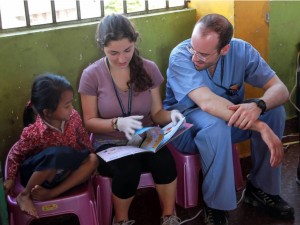
Reading to a little girl at a school located on an active landfill in Cambodia
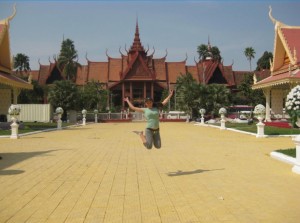
Jumping for joy in front of a museum in Phnom Penh
The weeks following my return from Cambodia were challenging, but in an altogether different way. I felt as though my eyes had been opened but that I just wanted to shut them again. I couldn’t reconcile the fact that my world and the one I had just returned from were the same. What had I done to deserve everything that I took for granted every day? Despite being surrounded by all these luxuries, I found my most inner peace in a place that I originally had been so afraid of visiting. Above all, I was intensely frustrated by the fact that I was expected to ponder quotes from The Great Gatsby while a child I had bonded with just a week before was pondering whether they’d have enough to eat that day. It also occurred to me how easy it would be to forget everything I had seen. Not because it wasn’t memorable, but because my life was so disconnected. There is so much corruption, poverty, and sadness in the world but most remain passive either out of ignorance or because these problems seem too overwhelming or distant. One night, as I began to cry out of sheer frustration, my dad said to me, “It’s okay to feel sad but you cannot let the knowledge that there is so much wrong with the world stop you from trying to do something about it. Sensitivity isn’t a weakness, it is your strength. Use it.”
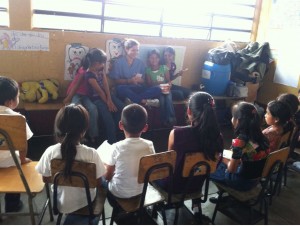
Teaching some giggly kids how to brush their teeth in Guatemala
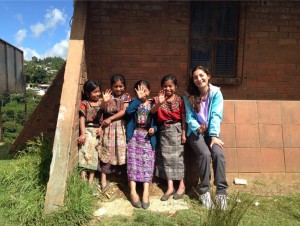
Some lovely young ladies (and me) in Guatemala
The next year I travelled with the same service group to Guatemala where I once again ventured to the edge of my comfort zone and yet found purpose. In addition to discovering more about myself, my understanding of all the unique issues that face developing countries grew. It started to sink in that these issues cannot be solved with just donations and foreign volunteers. Major change has to take a more powerful and sustainable form. One cannot enter a community without any context about the culture or lifestyle of individuals and expect to make a huge difference. There has to be understanding of the root causes, connections with the local community and a comprehensive plan for changing a specific aspect of injustice. When I read about the Global Social Benefit Fellowship, I had butterflies in my stomach and a fire in my eyes. The goals of the fellowship reverberated with my frustrations because of their aim towards the root of poverty issues rather than just the branches, or symptoms. The opportunity to work with ASDENIC in developing a sustainable solution to supply safe and affordable water in rural Nicaragua is the perfect project for me to pour my passion into. I’m ready and excited to hit the ground running.
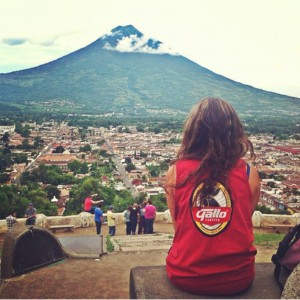
At Cerro de la Cruz, looking out over Antigua and el Volcan de Agua (an active and very noisy volcano)