Mending Wall is a poem written by Robert Frost, an American poet of the twentieth century. After reading the poem, I struggled to grasp several details throughout the stanzas, as the overall flow and story were both puzzling. Of the various implications of the poem, the only prominent information that I retained was “good fences make good neighbors”. Apart from the aforesaid proverb, I was unable to visualize what Robert Frost was attempting to convey.
One of the main factors that makes Robert Frost’s work so complex is attributed to the contradicting statement that he makes in line one and line twenty seven. By stating, “Something there is that doesn’t love a wall/ That sends the frozen-ground-swell under it/ And spills the upper boulders in the sun/ And makes gaps even two can pass abreast”, Frost indicates that barriers should not be present because such hindrances distract the fostering of a relationship (Frost 1-4). However, Frost creates a paradox by writing, “He only says, ‘Good fences make good neighbors’”, Frost indicates that barriers between two people exist to serve a moral purpose (27). Frost does an excellent job in terms of forcing the reader to interpret his writing rather than giving a clear message to convey.
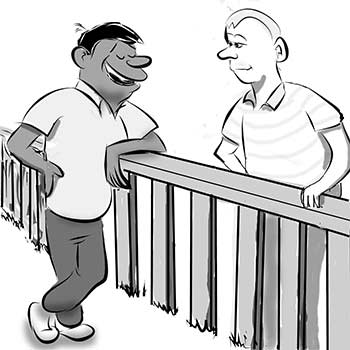
Overall, I saw that Robert Frost believes that fences are detrimental when building relationships, which I disagree with. Even in our own homes, most of us who have good relationships between our family members are not negatively affected by the doors. These doors are essentially barriers that separates one person from another as a means of providing privacy, and are thus a necessity. Because this reality serves to evidence how people are capable of fostering healthy relationships even with such barriers, for the sake of privacy, good fences could make good neighbors.
