Week 8 Blog

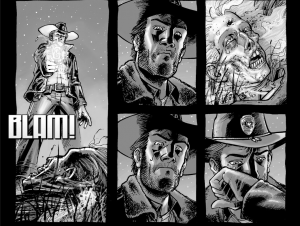
This week’s reading was somewhat unconventional, as our article was a comic book. Although I had never watched the television show, The Walking Dead in cartoon form was very interesting to read. Even within the first few sections of the book, there were various parallels to Cohen’s The Undead.

For example, in one of the scenes, the main character sees a zombie and cries the first time. In his second encounter, he pulls the trigger on the zombie, but does it reluctantly, and ends up crying once more. Just as Cohen argues that there is more to an essence of a zombie than a horrendous, diseased creature who loves eating brains, in this comic, this zombie is a reflection of a potential friend, partner, or distant relative of the protagonist.

One interesting feature of zombies that I noticed is the fact that zombies are not vicious towards each other. When Rick and Glenn go into the city to get guns, they are protected from other zombies temporarily, as they rubbed zombie residue all over themselves to recreate the smell. However, this only lasted for aAccept buttonshort amount of time, as the rain began to wash away the scent. When relating this to Cohen’s claim, it seems that zombies, otherwise dubbed “fears”, are not harmful to each other, but have the potential to be very deadly to humans. However, much like the way zombies did not harm Rick and Glenn when they were scented, when we learn to embrace our fears, we are capable of making ourselves immune to our weaknesses.

Green Arrow Over Wall Means Overcome Obstacles

Sources:
http://readcomiconline.to/Comic/The-Walking-Dead/Issue-1?id=1715
https://www.gograph.com/illustration/accept-button-gg61835774.html
https://www.gograph.com/illustration/green-arrow-over-wall-means-overcome-obstacles-gg63088456.html

Week 7 Blog

In this week’s reading of The Undead by Cohen, I enjoyed exploring a different perspective on the essence of zombies. In the past, the word “zombies” would trigger images of undead, diseased beings who seek to consume human flesh and brains. However, Cohen conveys a more positive interpretation of zombies. Rather than being afraid of the idea of theseClip art zombies apocalypse clipart kid 4 creatures, he celebrates how zombies give us a way to give form to various aspects of our lives (408).


The most evident aspect of our of lives which zombies reflect is our fears. I believe that Cohen admires the quintessence of zombies because only when we truly visualize our fears, are we capable to recognize and overcome our fears. Much like our fears, zombies are very undying, threatening, and are capable of consuming us when we decide not to take any action to prevent them. For example, in the movie
It, some of the fears of the characters are portrayed as zombie-like figures. These creatures come to life as the characters’ greatest It (2017) poster.jpgfears, but as they learn to accept these zombie-esque beings, the characters take their first step in overcoming what they fear (410). In light of this phenomenon, Cohen expresses how zombies so vividly represent our fears, and thus, we are able to more effectively overcome them.

I agree with the author in that confronting our “zombies” is the most effective method to overcome our fears. Initially, this process will inevitably difficult because even the slight thought of such horrors shocks us. However, because they exist as one of the most graphic thoughts inside our minds, through full visualization and acceptance, we are capable of defeating the very entities that seem undying.

Week 6 Blog

After reading “Using Sources” from The Craft of Research, I learned the importance of being able to read and absorb information as accurately and critically as possible. Often times, people tend to get hindered by focusing too hard on finding information, which causes them to forget the importance ofrecording what they find. Furthermore, our bias leads us to grasp onto our beliefs in a way that prevents us from retaining information objectively.

In order to stray from having our bad inclinations hinder our research, the author stresses how imperative it is to read within the context. In other words, when recording information or writing about it, we must look at that piece as a portion of a whole puzzle, rather than by itself. One reason for this is that “researchers build complex arguments out of several elements” (100). By disregarding the claim and support that the researchers build upon to establish a message, we are prone to misread its purpose. For example, the book compares “The war was caused by x” and “The war was caused by x, y, and z” (100). In the first quote, we miss two significant causes of the war, which is a grave mistake to make. By only using a portion of the quote, our applications of the information we find become very limited, which prevents us from further substantiating our claims.

This phenomenon is reflected by other parts of our lives, such as the saying, “Don’t judge a book by its cover.” Instead of prematurely formulating a conclusion, we should learn to see the whole picture to not only get the optimal information, but also to get the most correct facts.

Sources:
https://images.megapixl.com/4295/42959312.jpg
http://weclipart.com/gimg/183E159F39EC6839/MissingPuzzlePiece_1.jpg
http://cdn1.theodysseyonline.com/files/2016/01/04/63587483323600346362412802_carrot%20(2).jpg

Extra Credit Blog Post

Last November, American author Ta-Nehisi Coates did a book tour for We Were Eight Years in Power. During this event, a white girl questions Coates about what to do when non-African Americans spew out the “n” word. In essence, Coates explains how a stigma exists due to its history, as “words don’t have meaning without context” (Coates). Because the origins of this word sprouted from white slave owners condemning African Americans, not everyone is allowed to use it in everyday life.

This phenomenon is not limited to the “n” word; rather, it extends to our relationship with other people. For example, it is acceptable for Coate’s wife to call him “honey”, but it would not be okay for a stranger to call him the same. In this sense, the word in itself may not be derogatory, but the context in which it is used defines the meaning of the word. For African Americans, amongst each other, the “n” word may be acceptable because of their level of relationship. On the other hand, it would be unacceptable for a white person to call another African American by the “n” word, due to word’s context in the past between whites and African Americans.

Personally, I find it interesting that an white individual, whose native language may be English, is forbidden to use a word within their own language. Throughout this quarter, cultural hybridity has always been looked at in a positive aspect, but the “n” word shows that there are certain aspects of cultural hybridity that does not reflect a favorable turn in history. Although words have their own meanings, their true definitions are established through various forms of context. 

Sources:
https://www.alternet.org/sites/default/files/styles/story_image/public/story_images/screen_shot_2013-09-09_at_11.15.05_am.png?itok=u51WDOI6
https://headguruteacher.files.wordpress.com/2017/05/x20142711071202qitokro-s8uda-pagespeed-ic-afnisfpvf0.jpg?w=640
https://az616578.vo.msecnd.net/files/2016/10/13/636119392031889369953848753_customer-relationship.jpg

Week 5 Blog

In this week’s reading of “Monster Culture”, Cohen talks about seven different theses that depict what a monster is. Amongst these different descriptions of monsters, there are two that stuck with me: one that I completely agree with and one that I do not agree with.

Cohen states that monsters “inhabit the gap between the time of upheaval that created it and the moment into which it is received, which essentially means that the monster’s significance is defined by the culture that perceives it (Cohen 4). I agree with this argument, as there have been instances in the past when individuals with physical and/or mental disabilities were dubbed as degenerates of society. For example, those who had leprosy were often ostracized by the community around him/her, as the rest of society did not want to associate with that individual. However, today, the sick are very well-cared for by not just those in the medical field, but also by those around them within their community.  Although the ailing were once categorized as monsters by their society, now they are not condemned as degenerates but are encouraged as human beings.


The thesis I disagree with is “monsters are our children” (20). Children themselves are not monsters in their current state, as they are simply innocent beings. However, I believe that once children lose their innocence, they can become a monster. Often times, parents strive to protect their children from the cruelties of the world, in hopes to never have their children scarred. 

Unfortunately, the children grow to inevitably face the negative aspects of society, which is what causes them to question “why we have created them” (20). As children lose their innocence, they bear self knowledge, which gives them the power to have their own interpretation of everything around them, resulting in the witnessing of potential lies told by their parents.

Sources:
http://www.edspire.co.uk/wp-content/uploads/2015/05/monster.png
https://img1.etsystatic.com/196/0/16468631/il_340x270.1403118431_rucn.jpg
http://kindredmedia.org/wp-content/uploads/shutterstock_244072531.jpg

Week 4 Blog

As an Asian-American, I was interested to watch and have the chance to write about Fresh off the Boat, a TV show that revolves around Asians in the UnitedStates. In season 2, episode 20 (“Hi My Name Is…”), Evan, the youngest of the Huang family, becomes perplexed because he has to decide between writing his American or Chinese name for his bank account. The rest of the episode is spent as Evan’s family members attempt to tell him how names have no significance. His grandmother’s comments seemed most significant, as she tells him that his name does not make him; rather, he makes his own name.Image result for confusion clipart

Much like Evan, I have an American and a non-American name. However, I personally have never felt the conflict which Evan felt for having two names. This is partly attributed to the fact that everyone calls me by one name, so I have disregarded the other one. Although I believe that names do have a significance to a certain extent, there are numerous factors that mold a person apart from names. The way we act, the words that are spoken from our mouths, our passions––these all constitute us as individuals, despite what our name may be.

As a Korean-American, I have faced cultural conflicts because there would be times when I have to choose between something American or Korean. This sprouts from the fact I want to move towards the American side because I live here, but at the same time, because I am of Korean descent, I want to stick to my roots. In essence, I relate to Evan to an extent because we both face cultural conflicts, I have learned to move past the difficulty of having two names.

Sources:
https://vignette.wikia.nocookie.net/shipoffools/images/5/51/Identity.png/revision/latest?cb=20141106150055
http://moziru.com/images/paper-clipart-classroom-18.jpg
https://www.projectsmart.co.uk/img/pm-qualities.png

Week 3 Blog

Monday’s reading, “Stop Doing That” by Aneta Pavlenko, was mainly about why bilingual or multilingual families choose to speak in one language over theother. As a child who grew up from a bilingual household, much of the content was applicable to what I had previously experienced.

The author conveys how the parents may resort to using the first language when certain sentiments emerge, which is shown through “a Puerto-Rican mother… spoke to the children in Spanish when she was angry: her Spanish comments were commands or threats that followed the English versions and served to underscore them” (Pavlenko 181). This phenomenon captures the example of language dominance, as the mother resorted to her native language when speaking out of emotions. This is personally applicable to me, as my parents would speak Korean when feeling an extreme sentiment––not because they wanted to, but due to instinct. While my parents turned to Korean, I would use English when getting in an argument because that was my first language learned. In essence, people tend to speak in a manner of what feels most natural in order to clearly express themselves.

In addition to speech of language and emotions, the author presents another part of the spectrum: languages of emotions. This second form of speech in bilingual/multilingual households indicates how “linguistic means for emotional expression [are only] offered by a particular language” (183). This substantiates for the existence of families that speak multiple languages in the United States, as there are certain words that are incapable of conceiving the same meaning as one in their respective languages. I even find myself often mixing English with slight Korean in the presence of other Korean-Americans, as there are words that simply cannot convey my sincere emotion.

Sources:
https://i0.wp.com/ballzmag.com/wp-content/uploads/2017/11/instinctive-behavior-neuronal-network-choice.jpg?resize=240%2C300&ssl=1

https://thumb9.shutterstock.com/display_pic_with_logo/252589/106172195/stock-photo-welcome-in-multiple-languages-composed-in-the-shape-of-speech-bubble-106172195.jpg

https://media-exp2.licdn.com/mpr/mpr/AAEAAQAAAAAAAAL4AAAAJGY2MjhiZjFhLTZmMGItNDQ3OC05ZGRiLTg3NmU0NzVmZTRhNg.jpg


Week 2 Blog

After reading the seventh chapter in Borderlands, I learned that having multiple identities has the potential to cause problems within oneself. These conflicts emerge when people struggle to define a harmonious relationship internally, as their mixed backgrounds perpetually tug at different directions. Anzaldua states that the aftermath includes “insecurity and indecisiveness”, which is “plagued by psychic restlessness” (100). Because I am full Korean, I have yet to face trouble within my own ethnic background. Furthermore, coming from Cupertino, I grew up in a city that is dominated by Asians, which is why I did not encounter racial discrimination.


I believe this attributes to why I felt a little different when I first came to Santa Clara, as I became a distinguishable minority. I met people from all over the world and saw the predominantly white student body and faculty. However, I have not seen racist outlashes against anyone, and I believe that this is constituted by Anzaldua’s theory on reaching harmony. She states that we must be able to combine our identities by moving from a position that excludes to includes. At SCU, many are open to accepting students the way they are. By learning to be flexible, only then can we “stretch the psyche horizontally and vertically” (101). Anzaldua implies that through this flexibility, individuals can incorporate dualistic thinking, which may be the solution to ending rape, violence, and war (102).Physical

I understand Anzaldua’s thought process, as conflicts are sorted by finding a mutual solution for both sides. The first step to identifying such means is to be open to both sides, which is what Anzaldua dubs as “flexibility”. This may develop our characters to form collective consciousness, which is how we are able to come to a negotiation between two disagreeing positions.

Social Clipart

Sources:
http://www.clker.com/cliparts/w/T/j/1/r/Q/all-the-same-md.png
http://clipart-library.com/clipart/2090143.htm
http://clipart-library.com/clipart/359898.htm

Week 1 Blog

The second chapter in The Craft of Research emphasizes the importance of communicating with the audience. By connecting with the readers, the writer is able to establish a growing relationship as the audience continues to read, which encourages completion of absorbing the written ideas. This is why it is imperative to write by predicting the readers’ judgement on the writing in order to appeal to as many people as possible; readers judge writers, “but a thoughtful writer has in advance also judged her readers, by imagining who they are, what they are like, what they know, what they need and want” (18). Evidently, good writers are capable of writing in a manner that predicts the audience’s emotions, which shapes how a message is conveyed.

The authors of The Craft of Research theorize that distinguishing the roles the writers and readers play is the first step for a good research paper. Writers should be able to learn to convey whatever they found interesting in a manner that involves the reader. The authors state that one must “take a bigger step toward focused research when you can imagine saying to readers not just I have information that might interest you, but My information will help you solve a problem you care about” (20). Drawing a relatable picture for the readers will keep the readers engaged to the text, which is the primary goal of the writer: conveying his or her message.


In essence, the key to writing an exceptional research paper is to create a role for the readers, develop a relationship with the readers, and cater to their interests in order to keep them attached.


https://i.pinimg.com/originals/3d/55/b4/3d55b47a94ecd283b3a46e57f57f1711.jpg

http://www.itprotoday.com/sites/itprotoday.com/files/uploads/2015/10/connection_0.jpg

http://www.sabusinessindex.co.za/wp-content/uploads/2015/12/Attract%E2%80%8Cing-Talent.jpg

Final Project Blog Post

At Santa Clara University, first-year students often live in the Residential Learning Communities, ecstatic to start the new chapter of their life. They push the boundaries of their old lives and begin exploring the different world of college, but as they begin to interact with onImage result for collegee another, a problem emerges when they get too comfortable.
Although some may say that it’s imperative to fully express oneself to genuinely display one’s character, it’s more essential to be cognizant of our own actions. This does not suggest that students should shadow their true personalities, but rather, for the sake of respecting both the intangible and physical attributes of comfortability, they must learn to identify the border that distinguishes what other individuals accept and reject.

On campus, the violation of one’s comfortability is most frequently seen between roommates. Here at Santa Clara University, one freshman [Person A], stated, “I never stay in my room because my roommate [Person B], never cleans any of his mess, which triggers nasty odors everywhere.” This is a prime example of 

violating another’s comfort, as Person B’s ignorance exiled his roommate. Some may argue that staying in the dorm room is very uninvolving, but as recent emigrants from our homes, the dorm room most resembles our previous place of rest. Being uncomfortable in one’s own room will inevitably lead to stress, causing negative side effects.

One of the most prevalent and inescapable circumstances caused by stress is the plummet of a student’s academic performance. In high school, I had friends that struggled due to their strict parents, which ultimately led to terrible test grades, motivational failure, and increased tensions at home. It’s critical to visualize how the horrors of stress are directly correlated to our incapability to identify one’s border. Thus, it is our responsibility to be mindful of the border that delineates the acceptable actions from the unacceptable ones.                                Image result for academic failureRelated image


Similar to the consequence that ensues after an individual’s abstract privacy is compromised, violation of physical comfort may lead to academic failures and fear of socialization. Generally sparked by the consumption of alcohol, sexual assault is one of the most common forms of intruding physical privacy. Statistical analysis suggests that  “approximately one-half of all sexual assaults are committed by men who have been drinking alcohol. Depending on the           sample studied and the measures used, the estimates for alcohol use among perpetrators have ranged from 34 to 74 percent” (“Alcohol and Sexual Assault”). Evidently, alcohol serves as a medium which may instigate individuals to invade the physical privacy of another’s body.

Image result for alcohol abuse

The reality of victims of sexual assault struggling to recover for the rest of their lives is constituted by their overridden consent. We see similar tragedies at Santa Clara University on a regular basis, but many go unreported because the majority of the violated students fall into a psychological shock, which prevents them from reaching out for help in fear of being harmed once again.

Image result for fear of society

Although it’s important to expose ourselves and be vulnerable towards others in building strong relationships, to avoid violating the physical and nonphysical aspects of comfortability, we must be aware and conscious of others to sustain their security.


Source(s):
“Alcohol and Sexual Assault.” National Institute on Alcohol Abuse and Alcoholism, U.S. Department of Health and Human Services, pubs.niaaa.nih.gov/publications/arh25-1/43-51.htm.