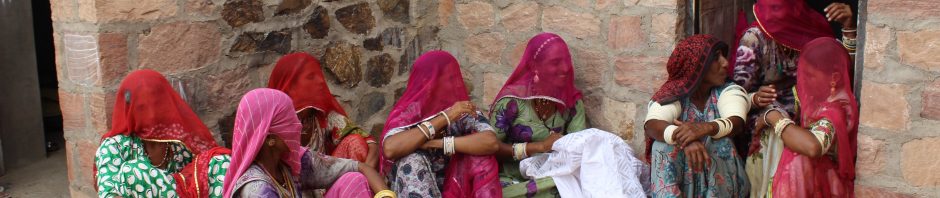
We arrived in Bikaner, Rajasthan four days ago after taking an overnight train from New Delhi. The past few days, we have been learning from Shivam, the CEO of Rangsutra, and Avesh, the head of operations to understand how Rangsutra functions as a business. Avesh spent a few hours explaining the business model and production process of Rangsutra in great detail. As the new head of operations, Avesh explained where he helped remove inefficiencies in Rangsutra’s production process to ensure that quality products were delivered to buyers on time. A good chunk of the production process depends on their suppliers, who provide them with fabric that Rangsutra then designs into products. The artisans mainly come in at the end of the business model, by offering their embroidery and embellishment services.
What has amazed me the most, however, does not have to do with Rangsutra’s detailed business model, but rather the success of organizations such as Rangsutra and its parent organization, the Urmul Trust. The past couple of days in Bikaner have helped me develop a comprehensive understanding of the state of Bikaner and northwestern Rajasthan.
A man named Sanjay Ghose is a hero here in Northwestern Rajasthan. In every cooperative we have visited, his picture is framed and hanging on the walls. Sanjay Ghose, a rural developer, was the founder of the Urmul Trust, an NGO in northern Rajasthan. Essentially, during the time of a severe drought, Ghose started the Urmul Trust in 1986 to initially offer basic healthcare services to villagers. With time, the services that Urmul offers has expanded. Today, Urmul offers projects and work opportunities in villages to aid in economic empowerment, offers training to teachers in government public schools, educates women about maternal and childcare, and more.
Yesterday, we visited a village called Lunkaransar where they dye cotton and make fabric using a power loom. It was an Urmul site, and we actually had the golden opportunity to talk to one of the Urmul managers. He showed us various training materials that Urmul uses to train individuals from a village, who are then expected to share what they learn with the rest of their village. He showed us new manuals which they developed for a pilot project about malnutrition for children. The handbooks were given to individual women in villages who were expected to train other mothers and look out for signs of malnutrition in their village. Depending on the success of the pilot project, the gentleman we spoke to said that the malnutrition project will be proposed to the state government of Rajasthan. The training manuals are extremely clear, as one need not even be literate to be able to understand them. They are all written in the local language as well.
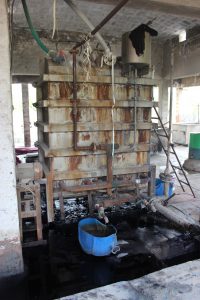
This fabric-dyeing machine in Lunkaransar is steam operated. The fabric will remain in the casing overnight. The rich indigo dye was speckled all over the dyeing plant that we visited.
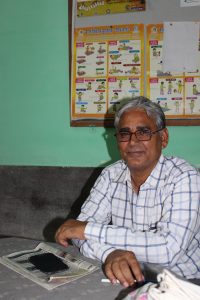
We spent a lot of time speaking to this local manager of the Urmul Lunkaransar site. It is only after our conversation that I fully came to acknowledge and appreciate the wide scope and effectivity of The Urmul Trust.
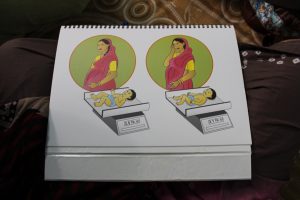
Clearly, one does not need to be literate to understand Urmul training manuals, which are sponsored by PLAN International as well as the Indian and Japanese governments, along with other groups.
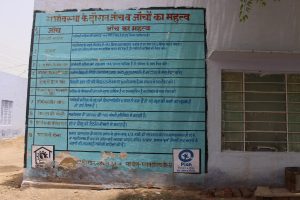
This attention grabbing memo is a public health announcement for families with newborns. It explains which vaccines children should receive at what age. Vaccine services are offered on-site, through Urmul.
Honestly, Urmul seems to be the ideal public health organization – if only what Urmul has done in northwestern Rajasthan could be implemented in all developing areas with the same functionality and success, support, and following that Urmul has here, half of the world’s problems would be solved. Interestingly enough, Rangsutra was founded by Sanjay Ghose’s wife, Sumita Ghose.
Yesterday we also visited the village of Napasar as well. I can not articulate how amazing and complex they weaving they did here was. The looms at this site are called frame looms, and they are all hand-operated looms. The amount of intricacy and finesse that goes into creating a single piece of fabric is beyond me. We spent an hour receiving various explanations about how the looms worked. There is so much manual labor and engineering involved in the process. Only a video and seeing it in person would do it justice. I gained a lot of newfound appreciation for clothing, and the supply chain for large clothing production companies in general. As we learned from Avesh, obtaining the right fabrics is an important part of Rangsutra’s production process, but never would I have imagined the amount of detail associated with this supply-process alone.
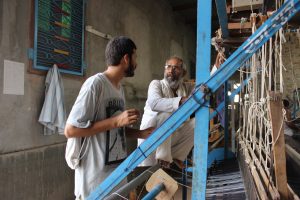
The site manager at Napasar patiently tried to explain the magical handwork produced on site.
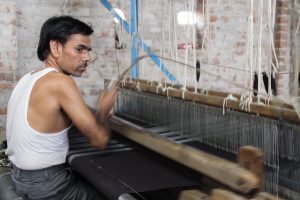
This is a hand-operated loom in action in Napasar.
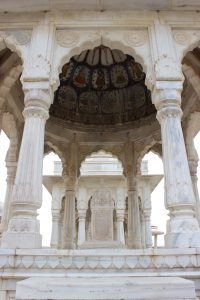
We stopped at this beautiful royal burial ground for generations of royal families in Bikaner while on the way back from Napasar. Rajasthani architecture often reflects Mughal architecture, prominently featuring beautiful arches as pictured.
Today, we spent a few hours talking in detail with Pappu, an extraordinary artisan who is employed by Rangsutra in the Bikaner main office. Pappu is 29 years old, and is extremely skilled and talented. While most women may know one type of weaving or embroidery skill, Pappu “knows them all.” Because of her intricate work and timeliness, Rangsutra hired her to create all of their sample pieces which they show to their buyers, Ikea and FabIndia, before the buyers place orders.
The sense of empowerment and agency that Rangsutra has offered Pappu is inspiring, and quite honestly, comforting. Pappu was so eager to share stories about the opportunities that working has offered her, how she plans to spend her savings in the future, why working with Rangsutra has helped her feel empowered, and more. I look forward to hearing more oft these stories during the next few weeks in Barmer, Rajasthan, where we will be conducting a baseline socioeconomic assessment, as Rangsutra is about to begin creating another campus in that area.
There are so many details and stories that I have left out of this entry. I could easily write more and more about many wonderful moments, thoughts and epiphanies.
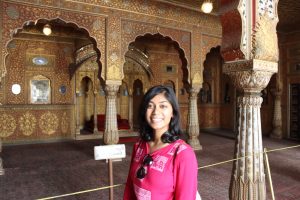
Before leaving Bikaner, we visited this beautiful royal palace, Junagarh Fort. It was full of walls plated with real gold and adorned with precious jewels.
It has been an amazing few days, and I look forward to what is in store – for the rest of my fellowship, and for the state of Rajasthan and rest of India in general.