“You are the sum total of everything you’ve ever seen, heard, eaten, smelled, been told, forgot – it’s all there. Everything influences each of us, and because of that I try to make sure that my experiences are positive.” –Maya Angelou
Reflecting on my past, I feel fortunate to have had so many diverse experiences and to have been taught the importance of service and passion. This is the story of why I was drawn to the Global Social Benefit Fellowship.
My mother’s family still primarily lives in India. She comes from a family that’s rooted in the value of service. My late grandfather’s philanthropy and advocacy was the basis for much of the development in the small town, Marredpally, Andhra Pradesh, from which my mother’s family originates. He was very invested in the teaching profession, and was the president of a university for many years. My mother, who moved to the United States upon marrying my father, followed in this track, first as a social worker at Valley Medical Hospital for several years, and now as a teacher in local public schools. By observing my grandfather and mother, I learned about the importance of kindness, humility, and service to others. Throughout my childhood and adolescence, community service was a huge part of my personal growth. I remember being begrudgingly woken up at 6 am every Saturday morning during my middle school years to make it to the Sacred Heart Community Center on time.
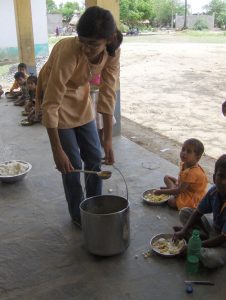
Serving lunch to children as a part of an eye-camp hosted through Sankara Eye Foundation at a school in my grandfather’s village in Varagani, India (est. 2009). Growing up, my father always told me, “Remember, it’s better to give than to receive.”
My paternal grandfather’s family is of the farming community—in fact, to this day, many of my father’s relative’s work on the fields of rice and chili plantations in Varagani, Andhra Pradesh. By day, my grandfather would work on the fields, and by night, he would sneak in as much studying as he could to educate himself. Ultimately, his brilliance earned him a college education in a local school, and upon graduating was invited to conduct aeronautical research at Cambridge University. Thus, my father’s family moved to England, where they would spend the next three years. My father was just entering high school at this time. From England, my grandfather received an invitation to work for NASA in California, and thus, my family settled down in the Bay Area.
Education and learning has always been of utmost importance to my family, for it was my grandfather’s thirst for knowledge, curiosity, and understanding of this dynamic world that gave my family the chance to live in this land of opportunity. While I may not harness academic excellence in the manner that my grandfather did, my passion for learning, particularly in the field of science, has always pushed me to try my best in school, and pursue my passions. I have always enjoyed being involved through various opportunities, such as participating in school science fairs. In fact, throughout high school, I interned as a research assistant in a Multimodality Molecular Imaging Lab (MMIL) at Stanford University that focused on cancer research. Medical issues—particularly concerning cancer—have plagued my father’s family, and I have always had a desire to help those in medical need. However, it was at the MMIL when I truly discovered my interest in the field of medicine.
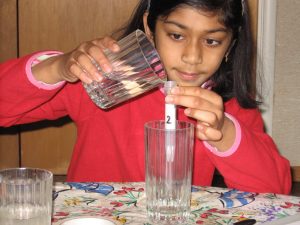
Conducting a science experiment for a middle school project. Practicing medicine is a professional goal of mine for the future.
After weeks into an experiment involving cancerous mice, my mentor gave me the phenomenal opportunity of helping her dissect tumors from the mice. This was my first time using a scalpel on fresh specimen. I had previously dissected a dehydrated frog and fetal pig in biology classes, which was no comparison to the fresh blood and body systems of the mice we were working with in this lab. With practice, I mastered the proper technique to extract the tumors—cutting into the skin with just the right amount of force, tearing open the abdominal lining in a manner that kept the body cavity together, using a scalpel with a steady hand to avoid puncturing other organs, and more. I was amazed by the fluidity of it all, and how interconnected anatomy was. To an extent, medicine has always seemed like an art to me. As someone who grew up with a talent for painting—I always tended to focus on the “big picture,” or function that an individual action was serving. The same principle applied to the dissections, for with every precise cut, another part of the puzzle would fit together.
When I joined Santa Clara University, I immediately immersed myself in the community. I was particularly drawn to the school for its Jesuit values: an emphasis on service to others, social justice, and learning beyond one’s self. Having attended a rather competitive high school, the gentle, nurturing nature of Santa Clara awed me. I felt drawn to give back as much as I could do the community. I joined the Emergency Medical Services team to serve the student community while practicing my passion for medicine, and also became a Community Facilitator in the McLaughlin-Walsh Residence Hall because I enjoyed the opportunity of helping empower new students to reach their full potential.
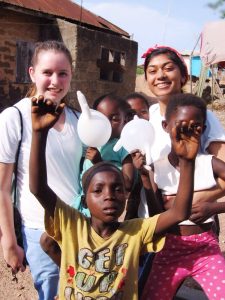
Visit to Ghana through Global Medical Brigades, 2014. I appreciate the importance of understanding the world around me and offering cultural sensitivity. More than being able to offer medical care in Ghana, immersing myself in the community was the highlight of the trip.
During spring break of my freshman year, I had the eye-opening experience of hosting a six-day medical camp in Ghana through Global Medical Brigades. Not only did we work with a team of physicians to offer consultations and immediate medical care in communities, but also offered public health education to several individuals. While I had previously taught at a slum school for girls in Hyderabad, India, this was my first hands-on international experience working with underprivileged communities in the health sector. It allowed me to witness the dire need for access to basic health care and means for livelihood in undeserved populations. Interestingly enough, that summer, I was researching in a biochemistry lab. While I enjoyed the science involved in my project, spending that summer in the lab validated my calling to direct social justice and public health-related work.
I am thrilled about GSBF and learning about social entrepreneurship because I hope that it will bring me closer to being able to positively impact the lives of those truly in need while offering a long-term solution to their problems. Last quarter, I made the realization that poverty can be a vicious trap, and that money—or a lack thereof—is the root cause of many social ills in developing areas. I look forward to understanding other cultures, and helping empower individuals in the face of poverty.
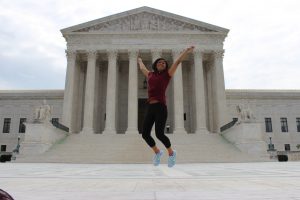
In front of the Supreme Court in Washington D.C., joyously jumping in support of justice.