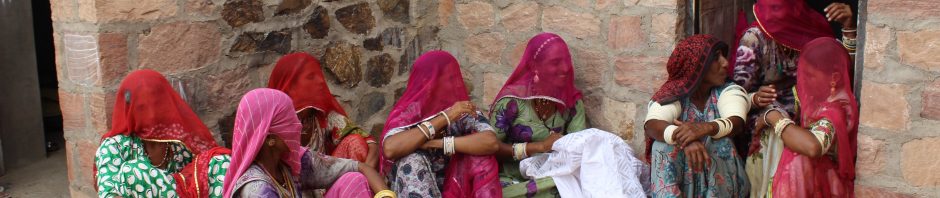
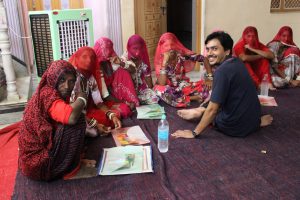
These working women wanted to leave work to be able to take care of their household. The craft manager training that these women were attending had a mandatory in-residence component, and despite this, their husbands let them attend. That being said, women sought to return home, showing that responsibilities at home were something they enjoyed and respected. In this photo, the women are struggling to convince Avesh, the operations manager at the Barmer site, to let them return home for a few hours of household work.
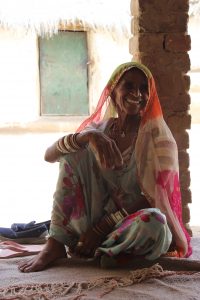
I have a clear memory of this artisan’s home – it was a typical village home, made of cow dung, straw, and mud. It was beautifully maintained, and artistically decorated. After visiting her home, I remember asking our translator, Mukesh about how and when families would move out of their village homes and live in more modernized homes, possibly closer to the city. To me it seemed that once a household saved enough income, upgrading their house would be a first priority (as it seems to be a priority here in the West). He simply shrugged and said, “I don’t think they would, this is their home.” They say home is where the heart is, and for these women, this sense of contentment could not be more true.
It’s been 8 weeks since I’ve returned from India. When I close my eyes and think about the experience, the same sight comes back to my mind. I see a golden desert landscape, with a sandy road perfectly centered between soft rolling hills, covered in awkward shrubbery and jumbled grassy plants. Whenever I think about this landscape, I think about how a scene so simple can be so comforting and peaceful to me. This simplicity also reminds me of the light and happiness the villagers in Rajasthan found in the midst of the socioeconomic challenges these families faced.
When I think about the Global Social Benefit Fellowship and the clientele that the social enterprises seek to serve, I think about extreme poverty, hardship, and underdevelopment. After reflecting a lot on my experience in the field, while the artisans and families I met were certainly underprivileged and facing difficult economic situations, I did not witness the same stereotypical image of extreme poverty that I would have expected to see, or that you would see in a magazine when reading about a developing nation.
Perhaps this reflects on the work that Rangsutra is accomplishing in Bikaner and Barmer, and how it truly is helping these families reach a point of economic stability. That being said, I know better. Based on the 131 interviews Grace and I conducted in the field—based on the stories which a few women shared about their hardships—I know that the artisans who were working with Rangsutra were all in need of more income, more services, and more help.
For example, one woman shared a story about how her husband was an alcoholic and did not contribute to the household, in terms of taking care of the home, or their financial situation. She faced the burden of maintaining the household and protecting her family’s honor. Another woman shared the story about how her husband received a fatal spinal injury during his early years of work, and that he has been paralyzed for the past eleven years. I am incredibly amazed by the strength and positivity that the women we worked with held. These people are inspiring human beings, capable of caring for their household despite the pressing economic challenges they faced. The women were smiling, composed, talkative, supportive of one and other, and well-presented.
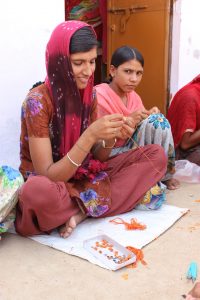
This young apprentice was learning about craftwork in preparation for her own future. The artisans in Bikaner and Barmer were well aware of their family’s financial situations and were dedicated to doing whatever was best for their household.
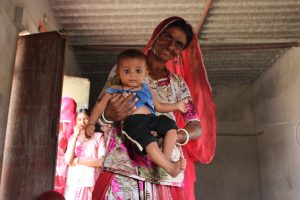
Despite the challenges that families faced, simple things still brought them joy and constantly lifted their moods. This proud grandmother was thrilled to share her grandson with us.
The socioeconomic challenges which these families face are so much more dire and pressing than simple academic stressors or social pressures which I may feel burdened with here at home. Yet, these women found light in their situations, and this is a huge inspiration to me.
The women I had the opportunity to interact with were all so open and willing to share about their personal stories, and I was astounded by this directness. Protecting confidentiality and sensitivity of our participants was of utmost importance to Grace and myself. We approached each of our interviews with caution to ensure that the women who were helping us felt comfortable throughout the process. However, it was quite surprising how much this confidentiality did not matter to them. This sense of vulnerability which these women opened themselves to reminded me a lot about humility and constantly making the best of situations as they stand.