Blind as a Lawyer

The television series Daredevil has reminded me that blind people have to go through an enormous amount of challenges just to lead a semi normal life. They go through life relying others and having to trust their other senses like feeling and hearing. They have to put so much faith in what they have. However, there are still a few blind people who push what they can do and beat the odds that were given to them. Jack Chen, a blind lawyer for Google, commutes to work by taking three separate subway connections from New Jersey into New York. He navigates people, columns, and busy streets everyday without the help of anyone. Chen uses a program on his computer that reads at 620 words a minute which is so fast that the untrained mind cannot understand it. He has done multiple Iron Man competitions where he bikes, swims, and runs numerous miles while attached to another competitor with a rope for guidance. He has not let his disability slow him down and he has proved everyone wrong. In the show Daredevil, Matt Murdock is a blind lawyer just like Jack Chen but instead of running Iron Mans and hiking mountains in his free time, he fights crime. Being active is one thing but I find it hard to believe that Daredevil could fight the crime in the city without a devoted sidekick helping him through all the obstacles. However, I do realize that this is a TV show and it is meant for entertainment so I will be lenient.

 

Image result for daredevil

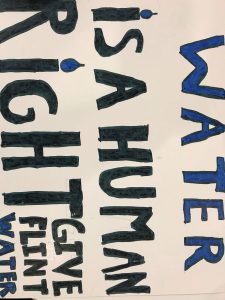
SCUwater4flint

Jake, Shaan, and I first decided that we wanted to raise awareness to the worlds water crisis but then realized we should narrow down our topic to make it more relatable. We came to a conclusion that choosing the Flint, Michigan water problem would bring a familiar feeling to students because it is within the United States and not some country overseas that students may not even know the location of. We believed that by choosing a topic close to home, we could get students to see that these kind of things are not just problems that exist far away and therefore the students would be more likely to help people that the can relate to. We started last week by making a Twitter account because we felt that it was the best way to get through to the most people. We concluded that using Instagram would spread our cause to the most people initially but would die out quicker and become less looked at as time goes on. With Twitter we figured that with the use of the retweet button, we could get our message out not only to our followers but also to our followers followers, therefore exponentially growing the amount of people seeing what is happening in Flint. I do not feel like this worked out very well but not because of the wrong decisions by us. Our posts did not reach very many people but I believe that with more time we could have grown our account to a very decent size and at the same time growing awareness.

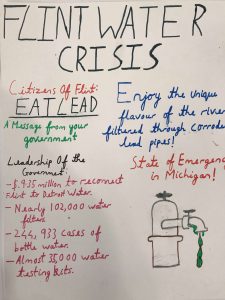
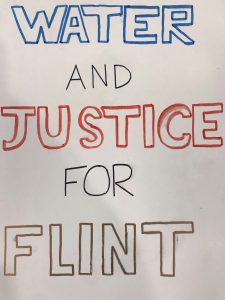
For the other way of spreading awareness about Flint, we decided to put up multiple posters in different Dorms. We did this so that people would not just see it once and instantly forget about it but they would see it a few times a day when going to or from their dorm room. We believe that because the students see it a few times a day they will retain the information on the posters better and may even want to look up more of the details of the crisis. I really hope that because of our posters we influenced a few students to want to help the disaster that is happening in our own country but we cannot be sure because we were not always there to see who was intrigued by the posters.

If we were able to change even one mind or even educate one student on what has happened in Flint, then I feel like this project was a success. I did not initially think that I would have much stake in this project but I feel that through my research that I have done, my eyes have been opened not only to the injustice in Flint but also to the societal flaws that is constantly separating the citizens of the United States more and more each and every day. Hopefully, starting this project will get people of all races, cultures, political parties, and ideals to get together and create a country where everyone helps each other without prejudice.

The Real Hero

In the dystopian novel, The Hunger Games by Suzanne Collins, the standout and main protagonist of the story is with no contest the silent, caring, and protective Katniss Everdeen. However, the real hero of the hunger games is actually Peeta Mellark whose sacrifice and kindness show that brains and brawn are not the only things that are needed in the arena. He should be considered the main hero of the book because throughout the entirety of the games he remains calm and only thinks about the well being of Katniss rather than himself. When he first gets chosen at the reaping, he walks up without any emotion. He does not show the fear that is within him and throughout the games he does not let his emotions get in the way of protecting the only thing he has left, Katniss. While Katniss focuses on making sure she is the winner, Peeta on the other hand would willingly lay down his life for her as we see in the end when he drops his weapon so she can easily put him down. Also, Peeta tends to get to know people even though they have nothing to offer him. He also counters Katniss’ emotional outbursts with his calm practicality. When Peeta gets captured by the capital at the end of the book, Katniss realizes that he was a crutch that she had leaned on throughout the recent events and that she could not have done it without him. All these reasons prove that Peeta is the main hero of the first book.

Politics from The Hunger Games

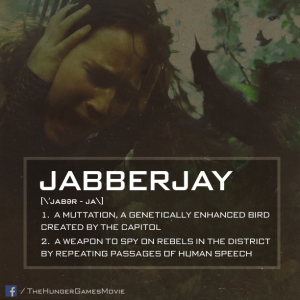
Suzanne Collins, in her book The Hunger Games, juxtaposes the politics of the country of Panem with the modern day United States of America. In her book she explicitly touches on political, social, and cultural issues like unauthorized surveillance, class structure and poverty, and the use of media to control the masses. First off, makes comparisons with the Capitol and the NSA. The NSA uses CCTV, webcams, and other modern technology to spy on its citizens, the Capitol uses new technology as well specifically their design and use of Jabberjays that pick up noises and videos of people throughout the twelve districts. This is an absurd invasion of privacy and if the government is working correctly then it should not be worried about people rebelling. The second comparison that Collins makes deals with poverty and different advantages of regions. District 12 is one of the poorest districts in the country whereas District 1 is the richest. When getting ready for the Hunger Games, kids in District 1 have been training since their early childhoods because they did not have to work to help feed their families like their counterparts in District 12. This gives a great advantage to some kids over others just like in America where kids coming from certain regions have to overcome an extreme amount of obstacles to get to where they want to be in life. The last comparison that Collins makes between America and Panem is the use of media to control and corrupt the masses. The government picks and chooses what it shows on the screens to lead the people to the governments point of view. Even when the Districts start to rebel in the later books, the government shows its people that they are winning even when they are losing territory. Major news channels in the USA tend to tailor their news broadcasts to make people think that their view is correct even if that means giving false news.