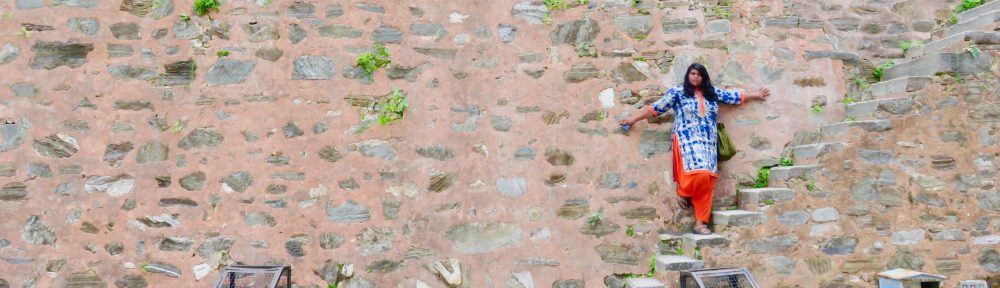
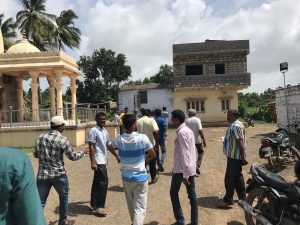
A common sight for us during our first three field visits
“Guess it’s just us two females hanging out in a crowd of just males once again.” This common phrase was jokingly uttered between Maya and I multiple times throughout our travels in India. Gender inequality is not a new concept to me as it is something I have become very conscious of every summer spent in India. Even though gender inequality exists in America, it is more apparent here in India. Even before I embarked on this fellowship, multiple family members expressed their concerns over my upcoming travels. During our first week here, we only saw one woman in our hotel, working at the front desk, while surrounded by men every morning as we ate breakfast. Everywhere men dominate public spaces while most women stay inside their houses. When we arrive to the rural areas to conduct our interviews with the end-beneficiaries, the men would crowd around us while the women would be outside their houses looking at us afar.
To see the social impact of Awaaz.De’s technology, we visited a total of five organizations: Precision Agriculture for Development (PAD), Self-Employed Women Association (SEWA), Ambuja Cement Foundation (ACF), CRISIL, and Jan Jagaran Shakti Sangathan (JJSS). All of these organizations uses Awaaz.De’s technology to further promote their mission. For example, PAD sends out voice messages regarding agricultural practices to rural farmers in Gujarat. Our interactions with the end-users during our first three visits—respectively PAD, SEWA, ACF—were filled with males. During these fields visits, our only interactions with women would be at the homes/fields we visited, and even then, women would only interact with us when they would give us chai.
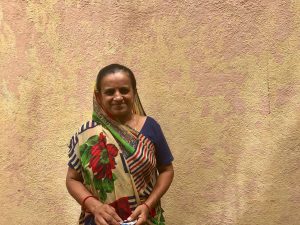
The first woman we interviewed was on ACF Day 2
At first, it didn’t bother me as much because I was used to it, but I never thought I would be so excited to interact with women before. Sometimes, I would find myself drawn to the women crowded on the the steps of a house and approach them with a simple head nod. They would immediately return the same greeting back to me, but I would have to leave soon after to conduct our interviews. However, for brief moments, when I would be able to have conversations with these women with my limited Hindi, I would feel immense happiness.
Our last two field visits were to CRISIL and JJSS where we interacted with mainly women, which may have been a factor to why these field visits were my favorite. For CRISIL, these women became financially empowered after going through a two-day financial literacy workshop and were receiving voice messages post-training to supplement what they learned. We met with many groups of women where they patiently answered all of our questions, expressed their gratitude for us visiting them, and repeatedly offered us food. One group even gave us gamuchas, traditional Assamese white rectangle pieces of cloth with red embroidery that is given to others as a sign of high respect.
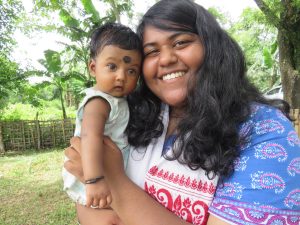
Sweaty me wearing a gamucha ft. cute baby
Our field visit to JJSS happened in Bihar, the only place where my parents were hesitant for me to go to due to Bihar’s reputation for crime. Before we came here, all of my family members expressed their worries over us going there and were immediately relieved once they learned we were going with two men. As a trade union for unorganized sector workers, JJSS started after individuals conducted a survey in Bihar looking at the effectiveness of the National Rural Engagement Guarantee Act (NREGA), which they found was not effective at all. Originally founded to help individuals gain work through the NREGA, JJSS expanded to talk about a variety of social issues including gender inequality.
When we embarked on our first day of our JJSS field visit, one of the founders, Kamayani, accompanied us to a village. On the bumpy car ride, she explained a major issue in this area is reluctance to inter-caste marriages. In this specific village, a young couple, an 18 year old boy from the Dalit caste and a 17 year old girl from the upper caste, ran away from home to be together, but they were found in Delhi. The girl was brought back to her house while the boy was put into jail where they both remain till this day. A month ago, she wrote a letter consenting to this relationship and explained that she left her home due to her abusive family. However, when she came back to her family’s home, she released an official statement where she stated that the boy kidnapped her and left her at a narcotics dealer’s place in Delhi before she was found. Because these two written statements from the girl didn’t match up, Kamayani explained that the family probably influenced the girl’s latest statement in order to preserve their reputation, as a girl running off with a member of a lower caste doesn’t look good on the family.
No matter what, nothing can be done to save the boy as he did break the law—the minimum age to marry is 18 in India. However, the boy’s father, grandfather, and maternal uncle have been in jail for 2.5 months now for no real charges, and JJSS believes the girl’s father bribed the local police to put them there. This situation is a clear unjust power difference, which is why JJSS is stepping in. Today, Kamayani will attend a meeting with all the other women in this village to write a petition to ask the police commissioner to take the girl’s statement again without the influence of her family. As well, JJSS is scared that the girl may be in an unsafe home situation, so they will also ask for the girl to be taken to a safe place without her family.
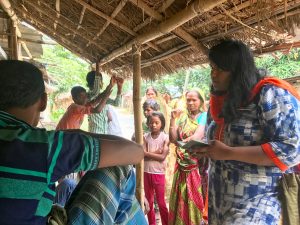
Typical day in JJSS field visit
If I am being very honest, I was in complete awe that an organization would step in to help this girl. I gained so much respect for JJSS as Kamayani explained this situation to us. As well, throughout our field visit, we interacted with so many women that it felt unreal at times. The hard truth is social norms are hard to change in any society, especially ones so ingrained like gender roles. Something I’ve always had to grapple with whenever I was in India was the limitations of my freedom, especially my freedom of movement, and comparing what I could do versus what my brother was able to do. For example, I could never walk outside in the villages without being accompanied by a male while my brother could play cricket with other children. I knew that my parents never meant to promote this inequality between my brother and I, but instead their actions were due to the stark reality of Indian society.
As a young child, I used to think that India needed to be more like America regarding many aspects, but as I grew up, I realized there was no such thing as gender equality in my homeland. Even then, who am I to say how Indian society should be like, especially as an outsider. What makes JJSS amazing in my opinion is how they tackle issues that the community members want to talk about, not what issues JJSS want to talk about. I feel that in order for me to understand what societal structures keep this inequality in place, I have to talk to Indians who grew up in India. I may never have the solution or even know what the solution may be to this social injustice, but if I ever wanted to do something about it, I knew that I need to follow JJSS’ footsteps and live among the community in order to hear the voices of Indian society to understand what the true issue is.