
It’s easy to think that people living in poverty are different. The narrative and images commonly used in the media, especially regarding Africans, show people that are starving, sick and helpless. They live half a world away and their reality is so different from ours in the developed world that sometimes it can be hard to relate to. And unfortunately, out of this narrative comes the idea that those in poverty are somehow less – less smart, less useful, less human. While it’s better than during colonialism, the white savior complex is still a very real thing. It’s something I grappled with a lot prior to my time in Uganda and truly am still trying to understand. Before heading into the field, I thought a lot about how I was going to interact with the people in Uganda and I was anxious I wouldn’t be able to find common ground with them. After all, I grew up in a wealthy suburb of Seattle and have lived an exceedingly comfortable life. What would I talk to them about? How would I relate to them when their wants and needs are so drastically different than mine?
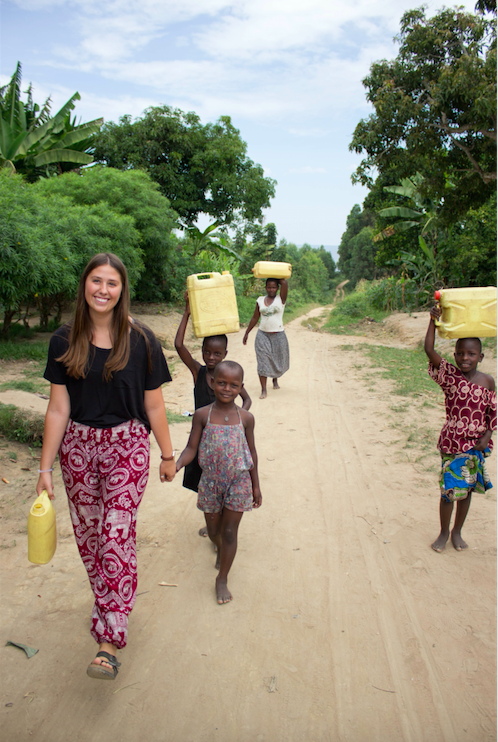
Walking with some girls I met on the shores of Lake Victoria.
On one of our first days in Uganda, we were visiting Bana and took a walk down to the shores of Lake Victoria. When we were walking back, there were some young girls carrying their jerry cans of water home. They only spoke a little English, but I introduced myself and offered to help them carry the water. Soon one of the girls grabbed my hand and we walked together for a while. What came out of this was, what I originally thought, the cutest picture ever, captured by my lovely partner, Will. While this was a genuine moment and interaction, looking at the picture now makes me sort of uncomfortable. To the outside world this is the most typical “white girl goes to Africa” sort of picture: a white girl, surrounded by African children, looking like a hero and a savior, leading them off to a better life. While this wasn’t the reality of my experience this summer, pictures like this made me wonder if maybe I am part of the problem too.
While I expected to get treated differently because I was white, what I wasn’t prepared for was the extent to which the people in Uganda give into the white savior narrative. I always thought it was more of a superiority complex on the part of the white person, but I realized that it really goes both ways. There were many occasions in which I was interacting with people and got the sense that they thought they were less than me just because I was white and from America. People in Uganda think so highly of
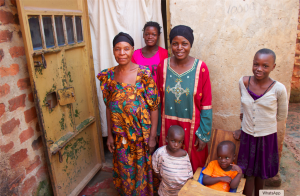
Beneficiaries of Nurture Africa at a home interview.
white people and they love being around them because it raises their social status. Countless times I listened to people talk negatively about their country and culture and ask me if I could bring them back to America. Mothers constantly wanted me to hold their babies. Even patients at the Nurture Africa clinic told us that one of the main reasons they come to Nurture Africa over other clinics is because of all the white people. Interactions such as this made me pretty uncomfortable. Yeah there are a lot of issues in countries such as Uganda, but the people don’t need saving. They don’t need to be taken care of or taken to America by a white person to live a happy life. They’re fully human and fully capable and it saddens me to think they don’t realize that and recognize their own humanity. While I’m sure much of this roots back to colonialism, I think it also has to do with empowerment. In order for this cycle of thought to be broken and for the narrative of the white savior to disappear, I believe it’s essential that Ugandans and those in poverty feel a sense of greater empowerment.
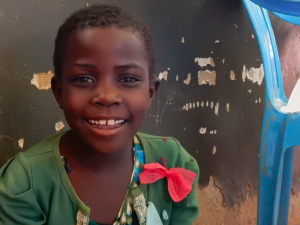
A young girl I met at the HIV outreach clinic.
One of the most challenging experiences I had in country was when Will and I attended an HIV outreach clinic with the Nurture Africa staff. Everyday at the Nurture Africa campus I saw the HIV patients sitting in the waiting room but I’d never really interacted with them as our research was focusing on primary healthcare. As we were driving to the village where the outreach was taking place, I felt sort of anxious. Not only are these people living in pretty immense poverty, but they’re also further marginalized by their HIV status and health. I’d never met someone with HIV before so I got nervous that I wouldn’t know how to act. I wanted them to feel comfortable, but I also didn’t want to overcompensate and be extra nice. I knew I was overthinking the whole situation, they’re just people after all. It was heartbreaking to see entire families and so many young children that were infected with HIV. I’d never seen anything like that before and it was an emotional experience to
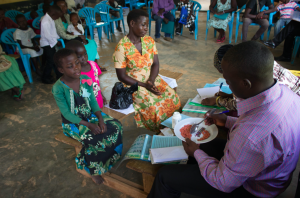
A nurse and patients at the HIV outreach clinic.
imagine what their lives are like. While I was sitting by the nurse who checks the patient’s viral load in their blood, one of the young children came up to me. She wanted to look at my camera and was obviously curious about me. Pretty soon we were playing and it felt much more natural to interact with her and everyone else. Looking back on it I don’t know why I was so nervous. We’re all just people. While we might not have much in common as far as our experiences go, we share a common humanity and a common home. And in the end we all want the same things. We all want to feel loved and feel happy. We all want to feel successful and fulfilled. We all want our parents to be proud of us and our children to be happy and healthy.
Vocationally, I think the experiences I had in Uganda taught me that I want to put my skills and talents towards empowering others, especially those in poverty. I think it’s incredibly important that everyone finds a sense of self-worth, freedom and acceptance. It’s something I only found pretty recently, but it’s radically changed my life and my perspective. While I’m still pretty confused about what I want to do career-wise, I feel myself more and more being pulled towards the field of global health. I believe that the
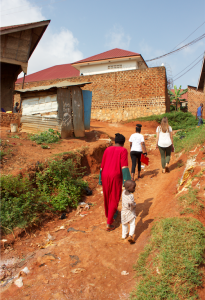
Walking through Nansana with our translator and beneficiaries of Nurture Africa.
health disparities evident in the developing world contribute greatly to people’s feelings of inferiority. By working to reduce these health disparities I will have the opportunity to engage and empower communities to live healthier, more fulfilling lives. While I don’t know what the future has in store for me, addressing global health challenges is something I could see devoting my life to, and I’m excited for the opportunity to explore it further.