Lost & Found

To Thane, Keith and the other fellows in Uganda for keeping me sane and loving me through the ups and the downs.

Vulnerability and Authenticity
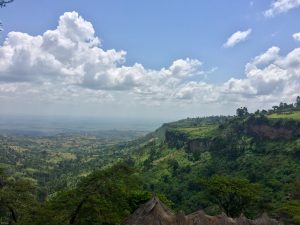
Beautiful Uganda.

I packed two books with me when I left for Uganda: Man’s Search for Meaning and Eat, Pray, Love. If it wasn’t obvious from the book choices, clearly I was looking for something. Junior year was a whirlwind of over-commitment and stress and I could not have been more ready to get away from all of it. My goals for my time in Uganda were two-fold. First, I wanted to disconnect from the craziness of university life in America and fully engage with every experience in Uganda. I find a lot of things in modern American culture to be pretty pointless, so I was eager to be able to focus on things that really matter, like learning about new cultures, reducing poverty and improving maternal and child health. Second, I wanted to focus on myself and seriously contemplate my vocation and direction in life. These goals may sound ambitious, but I was committed! I deleted all my social media accounts and said goodbye to my iPhone, opting instead for one of those Nokia brick phones. The place that Will and I were living had no Internet so I truly had nothing to distract me from achieving my goals. The other fellows in Uganda may have made fun of my new lifestyle, calling me “Grace off the grid,” but I knew it was what I needed to rebalance and focus my life.

I’d never considered myself a terribly emotional person before this summer, mainly because I never made time for emotions. I pride myself on being a person who’s independent, involved in a lot of things, has a wide social circle and seemingly has it all together. I keep myself so busy that during the school year I typically have about 30 minutes of free time a day. I usually like to use that time to shower or lay down and very rarely do I find myself reflecting on or contemplating life and my happiness. I like to keep myself unemotionally attached because I find it easier that way. It’s less messy, but I’ve also found that it’s less authentic.
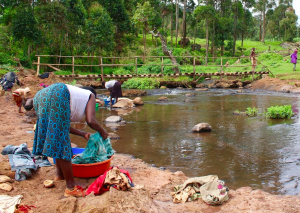
A woman washing her clothes in the river.

In Uganda I experienced just about every emotion possible. I was so over-stimulated and overwhelmed by the things we were seeing in the field that I had absolutely no idea what to make of it all. It also didn’t help that I suddenly went from having about 30 minutes of free time a day to about 7 hours a day. And with no distractions from my phone, the Internet or social media, I was truly alone with my thoughts. And boy did I dwell on the experiences I was having and the emotions I was feeling. I spent a lot of time alone in my room thinking and crying and feeling sad and lonely. I felt sad because of the poverty and healthcare disparities I was seeing and because I didn’t know how to process how immensely privileged I am. I felt lonely because my experiences and emotions were difficult to put into words and I thought that no one else would understand.

When I came home from Uganda, I found myself not even wanting to talk about my experiences. When I passed friends on campus they’d ask how Uganda was and I would say “Great!” and keep on walking. While my experience this summer was great, it was so much more than that. It was lonely, it was inspirational, it was exhilarating, it was uncomfortable, it was eye-opening, it was empowering, and it was heartbreaking. It was indescribable and full of contradictions and it shook me to my core. How could I explain that to friends I passed by on campus? I couldn’t, so I went with the easy answer, “great.” But after a while I hated that answer. I hated the way it tasted in my mouth and I hated how inauthentic it felt.
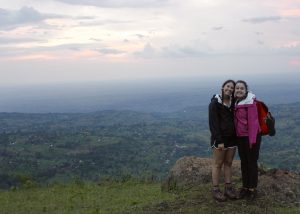
Forever thankful for my friendship with Lauren.

I think I had a really hard time reflecting on my experiences and figuring out how to explain them to people because I didn’t want to revisit the emotions I felt. When I returned to the U.S. and to school, I reverted back to that busy, emotionally unattached girl. I avoided reflecting on Uganda because I didn’t know how to make sense of it all and it made me sad when I did think about it. But as the fellowship came to a close, I got scared that if I didn’t internalize and make sense of these memories that they’d soon slip away from me. So here are some things I’ve learned throughout this reflection process. First, it’s okay to not be okay sometimes. Everyday isn’t going to be perfect and emotions are a part of human life. My emotions don’t make me weak, but instead powerful if I channel them into something productive. Second, people care when you open up to them. I never liked to express my emotions to friends because I didn’t want to be needy. But when you’re out of your comfort zone in a developing country, friends who understand what you’re going through are invaluable. The friendships I formed with the other fellows in Uganda continue to be some of my most cherished relationships. Third, too little or too much free time isn’t good for me. Too little free time leaves me emotionally disconnected, and too much free time can cause me to overthink things and become emotionally overwhelmed. While I’m still working to find the right balance, I’m trying to stay more connected to my emotions by meditating and keeping a daily journal. It’s these times in my day that I can hear the still, small voice inside me and re-center myself. I’m an imperfect and flawed person, but I’ve never felt more connected with who I am and who I want to be than I do at the end of this fellowship.

Next Steps

Since returning from Uganda, I’ve completely eliminated becoming a doctor from my list of potential career paths. And it feels great! Don’t get me wrong, being a doctor is a noble profession, but it’s just not for me. After happening upon and exploring the field of global health, I’ve decided that’s what I want to dedicate my life to. Having experienced the health disparities in the developing world first hand, I’m inspired to combat the unjust social equilibriums that hold these disparities in place.
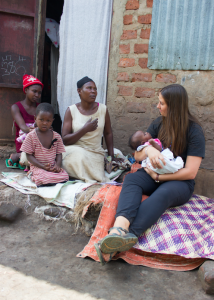
My favorite type of social engagement.

As I think back to Getting Beyond Better, I went through the “Understanding the World” stage while I was in Uganda. I apprenticed with the problems and became outraged by the current social equilibriums. Directly engaging with the beneficiaries of Nurture Africa allowed me to realize that that’s the type of social engagement I enjoy. While Will excelled at writing the surveys and extracting data from the patient database, my favorite part of our research project was sitting with clients and hearing their stories. It was hearing the pain and the joy in their voices, and seeing the emotions on their face that was truly inspiring to me.

Now I’m in the “Envisioning a New Future” stage. While I’m young and unattached, I want to work as proximal to the beneficiaries as possible. Ideally, after graduation I would move back to the developing world (hopefully Africa) and work with a health related social enterprise for a few years. After that I’d like to return to the U.S. and get my Master’s degree in Global Health or Public Health. Ultimately, I’d like to work for a global health firm like PATH. Will my career path end up like this? I don’t know, but what I do know is that I sure have a lot more direction in my life than I did before this fellowship.
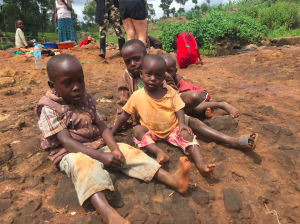
What’s calling me back.

After having such an emotionally draining experience, why do I want to go back to Africa? While this experience shook me to my core and broke me, it also gave me direction. Neafsy says, “One of the most privileged and sacred places where the Voice can be discerned today is in the needs and sufferings of our fellow human beings. We hear it by listening with an open heart to the cry of the poor and the oppressed.” I think the raw emotions and vulnerability I felt in Uganda this summer represent my listening with an open heart. Hearing the cry of the poor up close is both deafening and enraging. It’s maddening to me that the poor need to cry in the first place. And it’s maddening that so many people in the developed world have gone deaf to this cry or choose to put earplugs in. It’s a cry that rings in my ears and I can’t get out of my head. But it’s not just a cry anymore, it’s a call. Africa is chaotic and uncomfortable but it’s taught me more about myself and about the world than any class or professor has. And I don’t think it’s done teaching me yet. 

Looking Forward

It’s funny, I never finished either of the books I brought with me to Uganda. The parts I did read were great, but I think I realized that instead of reading other people’s stories of finding themselves, I needed to write my own. While these books could offer me hope, only I could piece together and make meaning out of the experiences I had.

They say that sometimes, you need to lose yourself to find yourself. I lost myself in Uganda. It was one of the most challenging, vulnerable, and powerful chapters of my life. It made my question my worldview, my values and what I believe about myself and my place in this world. But in the time following my return, I’m slowly finding myself again. Not the same me, but a new me. For a long time I think I was scared of listening to the still, small voice inside me. But I’m not anymore. I feel powerful and inspired and ready to tackle all that life has to offer. While I have a lot more chapters of my life to write, the chapter on Uganda and my time as a Global Social Benefit Fellow will always be one that’s dog-eared. One that I can turn back to when I feel lost or when I’m questioning what really matters in life. This chapter represents one of the most formative periods of my life and one that truly altered my sense of direction for the better. And for that, I could not be more thankful.
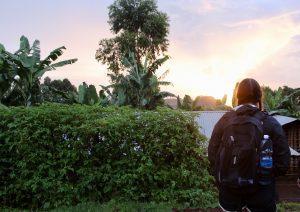
The sun setting in Sipi Falls.
Posted in Uncategorized | Comments Off on Lost & Found

Empowering Realizations

It’s easy to think that people living in poverty are different. The narrative and images commonly used in the media, especially regarding Africans, show people that are starving, sick and helpless. They live half a world away and their reality is so different from ours in the developed world that sometimes it can be hard to relate to. And unfortunately, out of this narrative comes the idea that those in poverty are somehow less – less smart, less useful, less human. While it’s better than during colonialism, the white savior complex is still a very real thing. It’s something I grappled with a lot prior to my time in Uganda and truly am still trying to understand. Before heading into the field, I thought a lot about how I was going to interact with the people in Uganda and I was anxious I wouldn’t be able to find common ground with them. After all, I grew up in a wealthy suburb of Seattle and have lived an exceedingly comfortable life. What would I talk to them about? How would I relate to them when their wants and needs are so drastically different than mine?

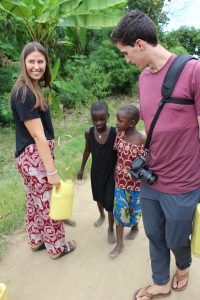
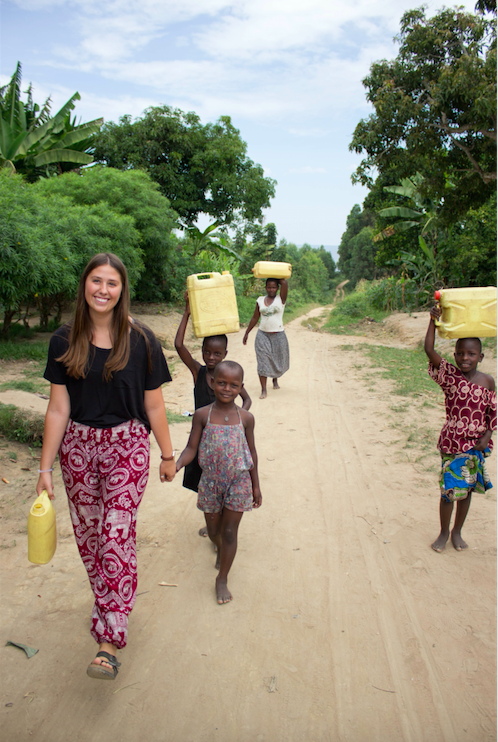
Walking with some girls I met on the shores of Lake Victoria.

On one of our first days in Uganda, we were visiting Bana and took a walk down to the shores of Lake Victoria. When we were walking back, there were some young girls carrying their jerry cans of water home. They only spoke a little English, but I introduced myself and offered to help them carry the water. Soon one of the girls grabbed my hand and we walked together for a while. What came out of this was, what I originally thought, the cutest picture ever, captured by my lovely partner, Will. While this was a genuine moment and interaction, looking at the picture now makes me sort of uncomfortable. To the outside world this is the most typical “white girl goes to Africa” sort of picture: a white girl, surrounded by African children, looking like a hero and a savior, leading them off to a better life. While this wasn’t the reality of my experience this summer, pictures like this made me wonder if maybe I am part of the problem too.

While I expected to get treated differently because I was white, what I wasn’t prepared for was the extent to which the people in Uganda give into the white savior narrative. I always thought it was more of a superiority complex on the part of the white person, but I realized that it really goes both ways. There were many occasions in which I was interacting with people and got the sense that they thought they were less than me just because I was white and from America. People in Uganda think so highly of

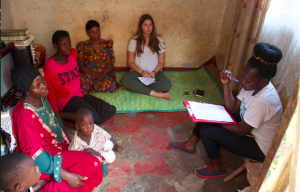
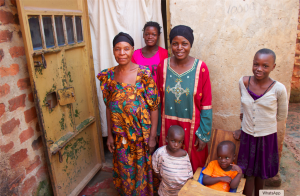
Beneficiaries of Nurture Africa at a home interview.

white people and they love being around them because it raises their social status. Countless times I listened to people talk negatively about their country and culture and ask me if I could bring them back to America. Mothers constantly wanted me to hold their babies. Even patients at the Nurture Africa clinic told us that one of the main reasons they come to Nurture Africa over other clinics is because of all the white people. Interactions such as this made me pretty uncomfortable. Yeah there are a lot of issues in countries such as Uganda, but the people don’t need saving. They don’t need to be taken care of or taken to America by a white person to live a happy life. They’re fully human and fully capable and it saddens me to think they don’t realize that and recognize their own humanity.  While I’m sure much of this roots back to colonialism, I think it also has to do with empowerment. In order for this cycle of thought to be broken and for the narrative of the white savior to disappear, I believe it’s essential that Ugandans and those in poverty feel a sense of greater empowerment.

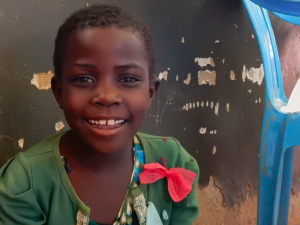
A young girl I met at the HIV outreach clinic.

One of the most challenging experiences I had in country was when Will and I attended an HIV outreach clinic with the Nurture Africa staff. Everyday at the Nurture Africa campus I saw the HIV patients sitting in the waiting room but I’d never really interacted with them as our research was focusing on primary healthcare. As we were driving to the village where the outreach was taking place, I felt sort of anxious. Not only are these people living in pretty immense poverty, but they’re also further marginalized by their HIV status and health. I’d never met someone with HIV before so I got nervous that I wouldn’t know how to act. I wanted them to feel comfortable, but I also didn’t want to overcompensate and be extra nice. I knew I was overthinking the whole situation, they’re just people after all. It was heartbreaking to see entire families and so many young children that were infected with HIV. I’d never seen anything like that before and it was an emotional experience to

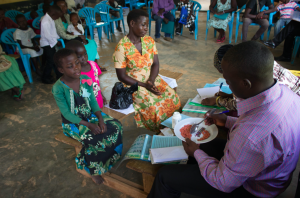
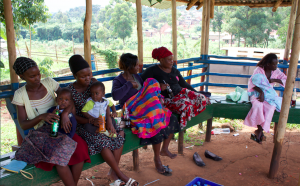
A nurse and patients at the HIV outreach clinic.

imagine what their lives are like. While I was sitting by the nurse who checks the patient’s viral load in their blood, one of the young children came up to me. She wanted to look at my camera and was obviously curious about me. Pretty soon we were playing and it felt much more natural to interact with her and everyone else. Looking back on it I don’t know why I was so nervous. We’re all just people. While we might not have much in common as far as our experiences go, we share a common humanity and a common home. And in the end we all want the same things. We all want to feel loved and feel happy. We all want to feel successful and fulfilled. We all want our parents to be proud of us and our children to be happy and healthy.

Vocationally, I think the experiences I had in Uganda taught me that I want to put my skills and talents towards empowering others, especially those in poverty. I think it’s incredibly important that everyone finds a sense of self-worth, freedom and acceptance. It’s something I only found pretty recently, but it’s radically changed my life and my perspective. While I’m still pretty confused about what I want to do career-wise, I feel myself more and more being pulled towards the field of global health. I believe that the

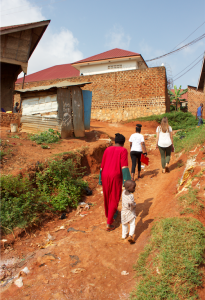
Walking through Nansana with our translator and beneficiaries of Nurture Africa. 

health disparities evident in the developing world contribute greatly to people’s feelings of inferiority. By working to reduce these health disparities I will have the opportunity to engage and empower communities to live healthier, more fulfilling lives. While I don’t know what the future has in store for me, addressing global health challenges is something I could see devoting my life to, and I’m excited for the opportunity to explore it further.

Posted in Uncategorized | Comments Off on Empowering Realizations

The Musings of a Mzungu

Helplessness

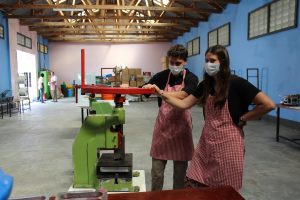
 My first “oh shit” moment came on Day 3 of being in Uganda. We spent the day visiting Bana, a social enterprise that sustainably produces women’s sanitary pads from the stems of banana leaves. After touring the facility and helping with the production of the pads, we sat down for a meeting and some snacks with the employees of Bana. Partway through the meeting, one of the other fellows, Indy, came up to me and quietly asked if I had any allergy medicine. I didn’t, which was unfortunate because he was having an allergic reaction to the jackfruit we were eating and his tongue was tingling and beginning to swell.

Indy and I on the sanitary pad production line at Bana (pre-allergic reaction).

Being an EMT, I jumped into action and started asking him a million questions about any other allergies or previous allergic reactions he’s had. While he was a great patient and answered all my questions, it was scary knowing there was absolutely nothing I could do for him. At home, I could give him oxygen, assist him in taking Benadryl and then call the fire department/ambulance who could give him epinephrine if necessary. But here, all I could do was offer him some water and try to keep him calm. Luckily, his reaction was mild and the tingling and swelling eventually went away. Nevertheless, it still scares me to think about what could have happened had he had a more serious reaction and gone into anaphylactic shock; we were in a small village and nowhere near a health facility that could handle such an emergency.

After this experience, I have come to always carry Benadryl in my backpack and purse, just in case. However, this is a luxury that most Ugandans don’t have. Instead, the reality in which they live is one without access to medication or any sort of emergency care. Even if one can get to a health facility, it’s likely the facility won’t have the means to actually treat them. In this moment with Indy I felt helpless, and this feeling of helplessness has become increasingly more prevailing after spending the last month conducting action research in the health clinic at Nurture Africa.

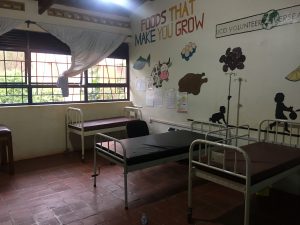
The resuscitation/emergency room at Nurture Africa.

Nurture Africa, as well as two other health clinics that Will and I have visited in Nansana, are under resourced and lack many essential medications and medical interventions, oxygen included. It’s also important to note that the clinics we have visited so far have been private. We haven’t yet had the chance to visit a public clinic, but from what I’ve heard, they’re even more under resourced and overcrowded than the private ones. Nevertheless, the health services offered at Nurture Africa are very, very basic. While most primary healthcare patients just require some drugs from the pharmacy, not much can be done for those that do require more advanced care, besides referring them to the national hospital in Kampala. Because there is so little that healthcare workers can do in these emergency situations, I wonder about their own satisfaction with their jobs. Do Ugandan healthcare workers constantly feel helpless because they don’t have the resources to properly care for their patients, or do they not even know that more advanced treatment options exist?

Conducting a home interview with former patients of Nurture Africa. It is the child in the white that has been struggling with pneumonia. 

Having worked in emergency medicine and knowing what modern medicine can do, it’s saddening to see that so many people lack access to healthcare and are suffering, and potentially dying from, treatable conditions. One day, while conducting a home interview, a woman told Will and I about her child who has been suffering from pneumonia off and on for several years. She had to stop coming to Nurture Africa because she couldn’t afford the payments, but the drugs she buys from the pharmacy aren’t as high quality. At this point, she doesn’t even have the money to buy the low quality drugs from the pharmacy, so the child has to go without. Given the musty nature of their home, it’s likely the child will continue to struggle with this issue. Stories such as this are heartbreaking to hear not only because the child is suffering, but also because it shows me how out of touch I am with the struggles of so many people in the world. I’ve been lucky enough in my life to never have to choose between food, school fees or a potentially life-saving medication. It’s honestly never crossed my mind whether or not I’d be able to afford a medication I needed. Although the healthcare sector in Uganda does require major development for it to properly address the health needs of its population, it is inspiring to see organizations like Nurture Africa that seek to shift such unjust social equilibriums, empower vulnerable people and allow them to live to their fullest potential.

The Conception of Time

 As part of our research project, Will and I are assessing patient satisfaction at the Nurture Africa health clinic. One measure that has produced interesting results is patient satisfaction with wait time. When a patient comes to the health clinic there are multiple points at which they will potentially have to wait – at the reception, at the cashier to pay their consultation fee, at triage, at the clinician’s office, at the lab, at the cashier to pay for their labs and drugs, and finally at the pharmacy. On average, patients are spending around 2.5 hours at the health clinic but only interacting with healthcare workers for maybe 20 minutes. And it’s not because the clinic is too busy; on a given day there are 5-15 primary healthcare patients. But here’s the catch, they aren’t complaining about the wait time! The vast majority of patients have said that the wait time at Nurture Africa is significantly less than at other clinics and that this is a deciding factor when they choose which clinic to go to.

Focus group participants sitting at Nurture Africa and patiently waiting for the discussion to begin.

This made me wonder why – why are they okay with waiting around for 2.5 hours to get treated? And if they think the wait time here is short, what is it like at the other clinics? Similarly, when Will and I held focus group discussions about the services offered at the Nurture Africa health clinic, they typically didn’t start until 1.5 hours after they were supposed to. Hardly anyone showed up on time, but surprisingly, most people were happy to wait around, even if they themselves were timely. “African time” is a real thing here and it has proved to be frustrating and difficult to adjust to given that the emphasis on productivity and speed that I’ve grown up with in the United States. Whenever I go to the doctor or to any other appointment, I want to get out of there as fast as possible so I can get on with the rest of my day. Interestingly, that doesn’t seem to be the case here.

The value that Ugandans place on time is strikingly different than Americans and it is possible that a certain degree of this can be attributed to poverty. Initially, it seemed to me that this country has a serious issue with productivity and planning ahead, but after reflecting on it, I think a lot of it has to do with the fact that most people are just trying to survive and when survival is the goal, you don’t have a lot of time to think about the future. In contrast, Americans are constantly planning for the future. This summer alone I’ve spent so much time thinking about what I want to do when I graduate from SCU, even though that’s 9 months away. But if you aren’t sure if you’re going to be able to afford food for dinner or medication for your child’s illness, you don’t really have time to think that far ahead. You’ve got to focus on the issue at hand and sometimes just get through the day. I am incredibly lucky that I have the stability to plan for the future. Often I even want time to speed up so that the future and everything I’m looking forward to can happen sooner. When reflecting on this, a sad thought occurred to me that maybe some people here don’t have that much to look forward to, maybe they want time to go slow because they’re so unsure and scared of the future. Or maybe this waiting time is actually an escape from their monotonous daily routines. Or maybe they’re just a really laidback and agreeable population. While I’m still not exactly sure why people are okay with waiting around for so long, thinking about the value of time from different perspectives has allowed me to reflect on my own time commitments and contemplate the ways in which I truly want to spend my time.

Mzungu

Will and I walking with young girls we met while they were collecting water from Lake Victoria. 

When I first arrived in Uganda I was so happy to discover how friendly and welcoming everyone here is. Whenever we go to a new place, they greet us by saying “you are most welcome here.” When walking on the street, or pretty much anywhere, children wave and run up to us, often holding our hands and walking with us for a while. Multiple times per day, employees at Nurture Africa will come to our office just to chat and ask how we’re doing. At first, I felt so welcomed and happy that they were embracing Will and I so easily, but after a few off-putting comments and interactions, I began to question why they’re so nice to us. Overall, Ugandans are an incredibly kind group of people, but they aren’t as nice to each other as they are to white people. Despite the horrors of colonialism, Ugandans still hold white people in such high esteem. Ugandans love being in the presence of white people because it automatically elevates their social status. It’s especially interesting to talk to Ugandans and hear their misconceptions about America and the western world. Even our translator, who has gone to university, had no idea that poverty or homelessness existed in America. When I explained the true reality of the situation to her, she could hardly fathom it. Similarly, some of the physiotherapist volunteers told us that many of the Nurture Africa clients they worked with couldn’t believe it when they told them that white people have physical and mental disabilities too. While it saddens me that people think so highly of us solely because of the color of our skin, I’m thankful to have had these experiences because it has given me the opportunity to reflect on and confront my own white privilege.

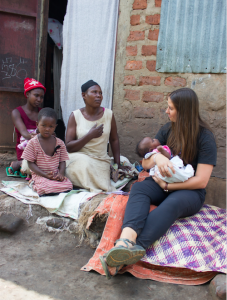
Conducting a home interview in Nansana. People love to give their babies to the mzungus to hold. 

As my time in Uganda comes to and end, one thing I’m definitely not going to miss is being called a “mzungu,” aka white person, a dozen times a day. I’m also not going to miss the treatment that comes along with being a mzungu. While everyone here has been incredibly nice to me and I’m not being negatively discriminated against, I can’t help but feel like I don’t deserve the treatment I receive. Yeah, I try to be kind to everyone I meet, but I’m a little tired of being given special treatment and attention just because I’m white. In the United States, I have the enormous privilege of not having to think about the color of my skin everyday, but here in Uganda, I am constantly reminded that I stick out. Facing racial discrimination is the reality for many people of color throughout the world and it has been a personally formative experience to be on the other side of it. I only hope that as the world progresses, racial privilege will cease to exist and that Ugandans will realize that they too deserve the treatment and kindness they show mzungus.

Posted in Uncategorized | Comments Off on The Musings of a Mzungu

Life is Short and the World is Wide

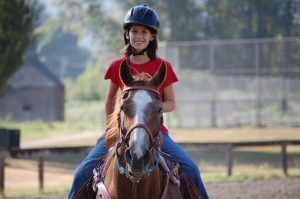
Riding my horse, Starlett, in Fall City, Washington. She celebrates her 31st birthday this year!

If I could describe myself in one word, it would be observant. I believe part of this is innate, but part of it can also be attributed to how and with whom I have spent large parts of my life. A huge chunk of my 21 years on this Earth has been spent with someone who to this day has never said a word to me – my horse, Starlett. Although we can’t communicate in conventional ways, I know Starlett better than I know a lot of human beings. And that has taken years and years of observation, patience and practice. The only way I can communicate with Starlett is through subtle changes in pressure and energy and, of course, loving nuzzles and treats. The only way she can communicate with me is through her body language, responses to my commands and frequent sassy flicks of her tail. Spending so much time around horses has taught me a skill that many people are uncomfortable with: how to understand, communicate with, and respond to the the world without spoken words. This has left me incredibly perceptive to the feelings and moods of others and allowed me to realize how much I truly value moments of silence in which I can reflect on and observe the world around me.

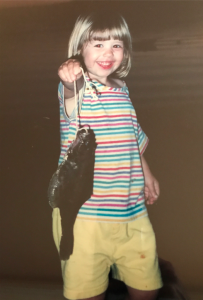
Fishing at dusk on Vashon Island, Washington

I grew up in a quiet suburb of Seattle, however, since even before I can remember, my weekends and summers were spent on Vashon Island – my absolute favorite place in the world. Since the mid 90s, my family has rented a cabin on the shores of Puget Sound. This row of cabins was built in the 20s during the Great Depression, so in all honestly, it’s pretty much glorified camping. Nevertheless, since I could walk, these cabins and the beach have been my playground and my classroom. Not only did this prompt my love for marine life, especially sea stars, but it also sparked my curiosity and interest in the ways in which our world works. Some of this can probably be attributed to the fact that both my parents are scientists – my mother is a marine biologist who spent her career at the Environmental Protection Agency and my father is a fisheries biologist.

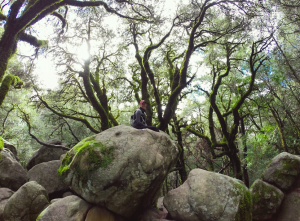
Hiking in Castle Rock State Park

From fishing, to observing the tides and the playing with the bioluminescent algae, over the years I have become attuned to the subtleties of the natural world in a way that I think most people aren’t. The natural world has it’s own rhythm and way of being which, in my opinion, is very out of sync with the world we live in today. I think that’s why I enjoy spending so much time outdoors. Whether I’m hiking or simply watching the sunset, being in nature allows me to slow down and reset my own internal metronome, matching it to the beat of the Earth. Last year, on a whim, I  got a tattoo of an evergreen tree on my ankle that reminds everyday to remember my roots, stay grounded and seek nature when things seem to be falling apart.

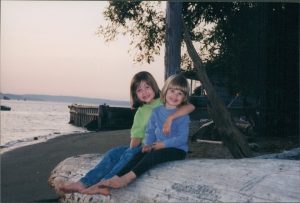
My sister, Kyla, and I at the beach on Vashon Island, Washington

Vashon fostered my love of the natural world and also taught me about genuine human connection. When I am at Vashon, I am away from technology and the craziness of the fast-paced world we live in. It is truly the conversations and connections I’ve made with my family members and friends over the dinner table or the campfire that have left me feeling most fulfilled. Any material item pales in comparison to authentic human connection and love. To remind myself of this, I have a poem taped into my planner that I make time to read everyday. It is written by Rupi Kaur:

most importantly love

like it’s the only thing you know how

at the end of this day all this

means nothing

this page

where you’re sitting

your degree

your job

your money

nothing even matters

except love and human connection

who you loved

and how deeply you loved them

how you touched the people around you

and how much you gave them

I like to think of myself as a “glass half full” kind of person. I think people are inherently good and at the end of the day, truly care about one another and the common good. I thought I knew how the world worked, until I realized how incredibly sheltered I’d been. While I am an expert on my own small part of the world, it took going to college and traveling internationally for me to realize just how big the world is and just how little I really know about it, it’s people and it’s problems. Although I’d volunteered and participated in charity extensively throughout my child and teenage years, it wasn’t until college that I learned the difference between charity and justice. The most transformative class I have taken during my time as an SCU student was called “Faith, Justice and Poverty.” In this class, we studied the nitty-gritty details of global poverty and what that meant for the daily lives and futures of those who lived in it. Additionally, as part of the curriculum, I spent two hours every week working with students at a youth center in a gang-ridden neighborhood of San Jose. Often times I left this class frustrated and sad because of how messed up, unequal and selfish our world is in so many ways. What disturbed me even more was how many people are either unaware of or turn a cold shoulder to these social issues. However, despite these realizations, I felt inspired to seek out more opportunities for justice in my own life so that the social equilibriums keeping these children, and the vast majority of the poor, from reaching their full potential can be shifted. This class not only illuminated to me how the majority of the world truly lives, but also irreversibly shifted and broadened my entire worldview by revealing to me a part of the world that I knew little about. While I still like to think that people are inherently good, we must be reminded of our common humanity if we are to truly care for one another and create lasting social change.

Despite my love of nature, vocationally, I always thought my calling was to become a doctor. For as long as I can remember I’ve been on the pre-med track. My plan was to go to college, major in biology, go to medical school and become a doctor – simple enough, right? That’s what I thought until I realized that I really don’t want to be a doctor. I love biology, I love working as an EMT and I love helping people, but I don’t know if I would ultimately feel fulfilled as a doctor within the current American healthcare system. What I value most is human connection and, with the amount of time that doctors spend charting and filling out paperwork nowadays, I don’t know if I’d feel as if I was making as much of a difference in people’s lives as I could. Don’t get me wrong, documentation is incredibly important and doctors can and do make remarkable impact on our world, but I think there may be other occupations in which I could form deeper, more authentic human connections than I could as a doctor. “What are those other occupations?” you may ask. I don’t know, but that’s what I’m on the hunt for.

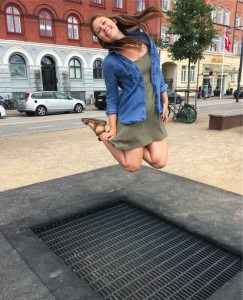
Jumping on a trampoline on the way to class in Copenhagen, Denmark. There’s a reason that Denmark is the happiest country on Earth!

I learned about the Miller Center and this fellowship from previous fellows that I worked with on the SCU on-campus EMT squad. In all honesty, I really had no idea what social entrepreneurship was, but the fellowship sounded really cool and after spending an amazing summer studying abroad in Copenhagen, I had the travel bug. So, I did a lot of reading, learned about the action research projects for the upcoming year and was completely hooked. Social entrepreneurship, and specifically an organization such as Nurture Africa, could be the ideal marriage between science, humanity and the promotion of the common good that I’m looking for. While I still have a tremendous amount to learn about social entrepreneurship, I am humbled and excited about the opportunity to help develop long-term health solutions that will have a lasting impact on the people of Nansana. More than anything, I look forward to learning about the culture of Uganda and forming connections with those I am working alongside. Life is short and the world is wide, so my plan is to learn as much as I can about the world and hopefully discover how I myself fit into it.

Posted in Uncategorized | Comments Off on Life is Short and the World is Wide