
Helplessness
My first “oh shit” moment came on Day 3 of being in Uganda. We spent the day visiting Bana, a social enterprise that sustainably produces women’s sanitary pads from the stems of banana leaves. After touring the facility and helping with the production of the pads, we sat down for a meeting and some snacks with the employees of Bana. Partway through the meeting, one of the other fellows, Indy, came up to me and quietly asked if I had any allergy medicine. I didn’t, which was unfortunate because he was having an allergic reaction to the jackfruit we were eating and his tongue was tingling and beginning to swell.
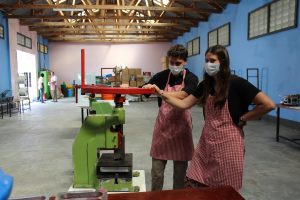
Indy and I on the sanitary pad production line at Bana (pre-allergic reaction).
Being an EMT, I jumped into action and started asking him a million questions about any other allergies or previous allergic reactions he’s had. While he was a great patient and answered all my questions, it was scary knowing there was absolutely nothing I could do for him. At home, I could give him oxygen, assist him in taking Benadryl and then call the fire department/ambulance who could give him epinephrine if necessary. But here, all I could do was offer him some water and try to keep him calm. Luckily, his reaction was mild and the tingling and swelling eventually went away. Nevertheless, it still scares me to think about what could have happened had he had a more serious reaction and gone into anaphylactic shock; we were in a small village and nowhere near a health facility that could handle such an emergency.
After this experience, I have come to always carry Benadryl in my backpack and purse, just in case. However, this is a luxury that most Ugandans don’t have. Instead, the reality in which they live is one without access to medication or any sort of emergency care. Even if one can get to a health facility, it’s likely the facility won’t have the means to actually treat them. In this moment with Indy I felt helpless, and this feeling of helplessness has become increasingly more prevailing after spending the last month conducting action research in the health clinic at Nurture Africa.
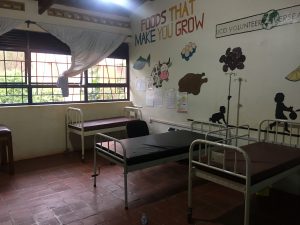
The resuscitation/emergency room at Nurture Africa.
Nurture Africa, as well as two other health clinics that Will and I have visited in Nansana, are under resourced and lack many essential medications and medical interventions, oxygen included. It’s also important to note that the clinics we have visited so far have been private. We haven’t yet had the chance to visit a public clinic, but from what I’ve heard, they’re even more under resourced and overcrowded than the private ones. Nevertheless, the health services offered at Nurture Africa are very, very basic. While most primary healthcare patients just require some drugs from the pharmacy, not much can be done for those that do require more advanced care, besides referring them to the national hospital in Kampala. Because there is so little that healthcare workers can do in these emergency situations, I wonder about their own satisfaction with their jobs. Do Ugandan healthcare workers constantly feel helpless because they don’t have the resources to properly care for their patients, or do they not even know that more advanced treatment options exist?
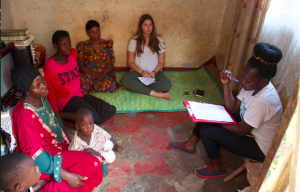
Conducting a home interview with former patients of Nurture Africa. It is the child in the white that has been struggling with pneumonia.
Having worked in emergency medicine and knowing what modern medicine can do, it’s saddening to see that so many people lack access to healthcare and are suffering, and potentially dying from, treatable conditions. One day, while conducting a home interview, a woman told Will and I about her child who has been suffering from pneumonia off and on for several years. She had to stop coming to Nurture Africa because she couldn’t afford the payments, but the drugs she buys from the pharmacy aren’t as high quality. At this point, she doesn’t even have the money to buy the low quality drugs from the pharmacy, so the child has to go without. Given the musty nature of their home, it’s likely the child will continue to struggle with this issue. Stories such as this are heartbreaking to hear not only because the child is suffering, but also because it shows me how out of touch I am with the struggles of so many people in the world. I’ve been lucky enough in my life to never have to choose between food, school fees or a potentially life-saving medication. It’s honestly never crossed my mind whether or not I’d be able to afford a medication I needed. Although the healthcare sector in Uganda does require major development for it to properly address the health needs of its population, it is inspiring to see organizations like Nurture Africa that seek to shift such unjust social equilibriums, empower vulnerable people and allow them to live to their fullest potential.
The Conception of Time
As part of our research project, Will and I are assessing patient satisfaction at the Nurture Africa health clinic. One measure that has produced interesting results is patient satisfaction with wait time. When a patient comes to the health clinic there are multiple points at which they will potentially have to wait – at the reception, at the cashier to pay their consultation fee, at triage, at the clinician’s office, at the lab, at the cashier to pay for their labs and drugs, and finally at the pharmacy. On average, patients are spending around 2.5 hours at the health clinic but only interacting with healthcare workers for maybe 20 minutes. And it’s not because the clinic is too busy; on a given day there are 5-15 primary healthcare patients. But here’s the catch, they aren’t complaining about the wait time! The vast majority of patients have said that the wait time at Nurture Africa is significantly less than at other clinics and that this is a deciding factor when they choose which clinic to go to.
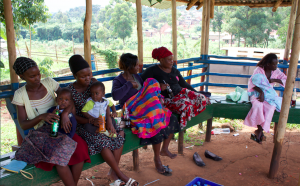
Focus group participants sitting at Nurture Africa and patiently waiting for the discussion to begin.
This made me wonder why – why are they okay with waiting around for 2.5 hours to get treated? And if they think the wait time here is short, what is it like at the other clinics? Similarly, when Will and I held focus group discussions about the services offered at the Nurture Africa health clinic, they typically didn’t start until 1.5 hours after they were supposed to. Hardly anyone showed up on time, but surprisingly, most people were happy to wait around, even if they themselves were timely. “African time” is a real thing here and it has proved to be frustrating and difficult to adjust to given that the emphasis on productivity and speed that I’ve grown up with in the United States. Whenever I go to the doctor or to any other appointment, I want to get out of there as fast as possible so I can get on with the rest of my day. Interestingly, that doesn’t seem to be the case here.
The value that Ugandans place on time is strikingly different than Americans and it is possible that a certain degree of this can be attributed to poverty. Initially, it seemed to me that this country has a serious issue with productivity and planning ahead, but after reflecting on it, I think a lot of it has to do with the fact that most people are just trying to survive and when survival is the goal, you don’t have a lot of time to think about the future. In contrast, Americans are constantly planning for the future. This summer alone I’ve spent so much time thinking about what I want to do when I graduate from SCU, even though that’s 9 months away. But if you aren’t sure if you’re going to be able to afford food for dinner or medication for your child’s illness, you don’t really have time to think that far ahead. You’ve got to focus on the issue at hand and sometimes just get through the day. I am incredibly lucky that I have the stability to plan for the future. Often I even want time to speed up so that the future and everything I’m looking forward to can happen sooner. When reflecting on this, a sad thought occurred to me that maybe some people here don’t have that much to look forward to, maybe they want time to go slow because they’re so unsure and scared of the future. Or maybe this waiting time is actually an escape from their monotonous daily routines. Or maybe they’re just a really laidback and agreeable population. While I’m still not exactly sure why people are okay with waiting around for so long, thinking about the value of time from different perspectives has allowed me to reflect on my own time commitments and contemplate the ways in which I truly want to spend my time.
Mzungu
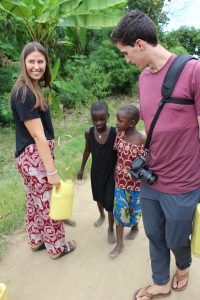
Will and I walking with young girls we met while they were collecting water from Lake Victoria.
When I first arrived in Uganda I was so happy to discover how friendly and welcoming everyone here is. Whenever we go to a new place, they greet us by saying “you are most welcome here.” When walking on the street, or pretty much anywhere, children wave and run up to us, often holding our hands and walking with us for a while. Multiple times per day, employees at Nurture Africa will come to our office just to chat and ask how we’re doing. At first, I felt so welcomed and happy that they were embracing Will and I so easily, but after a few off-putting comments and interactions, I began to question why they’re so nice to us. Overall, Ugandans are an incredibly kind group of people, but they aren’t as nice to each other as they are to white people. Despite the horrors of colonialism, Ugandans still hold white people in such high esteem. Ugandans love being in the presence of white people because it automatically elevates their social status. It’s especially interesting to talk to Ugandans and hear their misconceptions about America and the western world. Even our translator, who has gone to university, had no idea that poverty or homelessness existed in America. When I explained the true reality of the situation to her, she could hardly fathom it. Similarly, some of the physiotherapist volunteers told us that many of the Nurture Africa clients they worked with couldn’t believe it when they told them that white people have physical and mental disabilities too. While it saddens me that people think so highly of us solely because of the color of our skin, I’m thankful to have had these experiences because it has given me the opportunity to reflect on and confront my own white privilege.
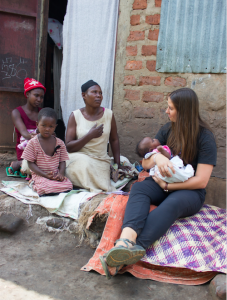
Conducting a home interview in Nansana. People love to give their babies to the mzungus to hold.
As my time in Uganda comes to and end, one thing I’m definitely not going to miss is being called a “mzungu,” aka white person, a dozen times a day. I’m also not going to miss the treatment that comes along with being a mzungu. While everyone here has been incredibly nice to me and I’m not being negatively discriminated against, I can’t help but feel like I don’t deserve the treatment I receive. Yeah, I try to be kind to everyone I meet, but I’m a little tired of being given special treatment and attention just because I’m white. In the United States, I have the enormous privilege of not having to think about the color of my skin everyday, but here in Uganda, I am constantly reminded that I stick out. Facing racial discrimination is the reality for many people of color throughout the world and it has been a personally formative experience to be on the other side of it. I only hope that as the world progresses, racial privilege will cease to exist and that Ugandans will realize that they too deserve the treatment and kindness they show mzungus.