Third Post: Blog Reflection

For my last assignment in my English 1A course I was told I must convert my academic essay on inequality to a blog post on inequality. At first, that seemed like the easiest essay assignment I had ever received, I would just cut out a few sentences here and there and add a few pictures. On second thought, I realized it was a bigger task than I had anticipated. After I had begun it ended up taking me hours until I was finished altering my essay to fit blog form, and here are the reasons why:

Difficulties

I started in on my essay about inequality in the economic and educational systems of America. I began to select sentences and hit ‘backspace’ until they were completely gone. After I was done chopping down my essay I went back and read it. That’s when I realized my essay now sounded like it had been written by someone with narcolepsy. Every few sentences it seemed as if I had fallen asleep and forgot to complete my thoughts. I understood that I would not be able to just rid of sentences without getting rid of thoughts or points which were essential to my essay.

wileecoyote

I was also struggling with making my academic essay sound more casual. How was I supposed to make a super complex and academic topic seem more informal? I started to wonder if I would have to change my topic on which I was writing about because I was at a stand-still. I had no clue how to make my long sentences into shorter more casual thoughts. So I started to think about when my words are most informal. I started to think about when I converse with people in person. In no way did I ever really talk about things in an “academic tone”, but instead I was very direct and informal with my words. I would think of the shortest and simplest ways to get my point across, and that is how I would talk to someone face to face. But how would this help me in my blog post?

Solutions

I thought about two different options in regards to shortening my academic essay. First, I contemplated the idea of leaving out a few key points in my argument over inequality in both educational and economic systems in America. I started to play with this idea in my head. I cut out a few arguments and removed points from each topic of discussion and then I went back and read it over leaving out those points I had cut. It did not take me long to realize this was not the way to shorten my essay. My arguments had become weak and empty. I left out so many key points that a five-year old could destroy my argument. So I thought of an alternative way. Instead of weakening both topics of debate I would instead focus on just one topic of discussion. I decided to only write about inequality in the educational realm of America. This served me well. I was able to complete my argument and make it strong while maintaining the attention of my audience by having a more reasonable length of writing.

In regards to the task of making my writing more informal, I began to think about the Monocle-man_545discussions I would have in day-to-day conversations. I would talk a lot about politics and problems in America with my family and friends, and never did I really talk in a complex or formal tone even though the topics I would discussed  were complicated. So I tried to adapt the way I spoke to the way I was writing. It was not that my thoughts had to be less complete, but rather my language had to be more appropriate for my time and place of discussion. I had to adapt my language to my audience. As I did so, I would read my sentences out loud and see if they would be suitable for how I would talk to someone in person. This really helped to guide my language and ideas throughout my blog post and my essay began to fit the identity of a blog.

Conclusion:

As a business major, I did not go into my English class with great anticipation. I could not see how writing essays would help me in my field of study. The usefulness of this course did not occur to me until the blog posting. I realized that these writings I was constructing were all directed to different audiences. My academic essay was directed toward my teacher who was expecting a highly academic tone. On the other hand, my blog post, although also being graded by my teacher, was expected to have a language for a broader audience. I started to see how this was going to help me in my business endeavors. Since business is world wide I would have to learn how to communicate with a wide range of audiences. I will eventually need to know how to talk to CEO’s or just inexperienced interns. This is why the transformation of my essay into a blog was so useful. It forced me to know how to express my thoughts to different audiences in different complexities of language.

Second Post: Inequality in College Admissions

In recent discussions of America, a controversial issue has been whether the American educational system is rigged in favor of privileged white Americans. Like a stubborn rash I cannot escape the ever popular idea of “White Privilege” on the major news networks or talk shows. In other words, whether you feel guilty about it or not, if you are white you cannot deny you have received benefits purely from the color of your skin. These political pundits point to examples such as, of the 1,602,480 Bachelor degrees given out between 2009-2010 only about ten percent of those were received by black students or that the black unemployment rate is double that of the unemployment for whites. Let me explain to you why these pundits are wrong.


COLLEGE=JOB

First let’s delve deeper into the issue of unemployment since having a job is usually an outcome of someone’s college career. How does someone secure a job? Well typically the criteria of a job is a specific set of skills that the applicant has to possess in order to complete the task of the position. If you are more qualified than your competitors for the job or if you apply before them then more times than not you will receive the job. In addition, most advanced careers that people will ultimately need in order to support their families require some sort of degree. These degrees are given out by colleges. Now the whole idea of job competition seems pretty straight-forward and fair, except for one part. The college degree. A tremendous amount of people believe that wealthy white kids some how have it easier because of the color of their skin. Anyone who doesn’t know what I am talking about has never heard of Affirmative Action.


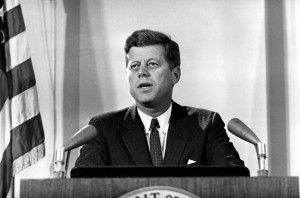
U.S. President John F. Kennedy reports to the nation on the status of the Cuban crisis from Washington, D.C. on Nov. 2, 1962. He told radio and television listeners that Soviet missile bases "are being destroyed" and that U.S. air surveillance would continue until effective international inspection is arranged. U.S. government conclusions about the missile bases, he said, are based on aerial photographs made Nov. 1. (AP Photo)

Affirmative Action was created in a time in America where white privilege actually existed. Whites had extra rights that were given to them solely because of the color of their skin. This undoubtedly was wrong. American Government officials and American citizens began to become enlightened and they corrected this issue with the Civil Rights Act of 1964 and other bills. To further make sure racial prejudices were not apart of the fabric of America, President JFK signed the Executive Order which first listed the term Affirmative Action. He stated America will have “affirmative action to ensure that applicants are employed, and that employees are treated during employment, without regard to their race, creed, color, or national origin” (Affirmative Action Link). As time went on Colleges began to insert this method into their application process.


NOT WHAT JFK INTENDED

We live in a time now where minority students, based purely on their race or color of their skin, get more attention from college admissions reps than do the white students who make up the majority. This is a fact. If you take a quick look back at JFK’s quote you can tell that the college process now is in stark contrast with the original intentions of the Affirmative Action order. At some point in time the words of JFK were distorted to mean that in order to repay the debts of those minorities who suffered during the civil rights era, we should unfairly show prejudice toward white Americans and make it harder for them to get into college compared to their minority counter parts. I am in no way ignoring the fact that minority Americans, especially Black Americans, were treated unfairly during the Civil Rights Era, but what I am suggesting is that two wrongs do not make a right. You cannot make up for the time in which Black Americans were mistreated by mistreating White Americans nowadays.


SET UP FOR SUCCESS

Although, some would continue to argue that the reason minority students get more attention during the college admission process is because the schooling of students leading up to college is not equal among all people. And, without a doubt, I would agree. Of course everyone’s lives are not the same. Some people are wealthy and can afford to go to better schools with better teachers, and others are not as well off and only have the option of attending a public school, many of which, specifically in poor inner cities, are not quality schools. But this has nothing to do with race. It has everything to do with financial means. But is it wrong that some people have the ability to attend better high schools, which will in turn prepare them better for college, just because they have the money to do so?


FAIR DOESN’T MEAN EQUAL

I would like to suggest a metaphor that I hope will answer that question. Dinesh D’Souza, a member of Ronald Reagan’s administration in the eighties, a successful movie producer, and a political debater compared the idea of the “American Dream” to a track race. A fair track race, such as America was intended to be, is when a straight line is drawn on the track,running-track everyone begins to run once the gun is fired, and whoever is the first to cross the finish line is the winner. Everyone would agree that would be a fair and just track race. But no one would go and argue well since runner number one had a treadmill in his basement that he could train on and runner number two could only run around his block that the race was unfair. In short, everyone encounters different circumstances in life, but what matters is how you perform once in the competition, or in our case the American Education System.


LOOKING FORWARD

Please do not misunderstand me. I recognize the problem of people attending inadequate schools, and I also recognize the difficulties that come with growing up in an poor family. I believe that when students apply to college their previous schooling and their financial status should be taken into account, but what should be left out is the color of one’s skin. It ultimately has no affect on the student’s ability to qualify for college, but only serves as a way for us as Americans to revert back to the unjust and racially biased ways of the past.