Life as a university student in the US essentially revolves around one single question, “What are you going to do after college?” The process is as follows: attend a good university, choose a major with career opportunities, get good grades, find a prestigious internship, and finally secure a comfortable job that you enjoy. This is how it is supposed to be and so long as you do this, you have succeeded. The linear progression of such a strategy is comforting and reassuring to university graduates that are just simply trying to live a normal, secure, and enjoyable life. As a matter of fact, most of us don’t even see this path as optional. It is the only thing we’ve ever been taught to expect. So long as we put our heads down and do our part, we will reach this happy secure life. But what happens if we pick our heads up? What if suddenly we realize that there might be another way forward?
Exactly how I came to pick up my head I cannot say, except that it was inadvertent and happened somewhere between getting good grades and getting a prestigious internship. I had decided to matriculate at Santa Clara University and was about halfway done with an Environmental Science degree and until this point, I was under the impression that I would end up pursuing a traditional career within my field of study. Just like my many friends in the business school who wanted to be accountants or marketing experts, I saw myself working toward some type of environmental policy or conservation career, because what else would I do?
But in the spring of my sophomore year, I was introduced to a whole new way of looking at what it meant to be successful. I was fortunate enough to take a class focused on social entrepreneurship as a method for addressing global poverty. Immediately I became obsessed by the notion. Its not to say that I was blind to the fact that there were over a billion people living in extreme poverty on our planet, I just could not see what could be done about it. The more I learned, the more enthralled I became. The concept resonated with me in that part of my desire to study environmental science was based on my belief that we can and should try to make the world a better place than it is now. Of course, there are always problems in the world, but this does not mean that progress is not possible.
Suddenly, the thought of pursuing the normal became almost entirely unappealing. I had stumbled upon something that had no answer, just an idea. Rather than being linear, this concept was barely getting off the ground and aside from a few successes, remained largely unproven. A normal job started to seem dull compared to this unsolved global issue. It required critical thinking, creativity, and perseverance, rather than simply the following of a predetermined path and doing the expected. Eventually, the obsession led me to this fellowship, and before I knew it, I was flying halfway around the world to test it out.
I remember flying over San Francisco and looking down at the neat streets, the tall offices, and the bustling of normality. Many of my fellow students at Santa Clara were down there, fulfilling the next step on the road to success. I, on the other hand, was about to embark on what I thought would be a life changing and awe-inspiring adventure to solve an unsolvable problem. I had spent months preparing for this adventure, reading about Zambia, about Africa, about the enterprise I would be working for, and everything else I could get my hands on. Hours of preparation, meetings, and phone calls had inspired me and filled me with expectations and ambition. How boring I thought the work below was at that moment.

The normal
Of course, it was not long after we landed that the realities of the developing world began to erode my pretentiousness. Almost immediately, our plans fell apart and we were left scrambling to do anything that would be of some use. The inspiration I had derived from learning about social entrepreneurship was reduced to desperation. I saw my expectations crumble before my eyes and felt a very real sense of irony sweep over me. I began to think back on that beautiful city, with its progress, its motivation, and its growth. Suddenly, normal began to seem less boring and it was my ambition that started to look foolish. What was I thinking? Who was I to think I could make any sort of difference here? Perhaps there is a reason social entrepreneurship hasn’t taken off, maybe it just doesn’t work! Everything that had formerly captivated me began to cause me to second-guess myself. How easy it would have been to just stay at home and get a regular internship just like everyone else. My initial arrogance was slowly replaced by envy for my friends who not only had comfortable jobs, but who were also able to live life blissfully unaware of how bad the world really is.
I learned very quickly to distinguish between knowing and understanding. Possessing knowledge is to acquire facts and information from the classroom, books, TV, and the Internet. Before coming to Zambia, I knew a lot. Understanding, on the other hand, is something far less accessible. To understand is to comprehend or perceive the meaning, significance, or cause of something. This is a far more abstract form of intellect that deals more with experience and engagement than it does with the regurgitation of facts and information. Unfortunately, the more I came to understand about the developing world, the less I could rely on my knowledge. Plagued with envy, frustration, and a sense of defeat, in a final act of desperation I decided to hunker down and do the best I could to salvage this project.
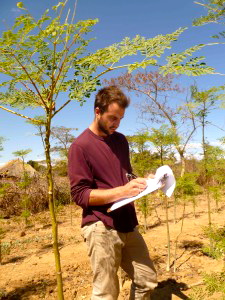
My cubicle for the summer
When I returned home, my thoughts turned back to the same old question, “what am I going to do after college?” Only now it seemed that the foundation on which I had constructed my alternative path had crumbled. What would I do with this experience? Had I just set myself back a whole summer? Was it too late to get back on the normal track? To say the least, I felt lost. It was not until many months after my return that I was able to dissect my frustration more objectively. Today, we rely so much on instant gratification. Communication between two people even across the world from each other requires only a text, an email, or a call. Information can be found instantaneously on the Internet. Even paychecks can be deposited electronically the second they are issued. I began to realize that perhaps I had a similar expectation about my experience.
The gratification for this project, however, was very different. At first, very few people know about what we had done. Even those closest to me never got much deeper than asking, “how was Africa?” But little by little, as we began to pull together what we had done, more and more people became interested in our work. Not only was I surprised by the positive feedback that we received from CEOs, department chairs, and others interested in this type of work, but I was also surprised by how much we had actually done. I had spent so much energy being preoccupied with what I was missing out on back at home, that I had not realized how much work we had truly learned. I felt particularly validated when a Jesuit working in Malawi expressed interest in reading my work on agro-forestry. After reviewing the guide, he explained how fascinating it was and how he would like to use some of the findings at the school he was opening in Malawi. I began to see that even though our plans had fallen through, we had still accomplished something. I may have had some lofty expectations at the beginning that did not come to fruition, but at least my work was going to be of use to someone and was not a complete failure.
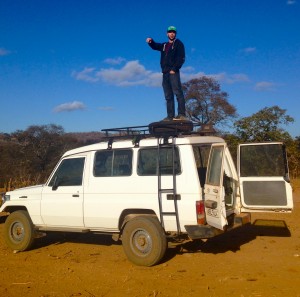
The view from the top floor of my office building
I have come to a sort of equilibrium in terms of how I feel about my work in Zambia this summer. Have I been hired? No. Have I solved global poverty? No. But am I any closer to knowing what I want to do after college? Certainly. I can draw several lessons from this experience that have taken me until now to understand. To begin, working in the developing world to combat poverty is not easy. If it were, the problems would have been solved by now. Second, simple goals produce simple outcomes. I do not look down on those following the normal path in life as I did in June from the plane. The choice to follow this path is for each person to make and there is nothing wrong with it. I sometimes get overwhelmed with where I will go in life and do sometimes wish that I had never lifted my head. But I no longer envy those on this path as I did during the hardest moments in Africa. This fellowship continues to bear fruit for me in ways that I could have never foreseen, whereas many of the normal internships taken by my colleagues have produced nothing more than a few lines on a resume and some spending money. Third, understanding is more valuable than knowledge. My knowledge did little to prepare me for what I would experience in Zambia, yet the understanding that I gained there has changed my perspective on life and led me to an intellectual position that will continue to open doors for me. Finally, and perhaps most importantly, I have realized that no matter how hard it might be at times, I will never be able to escape the fascinating and perplexing problem that is global poverty. The fact that this problem remains unsolved is not a source of cynicism or doubt, but rather a source of inspiration and motivation. I will never see the world the same way, and for that, I am grateful.
So where does this leave me as I look ahead? This remains a good question. I have no specific answer as of yet. But I do have what I would consider to be a good compass. I do not think I can turn my back on development, even for the most comfortable of jobs. I think that no matter what I do, it will be influenced in some way by what I have learned from this experience. Furthermore I realize that I have something to offer the field of global development. Being dropped in the middle of one of the poorest countries on the planet, watching my plans disintegrate, and still being able to produce something valuable has taught me that. It has also taught me that I can be resilient and resourceful, even though I may not recognize that I am being so in the moment. The hardships of working in the developing world are not a deterrent, though they are frustrating. The gratification of having a positive impact on someone’s future through my work on agro-forestry has far outweighed any gratification I have ever achieved from a paycheck, and that is no platitude. I believe that my passion for environmental science fits perfectly with my newfound passion for development. But for me to synthesize these requires more than knowledge; it requires understanding, which can only be attained through experience. My desire is to continue to learn more so that I can be a larger agent of change. Do I see myself returning to the developing world? Without a doubt. Although being young comes with naïveté and foolish ambition, it also comes with energy and vigor, and an openness to new ideas. So long as I remember the lessons I have learned from this fellowship, and make sure not to keep my head down, I think I will find that alternative path to success, whatever that may mean. I do believe that if those who plant the seeds of critical thought, vigor, and perseverance, will be able to reap a success that is far more fulfilling than that expected by society. I am excited to see where else this experience will take me, and it may be hard to measure, I consider it to be one of my wildest successes.