
We often struggle with what we should call the countries outside western Europe and North America (excluding Mexico and below, of course). There often seems to be the instinct to place our region as better, to say we’re “the first world”, “the developed world.” Even more neutral attempts like “the global north” and “the global south” fail because strictly speaking the countries we want to include in “the global south” are not all below equator. So it was with great interest I read the term “Majority World.” I found I really like it because well, it’s accurate isn’t it? The language casts a different light on the fact that the majority of the world have a minority of wealth and resources. The majority of the world often lacks access to clean water and education. In other words, it casts light on the injustice of the distribution of wealth and resources and perhaps adds a sense of urgency in their need to be addressed.
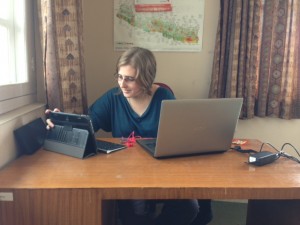
Two screens, completely necessary
Going into this fellowship I was already struggling with the idea of being an outsider coming into a community with far less privilege than me and acting as an expert. There is often a call to fix your own community before you go fixing others, and yet when is your community fixed enough to help people farther behind you? The answer often seems never. I struggled with understanding the boundary between offering needed help and imposing minority world standards on majority world people. And all the while I was preparing with GSBF and Equal Access for my placement in Nepal.
Actually, it took a while to determine exactly where we were going. From fairly early in the project it was decided that what Equal Access wanted from me was to research open source PC platforms for sending and receiving SMS. What took much longer to decide is which Equal Access location would be the best fit for Niki’s project and my project. Since, in theory, I could code anywhere most of the decision of which country was determined by Niki who needed to choose which place was most valuable to examine from a business angle. We did eventually settle on Nepal for its very successful radio programs (and relative safety). Before the summer began I had a few meetings with the head of IT in San Francisco, Yemen and Nepal to discuss what platforms they used and the challenges they faced with their current solution. Many countries, including Yemen and Niger, were using FrontlineSMS which was not serving them well as their audience grew. Nepal had also used Frontline but had found a rather expensive alternative by contracting out that service to a different company.
I had a couple weeks before I went off into the field to research platforms and run tests in the Santa Clara Frugal Innovation Lab. It became clear quickly that while FrontlineSMS was easy install it was slow and overall inefficient. However, we had only established one other free tool that seemed to fit the needs of the organization: RapidSMS. The learning curve on that application was quite steep and I unable was to hook my prototype to a modem before I was headed to Nepal.
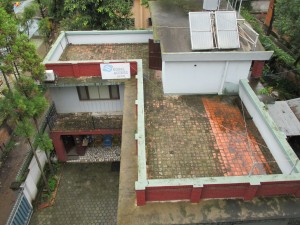
Equal Access offices as seen from the 5th floor
And then I arrived in Nepal. At first, it was a bit of a rough experience. Within my first ten minutes in Nepal I discovered that my wallet was missing. I was later told I seemed incredibly calm for someone who knew her wallet was a country away and had no idea who might be using her debit cards and could not make an international call get through to cancel them. Thankfully, people back in the US were able to contact banks on my behalf and fedex new cards to me. Even more incredibly the Delhi Airport found my wallet and returned it to me a month later when I made my return trip.
Since we only had three short weeks to work in Nepal, we needed to hit the ground running and integrate into the new environment as quickly as possible. I also found out that Pankaj, my main contact prior to coming to Nepal and head of IT was going to be away for parts of the second and third week, making it even more necessary to set a firm game plan at the beginning. I started work as soon as possible on rebuilding my RapidSMS app on a laptop there while at the same time meeting with Pankaj to really understand the system that was already in place. It was clear how superior the contracted service was to FrontlineSMS. It was also becoming clear that while RapidSMS was certainly more powerful and customizable than Frontline, it would likely not be much competition to that service either.
Pankaj also took me to meet a local tech startup called SparrowSMS focused on harnessing the power of SMS to aid both individuals and businesses. It was quite incredible to meet these entrepreneurs who had started this company. Their story sounds in some ways like a typical Silicon Valley tale of college friends getting together at the end of their tech degrees and starting a business around a good idea. However, this isn’t a common narrative in Nepal. When I visited them they were a finalist in the education category for an mBillionth award which recognizes mobile innovators in South Asia. What struck me the most about that visit was first the kindness and enthusiasm the head of technology showed when telling me about the infrastructure behind his program, and second how similar they were to so many techies I know in the states when we spent some time laughing at Apple and Samsung taking digs at each in their commercials on YouTube.
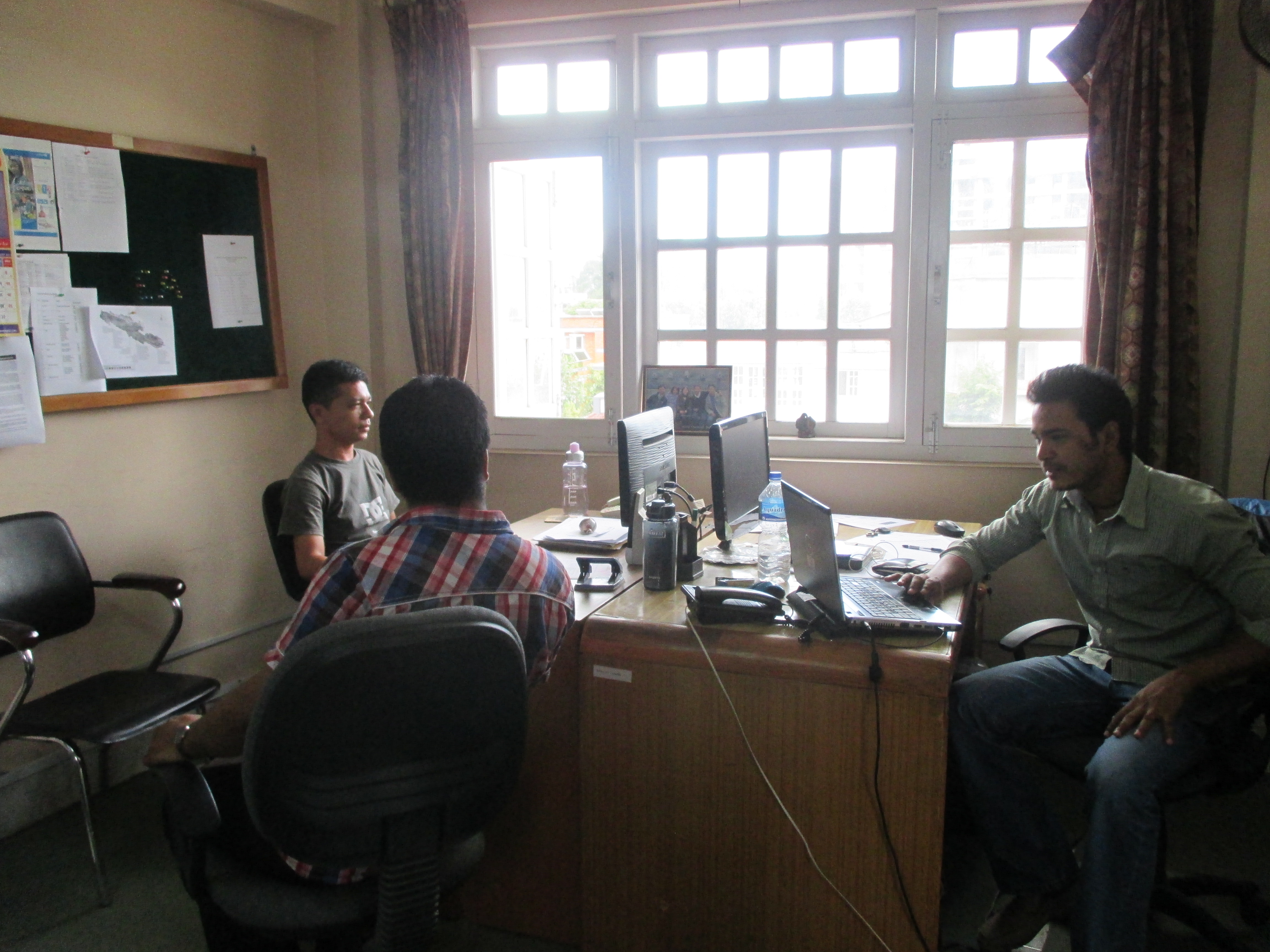
IT Team in Nepal
By the end of that first week I decided that working on building RapidSMS was no longer a valuable use of my short time there; a shippable product was not going to be created in two weeks time by myself and that even if I was able to create a working prototype the inconveniences and expenses of running that setup would probably not outweigh the inconveniences and expenses of their current one. After talking to several people on both sides of the world it was agreed that I should shift my focus onto creating a way to distribute radio programs to mobile phones, specifically, feature phones. This project idea turned out to have a couple of frustrating dead ends as well. I was able to make recommendations for a couple easy ways they could leverage their existing SMS platform to send download or streaming links to feature phones. However, it will take time before any solution can be implemented due to other considerations such as the large file size in which they make their program available.
So it was at a bit of a low point when our trip to meet communities served by EA finally arrived. The whole trip was rather thrown together: our tickets booked a mere half day before we took off to Biratnagar. We were accompanied by two members of EA’s radio team who planned this trip specifically for us and as a consequence was much less tightly planned than the trips the pair normally took. Despite being a little rough around the edges that trip was by far the high point of my time in Nepal. I got to meet people whose lives were touched by Equal Access’ radio programs and more importantly see how they turned around and used that knowledge to transform their own lives.
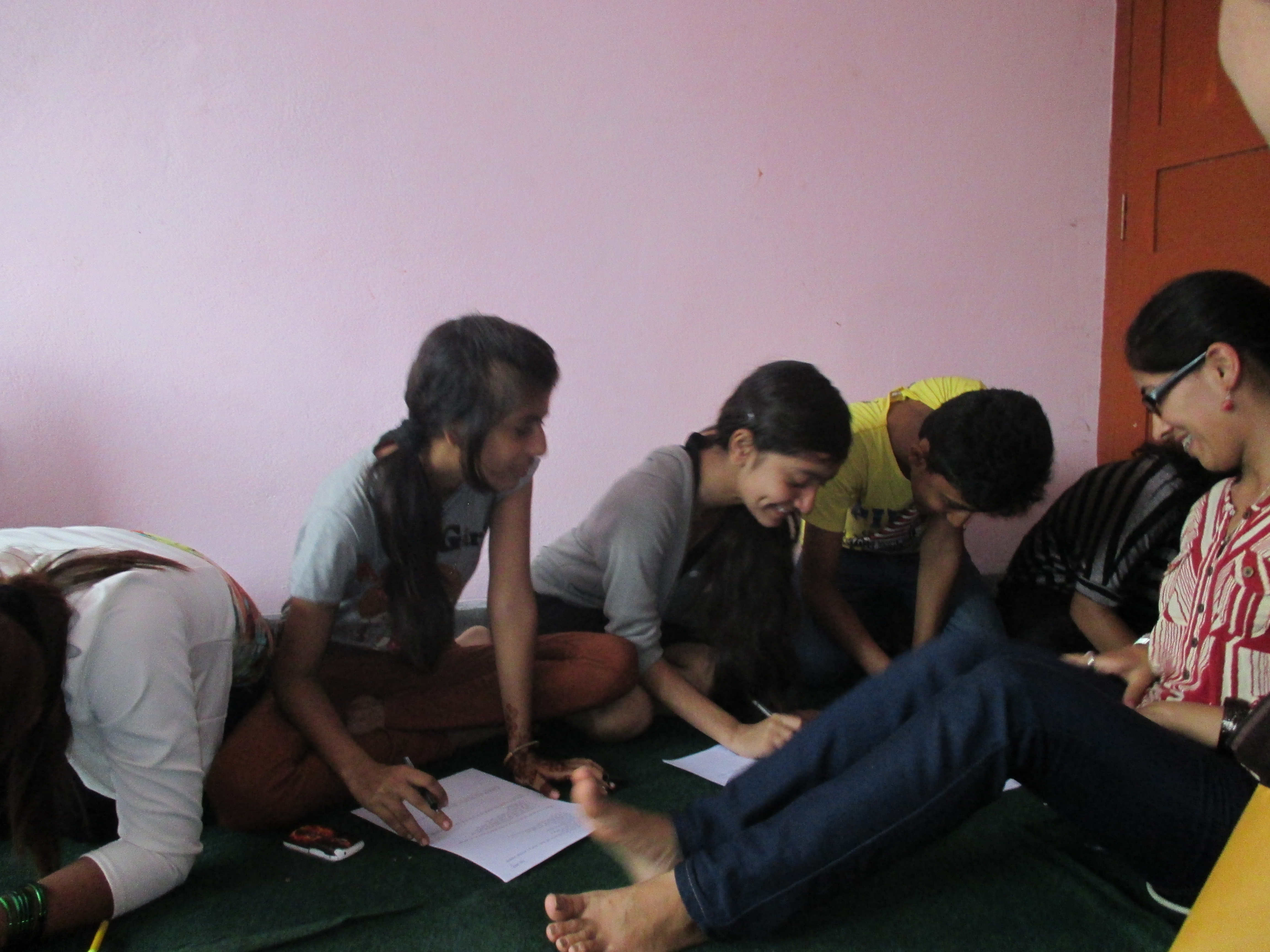
Girls in Youth for Blood taking our surveys.
We first met a group of urban youth in Biratnagar, Nepal’s second largest city. This wasn’t just any youth group; they organized blood donors in their area to address the shortage of blood banks by having a network of people who would donate on demand. They call themselves Youth for Blood. It was my first step out of offices and really into engaging with the people we were serving. They were fans of SSMK, EA’s longest running radio program focused on Youth Issues, but often didn’t listen as they were not dependent on it for information. For them the internet had arrived in the form of mobile phones. Niki and I were giving out surveys and I was researching what type of phones people used. I informally polled them about who had access to WiFi on a regular basis; about two people raised their hands, but when I asked who had access to internet through their phones about two people didn’t raise their hands. When they in turn asked me why I wanted to know what kind of phones they were using and I told them it was to find out if people had access to the internet, they laughed at me. Of course they had internet, I was informed, I shouldn’t need a survey to know that.
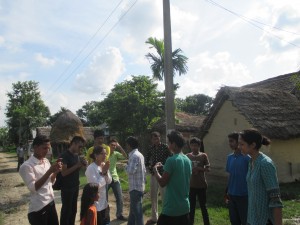
Villagers showing us their listener club house
(club house not pictured)
The next morning we set out for a rural village on the outskirts of Itahari. This village loved SSMK so much they had named their village after it. We met with the listener club that afternoon after an extremely bumpy ride getting there. We heard some powerful stories come from these people. One girl talked about how menstruation was demystified for her. Boys traveled miles over the bumpy road we crossed to get a decent education. In a more private conversation one woman told us the stress of life without her husband who was forced, like most of the village men, to work in a different country in order to support her family. The founder of the original listener club (founded more than ten years ago) spoke about how he saw child marriage ended thanks to SSMK. And the listener club takes these messages to the streets with street performances they create.
The founder, rather unexpectedly, spoke about how he thought this program should really be moving to TV because that was becoming the preference. Even in this village without paved roads and with thatched roofed houses radio is becoming outdated. Many people admitted to only listening to SSMK and sometime not even that. It also came out that people were already listening to the radio through their mobile phones.
Finally we moved on to Dharan; it was quite a contrast to the village as it is one of the richest cities in Nepal. The investment in infrastructure and clean roads was perhaps the most striking contrast. However we did not come there to meet the wealthy inhabitants. Instead we visited a boarding school for the visually impaired. It was perhaps one of the most powerful experiences I had in Nepal. We met this group of incredibly bright young people
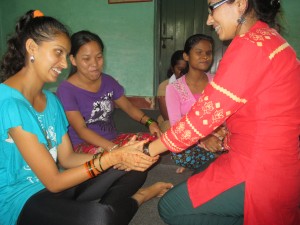
Girls meet their favorite radio voice.
who were in many ways even more eager listeners than the members of the village who named themselves in SSMK’s honor. For those students radio was the perfect medium for getting information. They do not have access to phones while at school and probably inconsistent access to the school computers. When I met them I felt regret toward this trend away from radio by more abled people because it is quite possible that when the change comes they will get left behind and lose a lot of the quality programming available to them now. One boy told a story in some of the clearest English I heard in Nepal of hearing one episode on SSMK where another boy had a disability and was still able to accomplish great things and impress his peers. This inspired him to become a poet and really push himself to do well.
It is so easy in situations where a group of people face oppression or hardships like poverty or visual impairment to forget the incredible diversity of stories and talent and potential that people living in those situations have. It is so easy to see it all as the same story; and worse to see the peoples as helpless victims unable to create radical change in their own lives. And yet all it took was a little push: hearing about someone like them achieve something, simply gaining access to new information that changed the lives of the people that heard them. And then there are organizations like Youth for Blood or SparrowSMS innovating and solving problems for their community without big foreign aid. Slowly sparking the change they want to see.
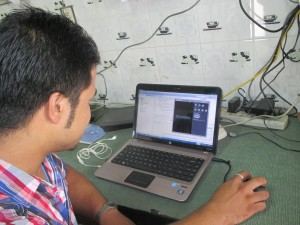
Manoj demonstrating his app.
When we returned to Kathmandu there was not too much for me left to do, as half of the IT team was out of the office and my projects were more or less at a standstill. At the end I got to know some of the people who were left in the office a little better. The IT teams newest member who was working on a mobile site to make the radio available spent some time sharing his knowledge with me. He also expressed interest in my work on RapidSMS and I wrote him a quick guide to setting it up so if he wanted to try his hand at it himself he would be able to get coding much more quickly than I had on my first attempt. If I had had more time there I would have liked to have worked more collaboratively with him and other members of the IT team on my coding projects.
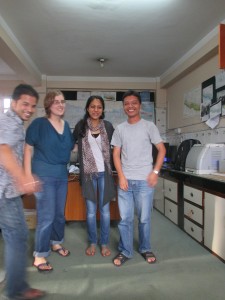
Manoj, Me, Niki, Niroshan last day with IT
I am still wrestling with the question of when it is appropriate for me as a minority world person to offer aid. However, I do think the answer involves “when it is asked for.” It may be appropriate to come in as an expert on infrastructure or technology if there is in fact a deficit but not, I think, to act as an expert on what their society needs. I believe Equal Access’ model is so successful because it’s content is created by local people. The organization may be administered and funded internationally but the content comes from the people on the ground for the people on the ground. Moving forward I don’t know if I will continue this kind of work, but even if my job is not to go into their communities we will still be part of the same global one. If anything became clear on that trip, it is how fast the world is connecting. In whatever path I choose, I will endeavor to remember that I will probably be serving their people too.