Words, Voices, Communication…

screen-shot-2016-11-22-at-2-36-48-pm
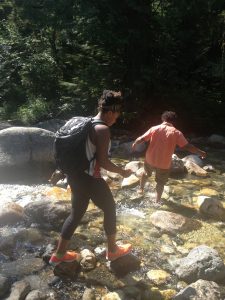
Our hike on the second day with Bana

Words are impactful. Voices that say words matter. What we communicate with our voices matter.

As a Communication major I’ve more or less been studying words, voices, and communication my entire college career. I’ve cited journal articles about the importance of words in the education of bilingual students. I’ve written papers about how role models in media can give disadvantaged communities a voice. I have literally written entire papers about how to engage communities through communication. But never before have I truly understood how important communication is than with Bana this summer.
screen-shot-2016-11-22-at-2-35-33-pm
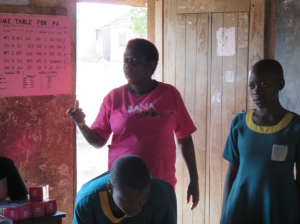
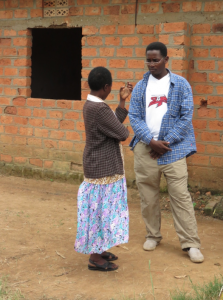
Jeremiah talking with the headmistress of the Bukibura Primary School. Forming these relationships through interpersonal communication is key to Bana’s success.

Bana helps give women and girls words that allow them to understand menstruation and how to take care of themselves. As Christina and I saw, and as all the fellows before us, knowing and understanding how to talk about something so stigmatized as menstruation gave women and girls alike the ability to talk about things that they never felt comfortable talking about.

In reflection of everything that I’ve experienced since that day in February when we found out we received the fellowship, I’ve realized that giving people words that help them find their voice to communicate their experiences is what I love to do. I quite literally begin to feel this sense of pride that I can only imagine a parent feels during their child’s talent show when I see someone I helped communicate their experiences in an impactful way.

When I had this realization upon my return from the field I realized that this wasn’t a new love that I only found out about in Uganda. Rather these passions for helping people find their own voices have slowly been developing my whole life, and Bana just shined a new light on it. From working in the Multicultural Center on campus to working on Unity 4 I have been trying to give a voice to marginalized communities on campus. Once I realized that this was something that I’ve been doing for years something clicked! This is what I want to do like in the real world—give marginalized and disadvantaged communities the ability to communicate their experiences in a way that makes the most impact.

That’s where the fun and uncertainty comes in. How do I, or anyone, know which form of communication makes the most impact?

That’s another area that this fellowship has helped foster. In all of the other enterprises and Bana they are considered innovative and exceptional, and what they really do is listen to and engage with their communities. From that engagement and listening they come up with these seemingly straight forward, but dynamic forms of communication and engagement that allow them to make such a large impact in their communities.
img_1574
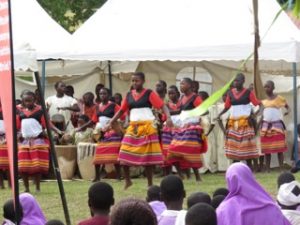
African Child Day in Nkozi. The whole community gets together and watches the school children perform.

The form of communication it takes to empower and give a voice to communities depends on the community. I’ve seen innovative and dynamic ideas come from these enterprises, and it inspires me keep an entrepreneurial and innovative mindset when it comes to communication and cause-based work. So while I don’t see myself starting a social enterprise any time soon, I definitely see myself applying that mindset that won’t let my work become routine and out of habit, but rather fresh, new, and inspiring. Unfortunately people have become desensitized to everything bad happening in the world, from environmental disasters to civil rights violations. Changing the way we talk about the problems in our world to inform and engage through stories and narratives can pool a multitude of untapped resources to solve problems together.
Our last night in Kampala.

Even if I didn’t receive this fellowship I could reasonably say that I wouldn’t be the same person I was one year ago, because that is life. Who knows what I would’ve done and how my life would be totally different without Thane, Keith, Spencer, and the other 17 crazy people. But, I do know that this fellowship has taught me how to stop living in the box, and think outside of it. I’ve always known that I wanted to help people (see my first blog post), I’ve recently stopped expecting and assuming things (see my in field blog post), I’ve been inspired by amazing women giving voices to their communities (see my last blog post), and now I have firmer grip on reality and the future.

In times that are as uncertain as they are now, knowing what my passion is, even if I don’t know what that literally looks like yet gives me solace. I’d be willing to bet that without this fellowship it would’ve taken me who knows how many years to find my passion in using communication to empower people voices with words.
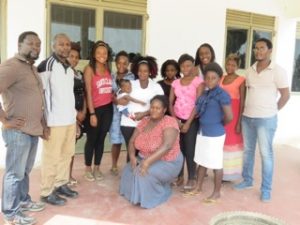
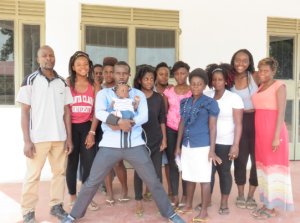
One last photo with everyone at Bana.


(Auntie) Florence

Like most international experiences I have come back a different version of myself. I cannot look at anything the same again. When I buy things I think ‘is this okay to burn?’ When I have to use the restroom I no longer have to prep myself to squat (praise). But more than these surface level changes in my mindset the connections to people I made in Uganda are what stick with me the most and have changed me the most.

screen-shot-2016-09-30-at-3-01-37-pm
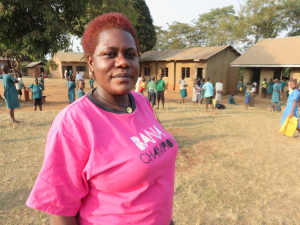
Florence [Champion. Mother. Teacher.] posing in front of the primary school she works at.
I will never forget what it was like to meet Florence. She was one of the last Champions we met during our research. Something about her reminded me of my aunt Esther. She looks nothing like my aunt, but we walked into her home to eat lunch and talk to her and I felt like I was meeting a long lost family member. Florence’s charismatic and funny personality was contagious. Even though they were speaking in Luganda and I was in a stranger’s home I couldn’t help but be comfortable.

My admiration of Florence has to do with more than her personality, but also her passion. When we were talking about the impact her role as a Champion has on her role as a Senior Women at her school she was passionate and “matter of fact” about how it helped her support the girls at her school. (A Senior Woman is a woman at schools in Uganda that deals with the issues of all the girls at the school, so menstruation, other parts of puberty, among others) She is committed to changing the lives of her daughter and the children at her school. Meeting her reminded me why were their helping Bana. At that point the interviews became routine, and school visits slightly predicable. But, Florence reinvigorated my passion for this research project. This was probably the best interview Christina and I conducted. It truly flowed like a conversation, and towards the end I started to ask question that was more aligned with my interests than that of the research’s. was more aligned with my interests than the of the research’s.

Florence teaching the girls at her school business skills.
Florence teaching the girls at her school business skills

I think what really drew me to Florence’s story was her efforts of bringing her privilege to the rest of the community. She is able to take the knowledge and advantages she has in life and make life better for those around her. All while being the most jubilant person I have ever met.

Looking back on it I realize that she reminded me of my aunt, all the women in my family, and myself because of both her charismatic personality and passionate determination to help others. In my first blog post I wrote about how my family has constantly helped others, so not helping others is more alarming than the former. Florence’s passion and personality reminded me of my family. I didn’t really connect the dots until writing this blog post, but that is why her story and our interaction meant so much to me. After meeting her I told Christina we have to include her in the case study, period. Florence showed me how becoming a Champion is not a job, but rather an added identity. With this new identity Florence can better support her students, daughters, and community members.

Florence talking to the girls at her school

What Florence is doing for her community, and I what I am doing for her is what I have found I love. She is using her own privilege to give a voice to the girls at her school, and I am using my position as a fellow to tell her story, and stories like it, to a broader global community.

This is where my passion lies. If anyone asks me what I plan to do after graduation I can list several different options and opportunities, but they all come down to using my position to give a voice to those without it. Regardless of the exact path I take, from changing the narrative of environmentalism to be more inclusive and less purists or including marginalized communities in the problem solving process, I now know that what ever it will involve connecting with communities on an authentic and “human-to-human” level before ever attempting to tell their stories.

The Bana family (minus Richard and Jeremiah)

Personal and vocational growth aside there is so many small things I miss. I miss Jackie’s sly looks, Grace’s sense of humor, Shannon’s giggle, and so many other small things. Even though I’m done unpacking my suitcases I will never be done unpacking this experience, and for that I am forever grateful. This fellowship has been the gift that will continue to give for the rest of my life. The more I talk about my experience the more I realize how it has effected me. Today I realized how much meeting Florence effected me, and I’m sure a month from now I’ll have a light bulb moment and realize how some other interaction changed my perspective. The learning did not end in the field, but rather is kick started and will continue for the rest of my life.


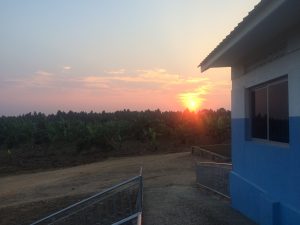
The last sunset at Bana HQ.


Assumptions. Assumptions. Assumptions.

When I boarded that plane at San Francisco International Airport on June 14th I had a lot of assumptions about what my experience in Uganda and with Bana would be like. I literally dreamed of different scenarios and expectations. At the time I was unaware of just how many assumptions I had floating around in my head.

I assumed my research wouldn’t really pick up until half way through the 2 months here. I assumed that it would be hard for women to open up to us. I assumed we would MAYBE just maybe get to go to one school visit while here. I assumed people would know I was Black American. I assumed getting used to the pit latrines would only take a week or so. I assumed that our relationship with everyone at Bana would stay mostly professional and work related, but still friendly. I assumed that it would be humid and rarely dusty. Let’s just say most of my assumptions were wrong, because it is somehow both humid and dusty at the same time.

Screen Shot 2016-07-21 at 5.10.00 PM
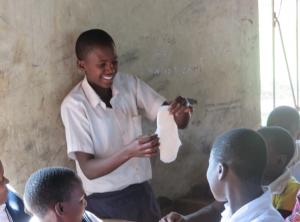
One of the school girls laughing as she demonstrates how to use a Banaad
Screen Shot 2016-07-21 at 5.10.15 PM
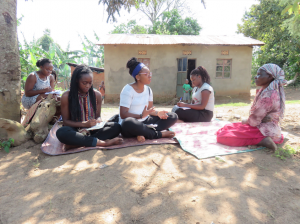
Christina and I conducting an interview with a Champion. By this time we got into the flow of things and the interviews went much better

We began our research during the first week we were with Bana… the first week! I remember giving Christina a wide-eyed look when Jeremiah said we could do our first interview and clinic visit on our 2nd working day. But, since then we’ve been on a roll from school visits, interviews, community events, to health clinic observations and learning the manufacturing process for Banapads. The research has of course been insightful for everything related to our deliverables, but it’s also been more eye opening about the Uganda and Ugandan culture itself. Like the way women have to sit when on the floor, random Luganda words, and the interesting origins of a lot of menstruation myths. While it was a surprise to start our observations and interviews the first week it has allowed us to continuously have free time during the day and on the weekends even with typing up field notes after every interview and visit for a couple of hours.

Screen Shot 2016-07-21 at 5.09.08 PM
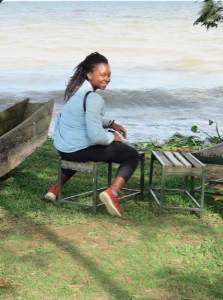
Christina caught a candid of me just trying to enjoy the lake. Paparazzi never stop, even in Uganda

All this free time has led to afternoons dedicated to hanging out by Lake Victoria, visiting Crocodile Farms, watching Portugal win the EuroFinals, playing ‘Ludo’ with some of women who work and live and at Bana, and even finding some great television. (If you ever find yourself in Uganda I highly suggest watching Pasión Prohibida dubbed in English and “Be My Date,” great shows everyone). All this free time has led to my relationship with most people at Bana to be as much friendship and personal as it is professional and formal. I genuinely care for and will miss a  lot of the people here.


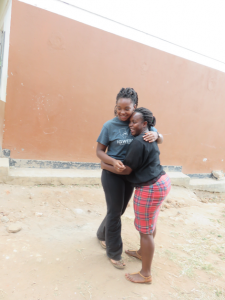
The Bana girls love to take photos. This is a candid of Shannon coming up to me mid-photoshoot
IMG_1081
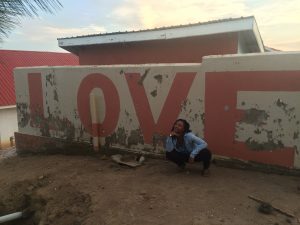
Posing “behind” the pit latrines. Cause even though we have our struggles its all love!


Clearly I was wrong about a lot. But, the biggest one I was wrong about was the pit latrine. Let me tell you this right now: You. Never. Get. Used. To. Pit. Latrines. Just when you think you’re used to the squatting, the flies, and you get your aim down something happens to make you uncomfortable with them again. A lizard jumps on your shoulder as you walk out, a mosquito bites your bum, or you get sick and pass out in the pit latrine for a few minutes. Trust me you don’t quite get used to it, but you live with it and when you go into town you fight the urge to yell “TOILET” when you go to the restroom and find one.

(For those not really sure what to imagine when I say pit latrines let me explain it for you. Imagine a porta-potty that you find at outdoor venues. Now replace the plastic walls with cement ones, the door with a wooden door and a latch, and the toilet for a rectangular hole in the cement ground.)

The other assumption that I had that has impacted my time here a lot is that whether in a school observing a menstruation education demonstration or at the supermarket in Masaka, being mistaken for a born and raised Ugandan still surprises me. I assumed my ‘Americanness’ reeks by the way I look and dress. But, people still try to communicate with me in Luganda before someone I’m wit interjects in Luganda explaining that I’m American, or Christina and I awkwardly say we only speak English. (Usually though once they hear me talk they know I’m American—I’ve been told I have a very strong accent.) Part of the reason that this baffles me so much is because I just took at as obvious fact that Ugandans look a certain way and I clearly don’t look that way. I can’t really tell you where that assumption comes from, but I had it and it was clearly wrong. Even Jeremiah told us that when we introduce ourselves we have to make sure to mention that we are not from here, because people might assume that we were just trying to be uppity by only speaking English. I’m not sure just how this could have effected our research, but I definitely think that being mistaken for a Ugandan has helped me feel more at home here. No one stares or wonders why we’re here I just fit in with no questions, and to be honest I rarely feel this most places on Santa Clara’s campus. To not have your presence questioned is something that kind of puts me at ease.

Screen Shot 2016-07-21 at 5.10.06 PM
Us casually blending in with the locals during our fieldwork and laughing it up

At the same time though, so much here is different than my home from pit latrines, using bottled water to brush my teeth and wash my face, sleeping under a mosquito net, or calling French Fries chips and Potato chips Potato crisps. Yet I truly do feel a sense of home at Bana. We were driving back from Rakai (another district a few hours away) after two days away. When we pulled into Bana a sense of relief and satisfaction came over me. I thought to myself “I’m home.” And then immediately thought “wait, no I’m not.” That’s when I realized that this place, these people, the food (shout out to the cooks Joanne and Teddy), and the culture have become a part of my life and I a part of it. That home feeling can exist about Bellevue, Santa Clara, and Bukibura. I assumed that I couldn’t ever be comfortable here and miss home at the same time. But, I am and I can. I can love the chapat and watching soccer games together, but also miss La Vic’s nacho fries and going to Lake Washington for fireworks. (btw- experimentation will be done when I get back to see if La Vic’s nacho fries wrapped in chapat will be as good as I think it will be)

Screen Shot 2016-07-21 at 5.09.49 PM
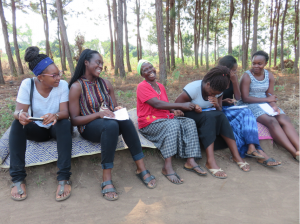
Dina (aka Déjà + Christina) interviewing!

Without taking up too much more of your time I have one last assumption that I am so grateful I got wrong. Coming here with one of my best friends and housemates has been a blessing in SO MANY WAYS. When I’m mentally wishing for a toilet I could share that with Christina without feeling weird about it. When I was sick, I was so happy someone who knew me as well as she did was watching me and helping me get better. No, we’re not always on the same page, but to not always have to explain myself to her when has helped make me feel at home here. And for that I am grateful. Having someone to talk to about all the ways I see sexism everyday as a part of life here, or all the ways I feel safer here than as a Black person in America, has been priceless.

As I begin to wrap up my days here with Bana I think of how many assumptions I’ve let go of. It reminds me a bit of Spring Quarter when I was preparing for this experience. I consistently fielded questions like “do you have your visa?” or “when are you leaving?” or “did you get you shots?” In the beginning when I got these questions I answered a simple “it’s in the works, I’ll let you know!” But as April ended and May began these questions started to make me think “when will I get my visa, vaccines, and travel info?” One day I jokingly responded to a friend when they asked, “I just let go and let Spencer.” It started as a joke, but then it was my phrase for when I noticed myself getting antsy or stressed. To be honest, it worked. Spring quarter turned out to be great practice, because here in Uganda a shorter different version of that phrase has become my mantra. “Let go of…” Sometimes I’m letting go of fear of ‘Journey to the Center of the Earth’ looking wasps, and often times it’s my own assumptions (and the want of a real schedule from time to time). Either way the more I let go of all the assumptions I have floating around in my head, the more I enjoy and love this experience.

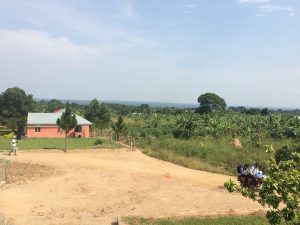
The view from the top of the hill

Why not?

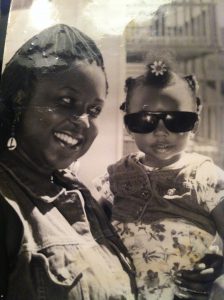
My mom and I when we lived in Atlanta.
My mom and I when we lived in Atlanta in the late 90s.

Born in Atlanta, Georgia in 1995 I have many ‘Southern’ tendencies. I like my tea sweet, my sauce hot, and am prone to use ‘y’all’ instead of you all.

My Southern tendencies go back to my grandparents. My grandparents went from growing up in Utica, Mississippi in the 1930s and 40s to owning three storefronts (a barber shop, a liquor store, and a diner) in South side Chicago from the 1970s to the early 2000s. Having never lost their sense of Southern hospitality my grandparents, especially my grandmother, always put others before themselves. All the summers I can remember from my childhood were spent running around the back of the stores, helping count money, and going on road trips with my grandparents and cousins.

I am the product of a family working hard to give endless opportunities and make the lives of their loved ones easier. Business has always been a way to both help others and support our family. Putting my energy into helping others, and not worrying so much about myself, has been something my family has taught me through their words and their actions. With this background the idea that businesses can be a way to help others, yourself, and serve as a sense of pride is natural and obvious to me. 

I want to continue to help others the way my family, but on a larger scale. This is not because I want recognition or I have guilt, but because I have the ability to. If I have the skills to help others, and the stability and privilege to do so why wouldn’t I? This Global Social Benefit Fellowship allows me to further explore what it means to help others on a global scale. Being born into a family who taught me to help others is not the only thing that led me to where I am today–it was the little moments along the way that directed my path.

The earliest defining moments in my path that I can remember was when I was about 10 years old. For Father’s Day I planned a whole day for my family. I got on the computer found some pretty fonts, colors, and clip art and wrote a schedule. I printed it out and handed it out on Father’s Day at breakfast. No one, including me, can remember what was on the schedule, but I still remember taking it very seriously. (In hindsight that made no sense, because my Dad is a go with the flow kind of person, and not one to stick to a schedule despite his best efforts)

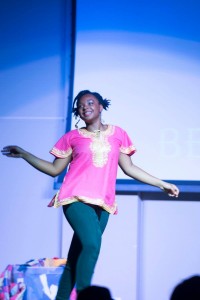
Walking the runway the the 2016 Igwebuike Culture Show.
Walking the runway at the 2016 Igwebuike Culture Show.
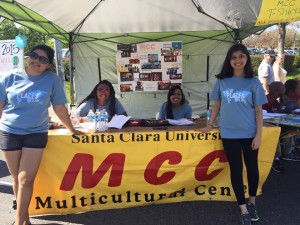
Tabling for the MCC at the annual Global Village. A street fair that showcases the diversity of the SCU and the greater community
Tabling for the MCC at the annual Global Village. A street fair that showcases the diversity of the SCU and the greater community.

At the age of 10 I didn’t realize that my planning of Father’s Day was a skill that would shape my high school and college careers. That skill grew and led me to becoming a class officer in high school. I planned dances, spirit weeks, Prom, and other school-wide events. In college, my planning and organizational skills continued to grow and expand while helping with the promotion of an open mic night and joining the staff of the Multicultural Center (MCC) my sophomore year. As a staff member of the MCC I participated in the planning of a street fair, coordinating and promoting for an end of the year awards night, photographing and participating in community dinners, and coordinating other events pertaining to inclusivity and diversity at SCU. It was through this position that I began to understand the world from a global context having attending culture shows and events for the Filipino Student Union (Barkada), Pan-African Student Union (Igwebuike), the Asian-Pacific Student Union, and many others.

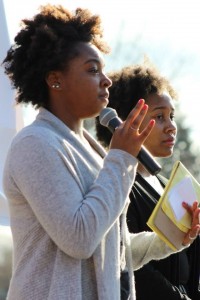
Speaking at the Justice Matter Rally on Martin Luther King Jr. Day.

Through all of those activities and personal reflection I noticed I had a talent at quickly connecting with people. This developing talent led me to fully realize another passion. I quickly got involved in social justice activities on campus as a freshman, because of the people I connected with and stories we exchanged. This ultimately led me to speaking at a Justice Matters rally on campus in response to police brutality in the United States. It was that moment that solidified my desire to use my talents and skills for empowering marginalized people who feel as if they don’t have a voice in social and environmental justice issues.

My passion for social justice in my opinion is the flower that bloomed as a result of the seeds planted in my childhood. Born in Atlanta, Georgia, I moved to New Jersey at the age of 3, moved back to Atlanta, Georgia at the age of 7, moved to Bellevue, Washington at the age of 12, and came to Santa Clara, California for college at the age of 17. To add to my diverse regional influences my mother and biological father are from Chicago, Illinois, with roots in Mississippi and Louisiana respectively, and my dad (technically stepdad, but I’ve never used the word step) is from Manhattan, New York. Each new city or state influence brought new foods, new people, and new cultures. I appreciated, respected, and loved the new cultures and the nuances that came with each move and growing up (and honestly still now) don’t know how others don’t feel the same. Therefore, in my social justice work on campus I have attempted to foster the same appreciation and respect that my upbringing planted in me.

Hiking to the Franklin Falls in Snoqualmie, Washington
Hiking to the Franklin Falls in Snoqualmie, Washington.

Moving around also helped shine light on a passion that I don’t think I would ever learned about in Atlanta or New Jersey. Moving to Bellevue, Washington exposed me to hiking and exploring nature. I grew not only to love my “city in a park,” but to also understand the social and economic benefits that came along with it. The more I came to understand those benefits the clearer it became that the benefits and risks from dealing with the environment were not received equally in different communities. A trip to the landfill in 11th grade added fire to this flame because the landfill we visited was located in a predominantly minority and low income area.

A year later while applying to college I only applied to colleges with an environment related major, because I wanted a better understanding of how people can better interact with the environment in an equitable way. Ultimately it was the recognition of a passion for sustainability and environmental justice this had a greater impact on my path, because it was my Environmental Studies adviser, Chris Bacon, that recommended that I look into the Global Social Benefit Fellowship my freshman year. Previous to this recommendation I didn’t know that the concepts of sustainable development that I was learning in my classes and the social justice activities I was doing outside of class could be combined in such a powerful way.

With the Global Social Benefit Fellowship in the back of my head I studied abroad in Barcelona, Spain for four months in the Fall of 2015. As quickly as I arrived I realized that American views and practices are just that—American. What I may have thought of as offensive, normal, or inappropriate were the exact opposite or didn’t even exist in Barcelona. As I traveled to Morocco and Italy that concept proved even truer. It was in Ouarzazate, Morocco after talking to locals that something finally clicked. I realized that I cannot help other voiceless and marginalized people, but rather I can help them help themselves. It was this realization that truly pushed me to apply for the Global Social Benefit Fellowship, because the focus is on how I can facilitate existing measures coming from within a community and not on imposing my own measures.

I can be a tool,  a helper, a resource, a guide, but not the primary problem solver. It is with the support of my family and friends, a strong organizational, yet adaptable sense of self do I plan to go to Bana, my assigned social enterprise, to be resource for their success. Providing Bana with a set of eyes, ears, and hands that can take lessons taught in classes over topics such as strategic communication, sustainable development, marketing, and more that they can use to their advantage. Just as I will be resource to Bana, they will also be a resource to me. There are somethings that I know I will learn and other that I will only discover in the field. Regardless, with my Southern tendencies, strong sense of family, a why not attitude I am excited to see what kinds of seeds these next 9 months will plant in my vocational journey.