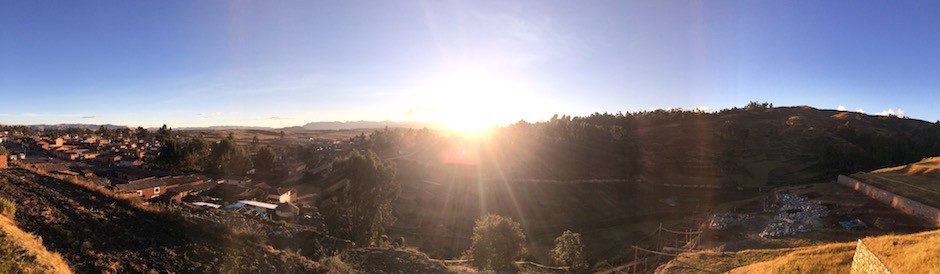
I had never really fully recognized the idea of “social justice” before stepping foot onto Santa Clara University. Coming from a small, secular, liberal high school, politics was the hot topic of conversation. The more pressing, social, political, economic, and ecological crises conversations that ail the world (including the U.S.) was left untouched.
So as I began to take my first few classes at Santa Clara, I noticed recurring themes that continually popped up again: privilege, justice, equity vs equality, and opportunity—my early questions at the time included: What did these themes entail? Why should it be important to me? And what can I do about it?
That was the main question: what can I do about it? It’s a question that continues to drive and impassion me but at the same time this question terrifies me. Do I truly make a difference? Do I do enough in this world to help others that is beyond my self-driven ambitions? I still ask myself these questions, and probably will for a very, very long time.
I had all these questions, yet I had no answers. I decided to start somewhere by applying to become a Jean Donovan Fellow to better understand social justice issues and to participate in solidarity with a community. This is where I got the privilege to be able to volunteer for 5 weeks as an EMT in a clinic in Cusco, Peru.
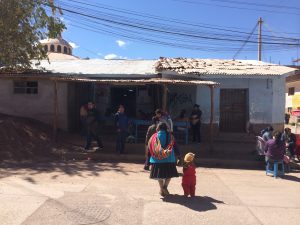
The government subsidized medical clinic in Santa Rosa, Cusco where I volunteered.
Going abroad and serving as a volunteer was an amazing experience, and I learned so much experiencing another culture. It was definitely lonely at times since I traveled alone, but it also allowed me to be comfortable with doing and figuring things out for myself. Despite that, I had some of the best times of my life traveling to different areas of Cusco. Another positive was my interaction with llamas! I’ve always had a great love for animals so its no wonder that I had a fun time seeing them.
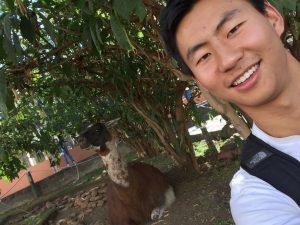
Selfie with a llama in the zoo at Universidad de San Antonio Abad del Cusco
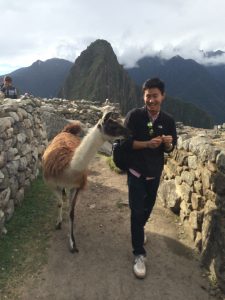
Roaming llamas in Machu Picchu!
My trip to Peru was also a completely eye opening experience. I remember first walking down some of the streets of Cusco and being absolutely shocked by the poverty. Prior to Cusco, I had never seen such dilapidated buildings and neighborhoods.
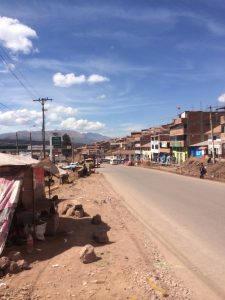
Road leading to one of the medical clinics
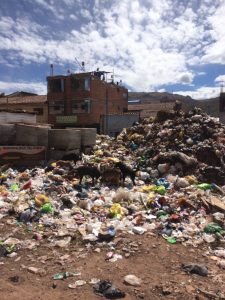
Piles of trash with stray dogs on that same road.
However, as I began to build relationships, learn the language, and immerse myself in the culture, I learned something that changed my outlook of the world— that despite the poverty and the lack of luxury that we would take for granted here in the U.S., the people in Cusco are just as happy, and possibly even happier than the people here at home. It is a realization that continues to stick with me now, and it puts into perspective important things in my life.
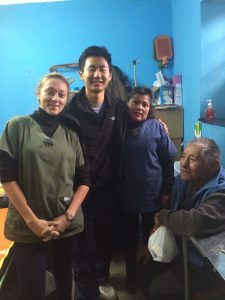
Another volunteer with Maria, the nurse, and Ramún.
Without a doubt, going abroad made a profound impact me—but I still felt something was missing. As I reflect on how much of an impact I made on the community in Cusco, I wonder how much I actually achieved. If anything, I made a very temporary and short-lived impact. I went abroad; I came back home. And that was it. I didn’t leave anything lasting behind.
This leaves me to where I am now. Why do I believe in the Global Social Benefit Fellowship and in social entrepreneurship? Why am I in this? When it comes down to it, I fully believe in the idea of empowerment and of enablement. As Martin and Osberg would say from their book, Getting Beyond Better, a social entrepreneurship is a “shift of the equilibrium” to initiate a new paradigm. As opposed to charities that just give money, social entrepreneurships change from within and make a systematic improvement that actually makes a lasting impact on people who need it the most. This fellowship culminates Santa Clara’s Vision and Mission, while also providing fellows the opportunity to do something few others will ever have a chance to do.
Even now, my definition of social justice evolves. Just this past Winter Quarter, I had a professor offer her poignant view of social justice using the parable of the rich man and Lazarus in the Bible. To provide a short summary, Lazarus was a homeless beggar with painful sores all over his body. Everyday, he would wait outside a rich man’s house and only hope for the crumbs of food from the rich man’s table. He lived the remainder of his life in this existence and died without ever having the rich man even acknowledge his existence.
This brings up the question of: Who do we see? Who do we not see? Are we, the rich of the world, failing to see who is right in front of our own door? As I come to understand more about social justice, I believe it’s more than just addressing economic, political, and health disparities, it’s also about “seeing” those who are unseen by society.
So as my team members and I all prepare to take part in our placement, it is my deepest hope and desire that we not forget why we are doing this fellowship and to help actualize the greater impact and change we hope to see in this world.