I need to take things day by day, step by step, and one step over the next or else I may have to call over my two teammates, Aidan and Elia, to come over and resuscitate me. It’s a little bit of an over-exaggeration, but it does truthfully reflect a part of my current emotional state in my 5th week here in Nicaragua: frustrated, discouraged, and stressed. I feel frustrated with the pace of my own learning of Spanish. It is progressing! But it… is… painfully…… slow… There is nothing more frustrating than not being able to truly convey what you mean to say or to be lost in conversation. I feel discouraged for the same reasons. On the bright side, I have found a light chuckle and a genial smile to be quite the asset when I don’t completely understand someone…
Needless to say, the learning pains are not stopping me from trying, and I am well reminded of my own silly and embarrassing mistakes as there is a current list of my spoken mishaps courtesy of Aidan (all in love and fun jokes I know!). Finally, I feel stressed for fear of not being able to achieve everything we set out to achieve in our time here—since we had a bit of a slow start, we just started making our first visits to the communities. Without a doubt, living abroad to a different country is hard. Acclimating yourself to a different country is hard! And trying to overcome language barriers is HARD! Whoever said this stuff was easy?!
Despite it all, there is still so much that has happened and so much to look forward to. Our first highlight of our trip so far has been with the “Intercambio”, a youth exchange convention where students and employees from various universities and organizations from Mexico, Nicaragua, and University of California Santa Cruz come together.
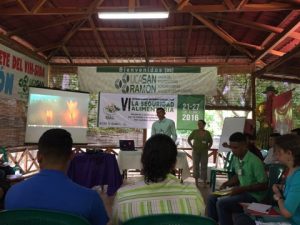
Welcome to the 6th annual Intercambio!
Although an initial culture shock, the Intercambio soon turned out to be an amazing experience where ideas, advice, concerns, and information were exchanged and presented. For example, we learned about the way cooperatives function (groups of small-scale farmers that come together for greater economic outreach and potential), and we actually had the opportunity to visit several of them.
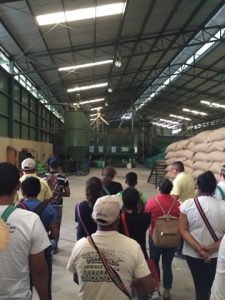
The inside of the PRODECOOP coffee processing plant.
To the left, you can see the processing plant of one of the most successful coffee cooperatives in the region, PRODECOOP. Here, they process thousands of pounds of coffee to be distributed throughout the world. Through their success, they have branched out to other areas of networking such as a food distribution and exchange center that allows small scale farmers to exchange unwanted surplus crop for another type of crop.
Even more valuable than the information that I learned were the people I got to meet and the cultural interactions that I had the opportunity to experience. It was so interesting to learn about the country specific colloquial expressions that don’t exist in the english language.
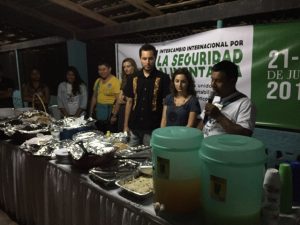
Cultural cooking night where teams from each organization or University comes up with a recipe that is “typical” of their country.
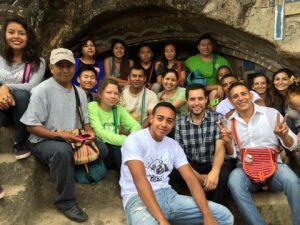
Friends!
After that crazy week of the Intercambio, we had an off-week that was starkly different in pace because we couldn’t start yet making community visits to start our research as a result of transportation issues. Thus, it wasn’t until the 4th week that we made our first visit a community called Buena Vista, a rural community about 2 hours away from Estelí.
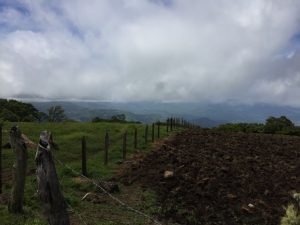
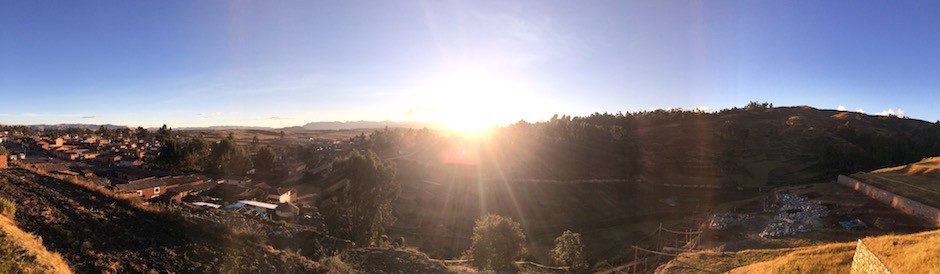
High in the mountains, Buena Vista did, in fact, have good views (buenas vistas).
It isn’t until now, in our 5th week here in Nicaragua, that we are truly diving into our research plan. It took 5 weeks. 5 weeks! Here are some observations and realizations that I have made so far: 1) We’re constantly learning new information—whether it’s information about the communities we’re going to visit, or information about our host organization, ASDENIC. It is mostly good news. However, there are instances where we hear something, or we receive a document, and we say to ourselves, “we should’ve gotten this before we even landed.”
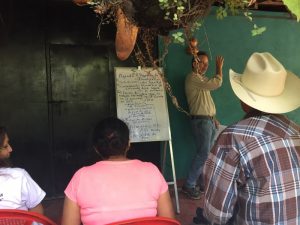
We accompanied our research mentor, Professor Bacon on a focus group session
2) Things take time. For example, part of our research plan is to conduct interviews and surveys. However, in our meetings with ASDENIC, we have been told that we first need to get to know a community better before we can start any sort of formalized surveys. This completely makes sense. However from a logistical viewpoint, we are on time crunch. With only 3 weeks left in Nicaragua and a community visit taking a whole day, that’s just more time expended. As a result, I have felt and still feel nervous about gathering enough data for our research plan. 3) Finally, I have realized early on that our research plan is subject to change. In addition to the fact that things absolutely do not go the way you planned it to go, we are realizing that we need to keep our minds open to change. It’s unsettling at first, but then you realize it’s all part of the process.
Although my initial introduction may have conveyed an overall demoralized emotional state, I don’t think it is at all uncommon. I can’t speak for all fellows, but I think we’re all feeling and experiencing some sort of pressure or difficulty in some way. When I shared some of my frustrations to someone close to me, they told me this, “the reward for our actions is greater and means more when we have to struggle for them”. I think it’s absolutely true. I think one of the reasons why our emotions run so high, especially in light of difficulties, is because we care so much. Personally, I truly want this project to succeed and I want to see the eventual fruition of a self-sustainable, successful, and effective water social enterprise here in Nicaragua; I know that Elia and Aidan want the same thing as well.
Some days I tell myself, there only “x amount of weeks left!” But who knows, maybe by the 8th week, I will wonder where the time went and if I could just have a little bit longer here. I was just getting used to it…