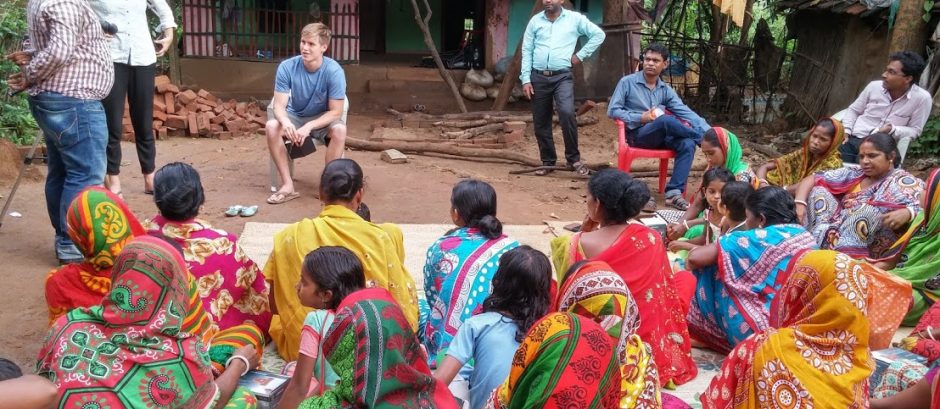
It’s hard to get my mind around the fact that I was in India two months ago. It feels like a distant dream, a past life that I sometimes sit and wonder if I’ve lived before. My reality was so different then compared to now – in too many ways to list . My experiences in India shaped the lens in which I see myself, my community, and the world at large. Often, images and moments come back to me and linger, forcing internal conflict and discernment. Here are three that have challenged me the most.
Facing Poverty
We’d just reached the kiosk to receive our passport photos. Drenched in sweat, we approached the stairs as the owner stood in the doorway. Erika, leading the way, stepped up to him and asked if we could take passport photos there. I stood behind, staring at the eight lanes of mayhem going on in the intersection we’d just crossed. Suddenly, a hunched figure in a green and yellow sari approached me.
She stared at me intently for a moment with her hand out. I stared back, examining her face. Her eyes were dark and sunken slightly back into her face. Her dry skin sagged, aged from years of spending days in the sun. Her sari and jewelry were beautiful in spite of her obvious poverty, something that would become a familiar sight to me as I became more acclimated to my surroundings.
As she continued to fix her gaze upon me, she motioned deliberately and fluidly at me. She put her fingers to her mouth, requesting I give her money so she could have something to eat. I froze. Regaining my composure, I waved my hand at her to signal I could not give her money. First of all, the money I had wasn’t even mine to give and secondly I figured if I was going to be in India for eight weeks, I couldn’t give money to every person I encountered who asked. But she persisted.
The fact that she asked again wasn’t what caught me off-guard. It was how she asked. Rather than to place herself in a position of pity, she motioned at me again, this time more matter of factly. Her body language seemed to say, “I’m not stupid. You have some money to spare.” Jarred, I looked at her as she motioned again. Coming to the realization that she was internalizing this experience just as much as me put me in a weird position. It’s hard enough to feel greedy without having to internalize that someone in desperate need is thinking the same thing. Feeling slimy, I turned away and headed up the stairs.
A Picture is Worth _________
One thing that really struck me at the first village we went to was how much some people wanted to be on camera. On the drive out, I’d gone through the scenario of how we were going to get people to agree to let us take pictures of them or film their everyday lives. Putting myself in their shoes, I thought it was going to take some serious persuasion. Having traveled in Asia before, I’d already experienced what it’s like to have strangers disturb me and ask for photos. I wasn’t a fan. While I was excited to get to work after months of preparation, part of me was dreading our arrival because I felt like an intruder. When we finally arrived and stepped out of the car – it was to the only scenario I hadn’t been preparing for – the best case one.
Every single farmer using the irrigation pump wanted to be interviewed and was willing to wait in line to do so. At first, I chalked this up to the fact that they were curious about our team. We were likely the only foreigners or white people they had ever met in their lives, and this bestowed a certain status upon us in their eyes. While this was undoubtedly a large chunk of why they were willing to devote so much time to helping us out, it quickly became apparent that they had other motives as well. Many of them had not had pictures taken of them before, at least not on a high quality camera.
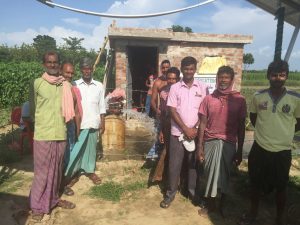
Men from the first village we visited pose for a photo
The value of this became especially apparent when they gave us a tour of the village later on. People came out in droves to show us their homes, as well as various aspects of their community like the school and fabric workshop. They asked for pictures. Some wanted them with us, especially Erika, but more than anything of themselves.
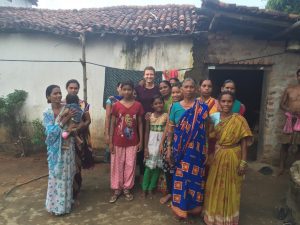
Erika with women in Odisha
Seeing the smiles and laughs women shared with one another when Erika would show them the pictures she took of them was truly spectacular. This was particularly true of women with their children, as they glowed with happiness at the opportunity to see themselves with their family.
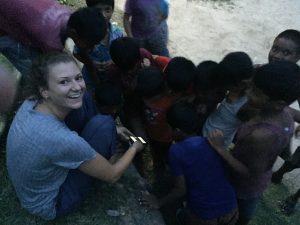
Children gather around Erika to see a picture she took of them
This realization hit me hard. I’ve never really liked to take pictures. It’s just something I’ve taken for granted. Seeing these ecstatic reactions made me think a lot about the way I’ve thought about pictures. Recently, I’ve associated them a lot with vanity and the social media age. And that line of thinking has definitely taken away from the value technology like cameras can provide in our lives. Not taking pictures is something something I regret looking back on my high school and college years. I’ve missed out on the chance to capture loved ones and amazing trips I’ve been fortunate enough to experience, among other things. I’d let the way other people and society use pictures cheapen the internal value that the privilege of being able to document beloved memories can have. Looking back on the pictures we took during our time in India fills me with joy. I wish I could share them with the people they would mean the most to.
Priorities Jumbled
Going into our week in Odisha, PJ was an unknown. I was actually concerned about having him with us. Erika, Nate, and I had developed an outstanding working chemistry and I didn’t want an added unknown during what felt like our most important week in India. Piyush and Shweta had just informed us that they expected us to capture how microgrids and microfinance opportunities were impacting communities in only a few days in the field. Compounding this was the fact that Erika got an ear infection the day before we left. She would be unable do much work because her hearing was impaired. This left me feeling a sense of desperation heading into the week.
Work definitely had a different feel for me in Odisha. Usually, I looked forward to having an opportunity to take a breather during a work day and try to get to know someone across the language barrier. But in Odisha, I felt compelled to try to squeeze out every last detail while I was there. PJ on the other hand, had a different approach. He would often steal off for up to an hour at a time to interact with locals, playing with children, or showing some of the men pictures of his travels in other countries. I didn’t pay much attention to this for the most part because of the stress I was feeling with the added workload Erika’s sickness hoisted upon me.
Then one day, PJ disappeared when it was his turn to do an interview. I looked around desperately as Nate and Erika set up the camera, but he didn’t seem to be anywhere. Shaking my head, I left the shaded area that the entire village had crowded around in anticipation of the interview. Peering under straw roofs as I walked through the village, I felt my anger grow. While I understood that PJ was an outsider who didn’t necessarily feel the same pressures as the rest of the team, I thought he was at least serious enough to show up when it was his turn to do an interview. As I neared the end of the aisle of huts, I was prepared to give up. Then I saw him.
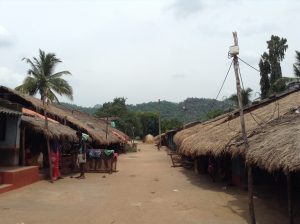
The village in Odisha I scoured looking for PJ
PJ stood there pumping the village well, as a man in a single wrapped garment cupped his hands underneath and brought water to his face. His body was glistening wet, as though he had just washed his body. PJ pumped several more times as the man put his feet underneath. After the man finished up, PJ rushed over to me, apologizing for being late to go interview.
“I’m sorry, so sorry,” he proclaimed. “I just saw the man trying to wash himself. He was pumping the water onto the ground and laying in it. He can’t get clean like that, laying in dirty water. It’s just very sad.” Startled, I stuttered, “it’s, it’s okay,” Feeling my face flush with shame from the frustration I’d felt just moments earlier. “He just has the one cloth you know,” continued PJ, “I just feel very bad.” I felt a newfound admiration for PJ. While I’d been so caught up in trying to serve ONergy and the Miller Center, I’d forgotten the core part of the fellowship – working in service of the poor.
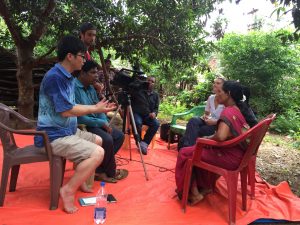
PJ finally completes the interview