“You were made to be significant, your life was created on purpose for a purpose. It is time to live on purpose.In order to live a life of significance and meaning, you can no longer be passive in the face of life. I think for a lot of us that is our default setting… A lot of us in life are tempted towards passivity instead of embracing responsibility…You and I need to reject passivity and embrace responsibility for our own lives…To be able to say I have a vision or goal for life is not enough, I need to also pursue that purpose. It is not enough to have the vision or the purpose, you have to pursue that vision and pursue that purpose. You have to take action on it. The happiest people on this earth have a God-sized vision, they don’t even have to achieve it, they just have to pursue it and they are joyful.”- Father Mike Schmitz
As I listened to Father Mike Schmitz’s homily this past weekend (around three months after my trip to Uganda), I couldn’t help but relate it to my current vocational discernment. Before this fellowship, I feared that I didn’t have a clear vision of what I wanted to do after I graduate. Now, I fear that my developing vision is not big enough, it is not God-sized. I want to become a Physician Assistant in maternal and child health. However, this fellowship, particularly learning about social entrepreneurship, spending time in rural Uganda, and reading Laudato Si, has challenged me to think about why I want to become a Physician Assistant. Yes, I want to become a Physician Assistant, but it doesn’t stop there. I want my vocation to incorporate work that seeks to eliminate health disparities. In particular, I want to create a God-sized vision that seeks to eliminate the health disparity of unequal access to holistic healthcare among marginalized women and children. Being a Physician Assistant is a worthy occupation that is necessary in this world today; however, beyond working at clinics and helping patients with their immediate needs, I also wish to provide women with knowledge to know how their bodies work so that they can make decisions regarding their health on their own. This maturity of thought with regards to my vocation is important because I do not want to live my life concerned about what I am doing, but rather why I am doing it (whatever that is). When I master the “why”, I believe I will have attained what Father Mike Schmitz describes as “living a life of significance and meaning.”
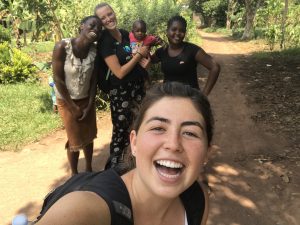
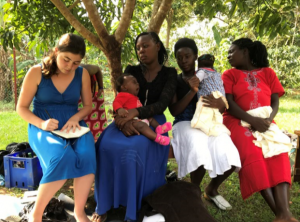
The joy of knowing someone on a personal level. Maggie and I with a Shanti Uganda client, Jackie, (left) and Grace (a Ugandan girl we lived with).
Social Entrepreneurship
If poverty is the “what,” social entrepreneurship seeks to tackle the “why.” In other words, social entrepreneurship generates systemic change within a community or population by breaking the unjust social structure that leaves people poor. Health services can lighten the load downstream, but providing women with knowledge to know their bodies and a steady occupation to raise their families in healthy conditions prevents them from having to take advantage of health care services in the first place. I have caught the social entrepreneurship bug because I believe it relies on individuals, like you and me, to remain active in the face of injustices. Yes, clinical jobs are needed and worthy occupations, but social entrepreneurship adds an element of hope into the world that I have a hard time letting go of. Like Father Mike Schmitz mentioned in his homily, we must not remain passive in this life. We are responsible for creating a just world for everyone to live and thrive in. I am not sure what my involvement in social entrepreneurship will look like in the women and child health care setting; however, I know that I want to be a change maker in the health industry. At the root of social entrepreneurship is systemic change, and I believe that will be the avenue I use to achieve this God-sized vision of mine.
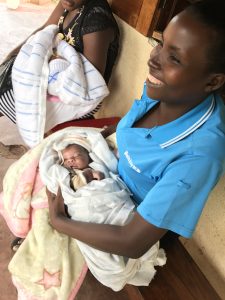
A Shanti Uganda patient and her newborn.
Uganda
In the past, I often answered the question “why do you want to go into medicine?” with some version of “The human body fascinates me, and I love working with people.” This response reflected my rather limited idea of what it means to serve a population, particularly a marginalized population in an under resourced setting. It is very apparent after my time in Uganda observing, interviewing, and interacting with women and infants in Uganda that having medical services available only goes so far. If women are not able to make decisions for their families, they will not be able to receive any medical treatment. Women at Shanti Uganda expressed that when they were able to receive services at Shanti Uganda at little to no charge, they saved money. With the money they saved, they were able to buy clothes for their babies, food for their families, and seeds for their gardens among other things. Other women expressed that that their husbands were in charge of their money and they were not able to make autonomous decisions. As a Physician Assistant, I want to pursue medicine with purpose. I want to provide medical services to my patients, but I also want to use my practice as an outlet to provide agency for women and their children.
Laudato Si
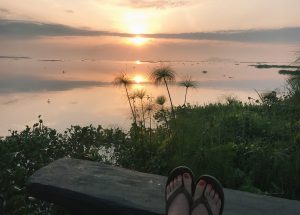
Watching a sunrise on Lake Victoria.
Laudato Si has taught me the importance of taking responsibility for my own actions as an act of love for my global family. The decisions we make on a daily basis ultimately affect our brothers and sisters around the world, particular those in vulnerable communities. As a part of my vocation here on Earth and as a future Physician Assistant, I do not want to become complacent with the reality of our world. In Laudato Si, Pope Francis writes, “If everything is related, then the health of a society’s institutions has consequences for the environment and the quality of human life, ‘Every violation of solidarity and civic friendships harms the environment’” (Chapter 4, section 142). With this is mind, it is my responsibility as a future medical professional to consciously care for human beings. As I care for human lives, I will also be caring for the physical environment since everything is interconnected. I am certain that if I am able to carry this task out, I will be living my vocation with purpose.
I am grateful for this opportunity to go beyond my comfort zone and take part in this fellowship. It has been nine months full of personal development and I have found joy working towards a purposeful life. I hope to never forget the ways in which this fellowship has formed me, now and forevermore.
All the Uganda fellows about to board their airplane to Uganda.
Scared. Apprehensive. Excited. Nervous. My emotions were all over the place as I boarded the KLM Airbus. After spending the previous summer in The Gambia I had a general idea of what to expect when I landed in Uganda, but I was trying so hard to let go of my preconceived notions of Africa and the inevitable list of expectations my mind wanted to create. I couldn’t help but laugh because it didn’t take long before my senses were bombarded with familiar smells, sounds, and sights that reminded my body of what it was like to be in Africa- wafts of burning trash in the distance, rings of African music coming from car speakers, waves of hot, humid air filling my lungs, and bumper to bumper traffic consisting of taxi cars filled with people of all ages to the brim. While there were many similarities to my experience in The Gambia- “African time” was no joke, it was not unusual to see more kids than adults in any given day, people are generally more open to receiving guests than in America- it is safe to say my time living and working in Uganda was truly an authentic and immersive experience. It is still hard for me to articulate all of the feelings and emotions I felt while in the field, but one thing is certain and easy for me to say and that is that I am forever changed. One of the most underrated, yet priceless gifts anyone can receive (in my newfound opinion after traveling abroad these past two summers) is global engagement. It is a humbling reminder of life’s simple purpose- to love others without limits. Not every moment of global engagement consists of warm, fuzzy feelings, in fact most of it is uncomfortable, confusing, and challenging. However, I am certain that it expands your heart for others and gives you the opportunity to reflect on the importance of human relationships. Here are a few thoughts that I contemplated while on my own journey of global engagement:
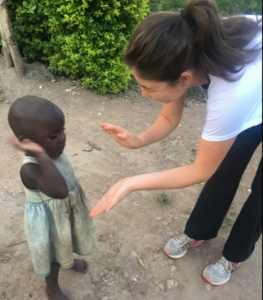
Contradiction. My mind keeps going back to the word contradiction. My experience in the Ugandan village of Kasana-Luweero consisted of many contradictions. I saw both poverty and joy like I have never seen before. Infants sitting in sewage run-off with ripped t-shirts, snot dripping down both of their nostrils, playing with a dirty, ragged tire, all while smiling and laughing at each other. A blind person could have walked by, only listening to the children laughing and engaging in conversation, and he or she might suspect that they were playing in a grassy, well-manicured backyard. But, the reality was they weren’t. Their playground was filth. Every time Maggie and I would walk onto the village main road to catch a matatu (or taxi), go to the market to purchase groceries, or visit the town we would walk past these same kids.
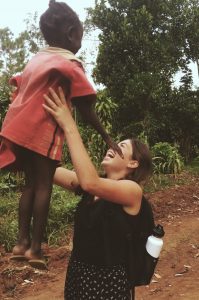
Brian, a child from the village, who we saw every morning during our walk to Shanti Uganda. He loved it when Maggie or I threw him up in the air and begged us every time we saw him to just that.
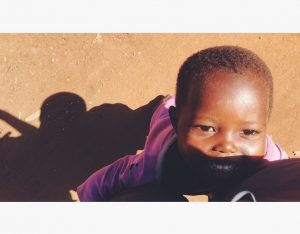
Each time during the day there was no father to be seen (he was most likely away at work), mothers were working together inside or directly outside the house (often times preparing meals or sweeping the compound floor, which was dirt), and multiple groups of kids playing with each other in the dirty streets (most likely because their parents could not afford school fees). It was a heart breaking scene to walk by every day. But amidst the poverty, there was also raw joy. My favorite memories are those with the village children. Walking to and from Shanti Uganda, we experienced children running up to us carrying smiles on their faces and genuine joy that exuded from their laughs and desire to be thrown up in the air by the Muzungus (a local name for a white person or foreigner). It was apparent that these kids, whom we quickly learned their names and befriended, suffered physically to some degree. Yet, within a world of hardship they found joy. Joy with each other and joy with the world around them. It was clear that the village kids had built a system of resilience for themselves. A skill that even some grown adults struggle to build.
Here I am playing with one of the village kids.
Another contradiction prevails within the culture of childbirth. Many of the women we interviewed expressed their gratitude for Shanti Uganda’s ability to provide safe and respectful births. At first, Maggie and I were confused by the term “safe and respectful births.” We had a hard time conceptualizing what a disrespectful birth consisted of. Although we have never given birth, it is generally expected in the United States that all pregnancies should be treated with utmost caution, care, and compassion. However, throughout our interviews it became clear that in Uganda that is often not the case. Many pregnant women are abused at local hospitals and clinics. They are not allowed to show any signs of pain during childbirth and if they do, they are chastised and sometimes even physically abused. As a result, women who came to Shanti Uganda were relieved by the midwives’ acceptance of showing signs of pain and were encouraged by their quality of care. We interviewed mothers pre- and post- birth and sometimes even when they were experiencing contractions (always with their permission).
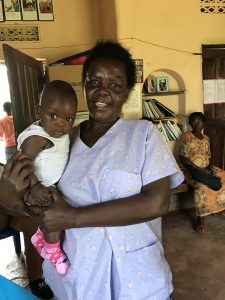
Sister Josephine, the Head Midwife at Shanti Uganda, is respected by many of the women in Kasana-Luweero for her quality medical care.
Even though Shanti Uganda explicitly tries to go show all mothers compassion and care throughout their pregnancies, many of the mothers were still reluctant to show pain. It is still hard for me to fathom that during one of the most painful events in a woman’s life, she is expected to be quiet and poised. But, witnessing the pride local women share for Shanti Uganda due to their ability to provide dignified births reemphasized what a privilege it is to have quality, respectful medical care. When I visit the doctor’s office, I don’t think twice about whether or not my doctor will chastise or abuse me, it is a given. It’s easy to pick apart the United States’ medical system and complain about certain qualities, but at the end of the day just having care that identifies the dignity of the patient and cares for the individual in a respectable manner is a great privilege.
While these are just two of the many contradictions I observed, they have taught me a lot about who I am currently and the person I want to become. I’ll start with the village kids first. I’ve known for a while that I want to work with kids. But spending time with the village kids in Uganda and the babies at Shanti Uganda, reignited my passion to nurture kids at a young age so that they grow up knowing they are worthy of a bright future and are motivated throughout their childhood to achieve the things other people tell them they can’t do. This realization is a win-win because at the same time I desire to inspire children from a young age, the village kids inspired me at such a young age. Joy is not a result of your circumstance, but rather it is a product of your mindset. I have also been inspired by the beneficiaries we interviewed at Shanti Uganda. Their horror stories about some of the healthcare experiences they have endured, motivates me to be the best healthcare provider I can be for those without quality care. I firmly believe that safe, respectable births, as well as all other medical procedures and services, should be accessible to all, even those in the rural villages of Kasana-Luweero, Uganda.
Ki kati! (“Hi!” in Luganda) from Kasana-Luweero, Uganda! Oli Otya? (“How are you?”). It has been about six weeks since my research partner, Maggie, and I arrived in Uganda and started working for Shanti Uganda. Shanti Uganda is located in a rural village about an hour and a half (with no traffic-if there is traffic, it can take up to five hours!) north of the capital city, Kampala. It is no exaggeration to say that life is pretty different out here in what the locals call “the bush,” compared to the hustle and bustle of the city life in Kampala. As one might expect, the speed of life is very slow. There are less people. There are latrine pits instead of traditional toilets. Electricity is not widespread. Life is pretty simple. As I reflect on my journey thus far, I can’t believe how fast these past five weeks have gone by. Before I left the United States, I was pretty nervous about spending six weeks in the field because I was not sure how I would manage being away from home for so long. I love to travel, but deep down inside I am a home body. However, we are approaching our sixth and final week here I admit I am not ready to leave. Although there are a few things I miss about home (my family, my friends, ice cream, and the beach), the simplicity of life in Kasana- Luweero is rather refreshing. But, whether I like it or not, in one week I will be on an airplane on my way back to the States. So much has happened during these six weeks and I could probably write a novel about my trip including the many different thoughts, feelings, and experiences I have encountered. In an attempt to summarize the most prominent feelings I have felt and memories I have had on this journey, I have decided to write a letter to my 30-year-old self, including the thoughts, feelings, and memories I hope to remember a decade from now.
Dear thirty-year-old self,
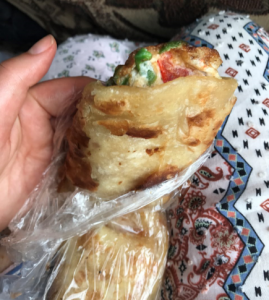
Rolex. A friend egg omelet with tomatoes, green peppers, and onions wrapped in Chapati (a mix between naan and a tortilla). So yummy!
Whew! What an adventure it has been in Uganda. First of all, I want to thank you for letting yourself take on this once and a lifetime opportunity. It has expanded your perspective of the world, allowing you to deepen your understanding of the many different cultures this world consists of, and experience firsthand the current setbacks the developing world is facing, further motivating you to find a vocation that seeks to alleviate some of these disparities. That is priceless. No textbook nor summer internship can replace the knowledge you have obtained and vocational discernment you have begun throughout this trip. I hope you remember that traveling is a gift that enables human beings to realize how small the world truly is and how large our capacity to love and connect with others is. Since every chance to travel is unique- there are different highs and lows to each individual trip- there are a few distinct experiences distinct to this trip that I hope still move you and make you think the way they did in the field. Right off the bat, I am sure a few words ring a bell and maybe even make you smile and laugh…Matooke (in case you forgot- a traditional, very bland Ugandan dish made of plantains that is eaten at almost every meal). Matatu (the name for a taxi, which is more accurately a vehicle in Uganda that is normally filled to the brim with people on each other’s laps going 75 mph down a highway). Rolex (another traditional Ugandan food that resembles an egg burrito that you had just about every day). “See youuuu Muzungu!” (the way little kids shout at you as you walk through the village and then laugh when they get your attention).
Julie, a little girl who we saw on the way to Shanti Uganda every morning.
But beyond these words and phrases you encountered on a daily basis, I hope that you remember the way the people made you feel and the opportunities you had to reflect on your own life throughout your research. These are the memories that have truly changed you.
Here we go my thoughts, feelings, and experiences from the field…
The People
Before I left Santa Clara, my friend sent me an article that described Uganda as “the friendliest country in the world.” After some time meeting and getting to know Ugandans, I think it is safe to say that I agree with that statement. Every morning when Maggie and I walk to work we receive countless “Oli otyas!” from locals in the village who stop in the middle of their work to greet us. It is also very common for children to run up to us with fearless joy and insist that we high-five them. Back home, it is not as common to receive a warm “hello” from a complete stranger. I love how easygoing most people are here. They aren’t caught up in the next thing to do, but rather they are very good about being in the moment and concentrate on one thing at a time. Especially when it comes to meeting new people.
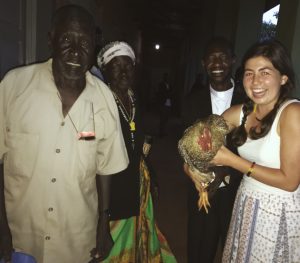
Beyond the surface level hellos, I have found that people here are also much more inviting and willing to let visitors into their homes on a whim. It is evident that for people in the village it is an honor to have guests, especially those from another country, and make them feel at home. The few times that we have been able to visit someone’s home in the village, we have been welcomed in with many smiles and hugs, copious amounts of food, and simple, yet completely sincere gratitude for our presence- we even received a chicken from a couple!
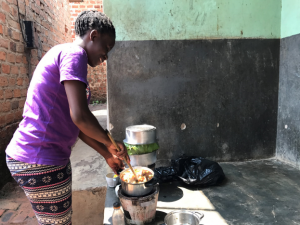
Receiving a live chicken from a couple upon our arrival. Later that night, we were informed that our chicken had become our dinner.Jackie making sweet potatoes and sauce for Maggie and I outside of her compound.
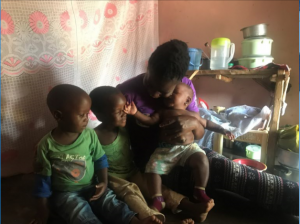
My favorite memory has been visiting the home of one of the Shanti Uganda beneficiaries, Jackie. Jackie is married and has two kids, a two-year-old boy named Junior and a 6-month-old girl named Brenda. She lives in a one-bedroom compound, which is located about five minutes away from the main road. I think the reason why Maggie and I are able to connect with Jackie so naturally is because she is twenty-two years old, only one year older than us, and speaks English very well. I admire Jackie because although she has very little material wealth like most of the villagers, she sticks out against a majority of the mothers we have met. She is intentional with her kids and plays with them despite all of the cooking, laundry, gardening, and household chores she has to do. It seems as if there is a trend here in the village. During the day, men are nowhere to be seen (most of them are off in the city working day jobs), leaving the women at home with their kids. Since there is so much manual labor for the women to tend to, the children who are not able to afford school (which there are a lot because school fees are so high) are left unattended. Despite this trend, Jackie takes time out of her day to be with her kids. While we were visiting Jackie at her home, it was the first time we saw a mother actively playing with her children. She threw up her daughter the air and her little girl immediately laughed. Although it was such a simple action, it made a lasting impression. That is not to say that all other mothers do not put their children first or attend to them, however the labor that is required for women and mothers to complete on a daily basis is not conducive to the constant overseeing of young children that is commonly seen in the States. There are no babysitters or daycares here, and as a result children learn to grow up and become independent very quickly.
Jackie playing with her two kids, Junior and Brenda, and her neighbor.
I bring up Jackie and my time getting to know her at her house because I hope you remember how powerful her investment to her kids was and how special her effort to get to know you and Maggie, who were relatively new people to her, made you feel. It was apparent that she loved people and as a result, it made you want to love others around you. This is the ripple effect I hope you still yearn to initiate- to love others so that they might learn to love. Love takes on many forms and the people of Uganda, including Jackie, have taught me that simple friendliness and hospitality goes a long way.
Before I overlook all of the things that I have enjoyed about the Ugandan culture and people, there were a few things that frustrate me. One of which includes the system of bargaining. Even though people are very friendly, those on the streets trying to sell you things can be very pushy. This is especially true in the city of Kampala where there are massive amounts of stuff and people everywhere, although it also exists in the villages particularly at markets. As a foreigner who sticks out like a sore thumb, I am a prime target. While it is very frustrating at times, it is also a clear indication of the economy here and how bargaining- or hiking up the price 3-4 times the true value- is how people make a living. I could definitely do without this part of the culture; however, it has taught me the luxury of fixed prices. At home, I can walk into the grocery store and know exactly how much I am going to pay for an apple regardless of who I am. Here, it depends on whether a local is with us or not. I say this because it is the little things like fixed prices that goes unnoticed in America. I hope that I still do not take for granted all of the little luxuries in America that often go unnoticed.
The Work
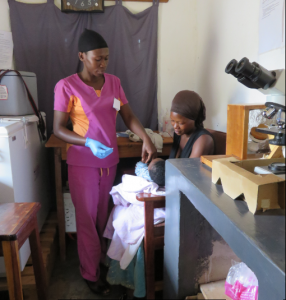
Here I am writing down notes during a focus group conducted by Flora, a Shanti Uganda midwife.Sara, the lab technician at Shanti Uganda, giving an infant an immunization.
The majority of Maggie and my research entails interviewing the beneficiaries of Shanti Uganda- particularly the mothers and the midwives. Our goal for the interviews is to find out how Shanti Uganda has impacted their lives in hopes of articulating it in a future report that will draw investors to the organization. Most of the women we have interviewed have been very docile and do not complain. Our translator has informed us that that is apart of the culture. Women still face a significant amount of gender inequality and tend to be passive in public places. Yet, it is not just the mothers and midwives who are reluctant to complain. In fact, sometimes I think Uganda as a country is a “complaint free zone.” In addition to the women and midwives at Shanti Uganda, I never hear adults complaining about anything, even their workloads, which can be very extensive (especially all of the manual, back-breaking work like laundry, cooking, digging etc.). And, for that matter I rarely even see babies crying. That being said, when someone does express their frustration it holds great significance. The most shocking piece of data that we have collected has been from the mothers who have given birth at Shanti Uganda. When we ask the mothers, “Why did you chose to give birth at Shanti Uganda instead of a government hospital or private clinic?”, most of the women express that the government hospitals are expensive (most deliveries cost anywhere from 40,000-100,000 shillings, or $11-$28), overcrowded, dirty, and the midwives are abusive. In contrast, they mention that Shanti Uganda is cheap (all services-which include antenatal, delivery, and postnatal- costs 7,000 shillings, or $2), the facilities are clean, and the midwives are caring. Some of the women have revealed that while giving birth in the government hospitals, the midwives yelled at them and told them to keep quiet or if it is too crowded they forced them to give birth on the floor. While I don’t see the truth of the situation as a complaint, their willingness to share what the reality of government hospitals is holds great significance. Maggie and I were able to visit both a local government hospital and a private clinic. Both of which lived up to what the women expressed- they are under resourced and overcrowded. Those who are not from Uganda may call the conditions at these government hospitals “appalling,” while others may describe it as “unacceptable”, but the truth is that often times that is all the women have. It is clear that Shanti Uganda, a clean, welcoming, and supportive alternative, is a haven for women. But, among these luxuries it still lacks many resources- including but not limited to an ultrasound machine, a theatre (or operating room), running water, and electricity. The infrastructure and staff currently in place get the job done, and have proven to be successful. However, at the same time they have to turn away many clients- those who are HIV positive and those who have complications. As I reflect on Shanti Uganda as a whole, I am amazed by scope of impact they have on the local community and how significantly different their services compared to those offered by the government are. But, that does not go without saying there is still so much that needs to be improved and incorporated into their services and facilities.
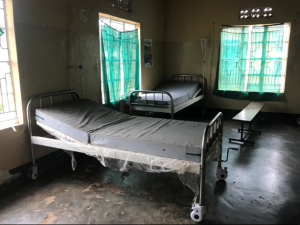
Beds from an emergency ward at a local government hospital.
I hope you remember how the stories of the women who gave birth at the government hospitals made you feel sick to your stomach. No women should have to undergo the disrespect and pain that many do during labor. To know that many women around the world do not have access to a safe and respectable birth is unfathomable. To see it in reality, though, is truly fuel to the fire within me. I am not sure what you are up to these days, but I hope that the work you are involved in continues to seek to improve the dignity of women, especially at the time of pregnancy and delivery.
Time has come and gone since your travels to Uganda, but I hope you continue to be a changed woman because of what you experienced that one summer your junior year of college.
Who I am reflects the people I love and the lessons they have taught me throughout my life.
Dad.
“‘Family’ isn’t defined only by last names or by blood; its defined by commitment and by love. It means showing up when they need it most. It means having each other’s backs. It means choosing to love each other even on those days when you struggle to like each other. It means never giving up on each other!”- Dave Willis
If you ever get the pleasure of meeting my dad, you will learn right off the bat that he is a family man. Family dinners, family game nights, family vacations…you name it, as long as my family is together, my dad is a happy man. Ever since I was a little girl, my dad has taught my older sister, older brother, and I to be present with each other and love and support each other without limits. Fast forward to today, and my sister, brother, and I are all living very busy lives in different parts of the country. We do not get to talk or spend as much time with each other as we used to, but when I do get to see them, I am reminded of the importance of having a strong support network that I can trust. Because of my dad and the deep familial connections he rooted within my family, I am inspired to build genuine friendships and support others in my work through the good, the bad, and the ugly.
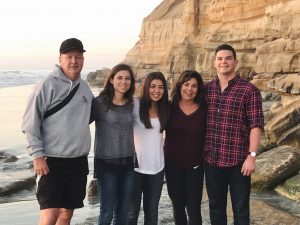
My family and me all together during the holidays
Mom.
“Somewhere along the way, we must learn that there is nothing greater than to do something for others.” –Martin Luther King Jr.
My mom is a pharmacist. That being said, she naturally has an entire drawer full of different pills and ointments in our house. Growing up, I never had to worry about what to put on a cut because I knew my mom would always save the day with her expertise. My mom works at a hospital and I was lucky enough to be able to attend work with her several times while growing up. I remember each time begging her if we could visit the maternity ward and look at all the newborn babies. Ever since I was a little girl, I was enamored with babies and caring for them. I would play with my dolls for hours on end after school, and if there was ever a baby in the room, I was always the first one to offer to hold him or her. It does not surprise me that in my future I want to work in the field of maternal and child healthcare. The care that my mother provided to me as a child certainly left a lasting mark on me. Because of my mom, I am inspired to respect and care for the lives of others, particularly mothers and their infants, with the same humility and compassion as my mother cared for me.
Channeling my inner perseverance while running for Santa Clara’s cross country team
Sister.
“Let perseverance be your engine and hope your fuel.” -H. Jackson Brown, Jr.
Growing up, my sister and I would always joke that we were the same person. Even though we are four years apart in age, we liked the same food, wore the same outfits (although I think that was my mom’s idea to dress us like twins), and had the same interests. It’s funny to look back and laugh at how similar we were growing up. Honestly, I think the reason why we were so alike was because I admired my big sister more than anything. I assure you that today we are two unique individuals with very different lives. However, that is not to say that some things have not changed. When my sister went to college and decided to pursue a career in medicine, it was not long before my interest in medicine began to arise. Watching my sister succeed in college, get into one of the top medical schools in the country, and live out her dream as a rising doctor has taught me that hard work does truly pay off. It takes perseverance and hope to jump over the hurdles that inevitably life puts in our way, but it is always worth it to keep going.
Brother.
“The fear of death follows from the fear of life. A man who lives fully is prepared to die at any time.”- Mark Twain
When I am with my brother, I always have a good time. He truly is the life of the party. I feel very lucky to have an older brother who looks after me and encourages me to become a woman of integrity. What inspires me the most about my brother is how much he loves life. He is the type of person who works hard and gets things done, but saves time each day to have fun and live in the present moment. He has taught me not to take life so seriously, but to take advantage of each day and see it as a gift. Because of my brother, I am reminded each day to stop and appreciate the blessings I have been given, to laugh a little harder than the previous day, and to celebrate small victories such as making a stranger smile.
My brother making my sister and me laugh
The Greatest Call
My desire to pursue social entrepreneurship and be involved in the Global Social Benefit Fellowship stems from my faith and my experience living in Africa last summer.
Faith.
Checking off an item on my bucket list–visit the Vatican
I was born and raised Roman Catholic. That meant that I went to church on Sundays and additional faith formation class occasionally. I never really understood the beauty and power of having a relationship with God until I got into high school. It was then that my desire to delve deeper into my faith first developed. As I began to learn more and more about what it means to be Catholic, I continually came across the theme of service. I began to read the book No Greater Love by Mother Teresa and was moved by her unwavering love and mercy towards the weak, poor, and vulnerable. She said, “The one who prays cannot but have faith, and when you have faith you want to put it into action. Faith in action is service. The fruit of love is service. Love leads us to say, ‘I want to serve.’ And the fruit of service is peace. All of us should work for peace.” After reading and learning about Mother Teresa’s life, it became clear to me that service is not just an opportunity to give back, but it is also a way to live out your faith and see God face-to-face in the lives of those whom you serve. As a student at Santa Clara University, which promotes the Jesuit values of service and social justice, it has become evident to me that as a person of faith, I am called to live a life seeking to improve the lives of those who are subject to the injustices of the world.
Home Sweet Africa.
“People who really want to make a difference in the world usually do it, in one way or another. And I’ve noticed something about people who make a difference in the world: They hold the unshakable conviction that individuals are extremely important, that every life matters. They get excited over one smile. They are willing to feed one stomach, educate one mind, and treat one wound. They aren’t determined to revolutionize the world all at once; they’re satisfied with small changes. Over time, though, the small changes add up”.- Katie Davis
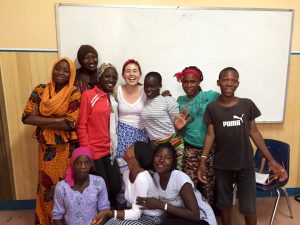
Me with some of the students from Starfish International
These are the words of Katie Davis, missionary and founder of Amazima Ministries International, that rocked my world the summer before my sophomore year of college. As soon as I read these words, I began to yearn for an opportunity to make a difference in the world—even if it be one life. Little did I know that nine months later my desire to answer this call would come true in The Gambia, West Africa through Santa Clara University’s Global Fellows Program. In high school, I loved volunteering at the local food bank or children’s hospital. It gave me so much joy to know that my time was positively impacting other people’s lives. Yet, at the same time, it felt weird to meet someone for a few hours, help them in a life-giving way, and then never see them again. When I came to college, I wanted to do something more than just a day of giving back. I wanted to connect with and truly understand the lives of those whom I was serving. I was immediately drawn to the Global Fellows program at Santa Clara because it is an immersive experience that gives students the opportunity to serve and live in a foreign country for an extended period of time. This past summer I spent five weeks teaching at Starfish International, a non-profit whose mission is to provide Gambian girls with an advanced education. Early marriage and gender inequality in the education system keeps many girls from pursuing their own dreams. Starfish International empowers young girls to see their true value and worth and provides them with the skills and knowledge they need to become active leaders in their communities. As soon as I arrived at Starfish International, I felt an immense amount of love and acceptance that was contagious—every day I was welcomed with hugs, laughter, and intentional conversations. It felt like home knowing that the girls accepted me for who I was in that present moment, not by my appearance, credentials, or skills. Throughout my trip, I saw the beauty of living in a communal society where everyone had each other’s backs, I witnessed the power of education in a girl’s life, I experienced the value of cross-cultural connections, and I fell in love with a country that depended on their faith and hard work to get them to the next day. My favorite experience in The Gambia was getting to spend a day in the life of one of the Starfish students, Mariama. At her house, I got to walk alongside her and engage in all of the chores and activities she does in a typical day. From washing laundry, shopping at the local supermarket, and cooking a traditional Gambian meal, to chatting and laughing with Mariama about the differences and similarities of our lives, my time with her was one of the most transformative experiences I have had in my life. I left The Gambia with a newfound understanding of hospitality, service, social justice and acceptance.
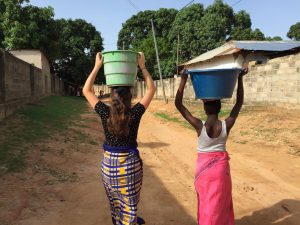
Mariama and me fetching water to bring back to her compound during my “day in the life” experience
After I got back from Africa, I knew that my desire to do something bigger than myself had not ended; it was just getting started. While at Starfish International, it became clear to me that lack of talent or passion was not holding any of the girls back, as I met some of the most outgoing, intelligent, respectful, and determined young girls. However, basic necessities like breakfast to eat, a notebook to write in, time to study, and the opportunity to go to college were stopping girls from living to their fullest potential. It bothered me that I could spend so long getting to know and love the girls on a personal level and see some of them struggle against the forces that were keeping them behind, but I had leave them to go back to my normal life. It seemed so unfair. After reflecting on my trip, I realized that given the platform I have been blessed with, support from a loving family and a college education, it is my obligation to work at fixing the injustices of this world. My exposure to the social injustices that Gambian girls face has become the fuel which drives my desire to not only seek to improve the lives of a population in need, but to disrupt and rebuild the status quo that is leaving them vulnerable to whatever injustice they face. I believe GSBF is the first step to answering this great call.