“This is revolutionary.”
I’ve heard this phrase bandied around more than a few times this summer. A Ghanaian farmer used it to describe a text-based feature phone service. A government worker for Ghana’s ministry of agriculture used it to describe an online survey tool. A rural Rwandan tile cooperative used it to describe a steel frame hacked together by a pair of college students in a garage during their summer break. Tech giant Apple used it to describe their new iPhone X, offering a 6-core 10nm processor more powerful than the latest MacBook Pro along with a slew of other improved features.
Spending a summer without the high-tech accoutrements I’m used to brought about the expected inconveniences, yet the biggest shock has been coming back to see all my digital screens again once experience after experience challenged my view of technological progress. Coming back to Silicon Valley, the “cradle of innovation,” I find that the Africans seem to have a better grasp of what constitutes revolutionary technology.
Watching Progress in Ghana
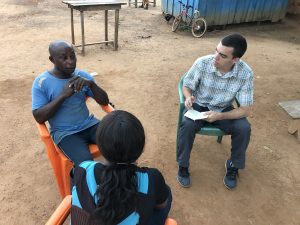
Farmers like Yaw (pictured) were eager to sit down and tell us why they felt Farmerline represented real progress
It was a summer of new experiences for me–2 months in Ghana with GSBF then 2 weeks in Rwanda for Engineers Without Borders–and each step along the way taught me something new about our relationship with technology. Working with Farmerline was the perfect introduction to start breaking down those preconceived notions. Day after day we journeyed out to villages and gave the same pitch: Purchase agricultural inputs on loans that can be tracked through mobile phones. Receive daily automated calls about weather, market prices, and agronomic tips in your local language directly to your phone. The ideas were simple, but the responses we saw were profound. The pitch rarely lasted more than 20 minutes, but we regularly waited around an extra hour to register farmers into the system. Their body language said it all: they smiled, laughed, danced, and posed for pictures while they waited for the registration process. They came up to us “obronis” and expressed their gratitude in broken English, explaining how Farmerline would help them to save money, grow more food for their families, and send their kids to school. One village explained that the government outreach had only sent them a single bottle of insecticide for the entire village, and thus the ability to receive needed inputs on credit was a huge step forward for them. To possess the capability to control their own development through a basic technology they already possessed was revolutionary. It was out there, among houses of clay and corrugated metal, that I realized this simple application to send out voice messages and track loans could be more aptly described as “technological progress” than anything I’d seen in Silicon Valley. It wasn’t merely new technology; it was drastically improving the lives of those it touched, and it accomplished this by leveraging tools that were already in place. The most impactful technology–the tech that results in drastic improvement for a majority of people–is necessarily democratic.
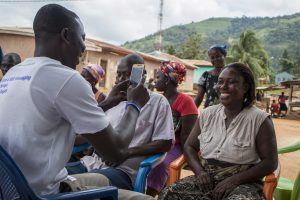
The most successful technologies are those that impact everyone
That isn’t to say that new, expensive technology can’t be impactful, but it needs to be carefully implemented in a way that promotes general progress rather than remaining in the hands of only a few. One of the coolest things I saw this summer was the reaction of some schoolchildren in a Ghanaian village when we brought out a drone: they had the same enjoyment you’d expect from a group of schoolchildren in the US. They ran after it, ran away from it, pointed, shouted, and laughed. It says something about the cross-cultural language of technology, how we all get the same thrill from watching a little quadcopter do aerial acrobatics. As a product, though, it would seem not everyone could benefit from the advancements in drone technology. Most of those kids would likely never acquire enough money to purchase something with that pricetag. Yet Farmerline is developing a program to use drones to determine crop health and alert farmers of the need for fertilizers and pesticides. Applied in the correct way, even new, expensive, decidedly non-frugal technologies can be adapted to provide democratic, wide-reaching benefits.
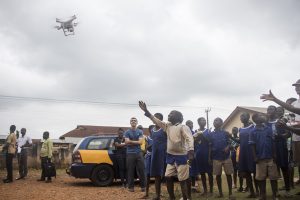
Who doesn’t love playing with drones?
Creating Progress in Rwanda
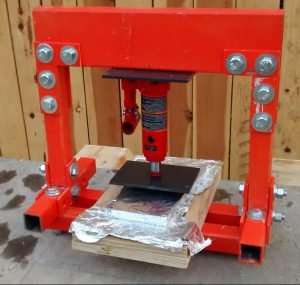
The “revolutionary” tile press
Even after leaving Ghana and the inspiring setting of a developing world tech company, I continued to see new challenges to our current view of “technological advancement.” I travelled to Rwanda with the SCU chapter of Engineers Without Borders, where we have been working with a tile-making cooperative over the past few years. The community, an exceptionally impoverished village in the Nyange sector, has been working to create clay roofing tiles to sell to supplement their income, and our club has been supporting them with machinery to improve the quality and efficiency of their process. This summer, that meant implementing a new tile press, which aimed to increase the density of their tiles and thus the strength, quality, and price point. Our solution? A bottle jack attached to a steel frame.
We scrapped it together during the 2 weeks before our trip and were expecting a modest, satisfied reaction from the community. Yet when we assembled it and showed them how to use it, the response was more excited and energetic than we could have predicted: the community started a “competition” of sorts, taking turns using it to make tiles and then writing their names in the tiles so they could see who made the best tile. It was laughter and excitement all around, and nobody wanted to stop at the end of the day. The most rewarding part? The villagers told us it was so easy to use that even the women were strong enough to use it, and they were now able to participate in pressing the tiles for the first time. Now THAT is revolutionary. Once again, I saw that technological improvement didn’t require expensive laboratories, Ph.D.’s, and years of research. It just needed a few college students, some Home Depot runs, and a garage.
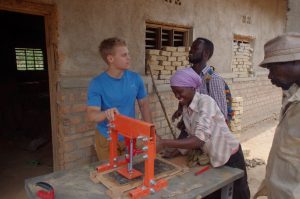
It doesn’t take much to see real progress
Defining Progress Moving Forward
So yes, returning to Silicon Valley, restarting my electrical engineering studies, and plugging back into the US news cycle has been a bit of a shock, and it’s left me to do a lot of reflection on my relation to technology and my future place in the tech industry. Technology is a tool used by humanity to shape and improve our own experience, so can we really call something technological progress if humans don’t progress alongside it? What’s more revolutionary: providing thousands of farmers across rural Africa with access to information and capital, or creating a phone that will load apps in microseconds rather than milliseconds for people who can afford the thousand-dollar price tag? What real progress could happen if, instead of marginally improving technology for the minority of us, we focused on applying our latest and greatest ideas (drones, data analytics, mobile phones, the internet!) in ways that could fundamentally improve the world for everyone?

Technology is something everyone can get excited about