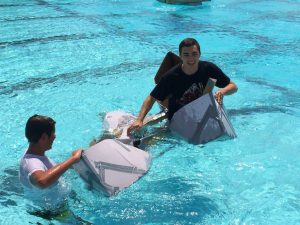
Learning how hard it is to make a boat out of cardboard and duct tape.
It’s a question I got asked a lot as a kid, and for the most part I gave the typical answer: a firefighting paleontologist-astronaut. It was an exciting time with so much to explore. My mom would take me to the library, where I would check out five books at a time about dinosaurs and their fossils. At Christmas, I got books chock full of diagrams of constellations and descriptions of far off stars. I learned about the planets in school and did science projects with model rockets. Information and opportunity were abundant, and I was ready to explore, always searching for an answer to that question, what did I want to be when I grew up?
That quest has really defined my whole life up to now. I applied myself in class and excelled at school, I fell in love with science and engineering, I built various contraptions in my garage, and I made friends with people who loved exploring as much as I did. We went on road trips to Utah and hiked all of the nearby trails together. We competed with each other in science fairs and trivia competitions. When the time came around, we all jumped at the opportunity to attend universities across the United States (and one in
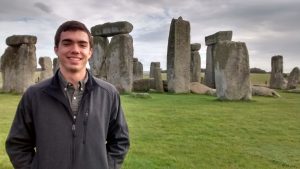
Visiting Stonehenge while studying abroad in England.
France). Santa Clara University has further allowed me to grow and explore, providing me with fantastic resources for studying not only engineering and physics, but also all of the other aspects that make up a well-rounded Jesuit education. I even had the opportunity to study abroad in London for a quarter, during which I took the opportunity to explore the rest of Europe, visiting Scotland, Spain, and the Czech Republic as well.
Experiencing Poverty
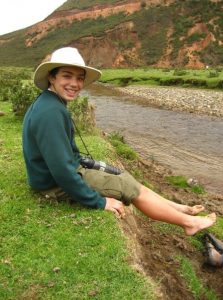
Drying my feet after crossing a river in Valle de Belen, Peru.
Back in the summer of 2008 my family went to Peru to visit my aunt and uncle, who were working there with the Peace Corps. We skipped the typical tourist attractions and spent a good deal of time in the rural village where they were working, where I saw houses scrapped together from corrugated metal, clay bricks, or wood paneling. Everybody had a dirt floor, water was delivered door to door in an oil drum, and electricity was available for two hours every evening. These living conditions didn’t shock me, though. They were what I had read about, what I had prepared for, and what I had really expected.
What really opened my eyes to the true nature of poverty were my interactions with the local community. My aunt and uncle acted as translators as we walked around to meet the neighbors, visited the local mango farm, and toured the nearby primary school. I got to know some of the other children my age, and had some conversations mediated by my aunt, including one with a young boy that really perplexed me. Drawing on the conversations I was used to having when meeting new people, I went for the classic “What do you want to be when you grow up?” To my surprise, the answer I got was “I’m going to work on the mango farm.” That one left me puzzled. Why not a doctor? Or an astronaut? Why would you aspire to manual labor? “But, if you could do anything…” I pressed. I could tell that my response also left him a bit puzzled. He thought for a minute before saying that, yes, he did want to be a doctor. Or a superhero. Or a soccer player. But he was probably just going to work on the farm.
Reflecting on that experience gave me a true sense of what poverty is. It’s not just lacking physical things; it’s not akin to camping. There’s much more to it than that. Poverty is when people are denied the opportunity to even dream about growing up. It’s when a future as a doctor seems as plausible as a future as a superhero, and the wonder and excitement of what could be is replaced by the reality of what will be. The Peruvian children I talked to made me realize that poverty is not simply a physical condition, but rather results in a struggle to support even a hope for a better future. With no library, limited schooling, and rarely even the ability to read, there was no opportunity for them to learn and explore the universe of information that so inspired me; there was no room to grow up.
Responding to Poverty
I still ask myself what I want to be when I grow up (the answer is still an astronaut, despite lacking 20/20 vision). I will probably continue to ask myself for the rest of my life, because I’m always growing up. I’m always growing, always expanding my horizon, always picking
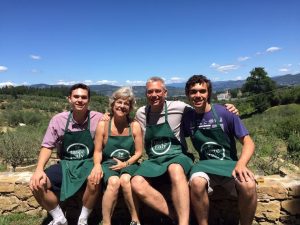
Exploring new skills with a cooking lesson with my family in Florence, Italy.
a direction that allows me to explore who I am. For me, that has translated into a love of learning, exploring and adventuring through the world, whether in a classroom, in a book, or out on a backpacking trail. Now, however, I take with myself an awareness that not everyone is afforded the same opportunity to grow in every direction. This understanding has inspired a lot of my decisions to this day. When I came to Santa Clara, I joined Engineers Without Borders, so that I could have an opportunity to use my own curiosity, engineering knowledge, and problem solving skills to create sustainable solutions for developing communities to improve their quality of life, while providing them with an opportunity to lift themselves out of poverty. During my time with the club, we have been able to revamp the process of a Rwandan cooperative making roof tiles, designing a tile press and bike-powered clay mixer that they could build and operate, allowing them to produce more tiles more efficiently. We are also looking at implementing solar power and biofuels for the community to eliminate the need for cutting down trees and burning wood.
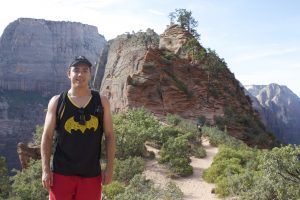
On Angel’s Landing in Zion National Park, Utah, during a weekend road trip.
The understanding of poverty I gained in Peru also inspired my decision to apply for the Fellowship. I feel called to apply my skills and knowledge to the problems that keep others in poverty. Alleviating poverty would mean not only alleviating the great suffering it causes, but also removing the obstacles it places for growth, knowledge, and exploration for the individuals it affects. When the poor have access to the information they need to explore, dream, and grow up, then I believe everyone will benefit from the explosion of ideas and opportunities they can create for the future. It will be an opportunity for the whole world to grow up and explore what it can be.